

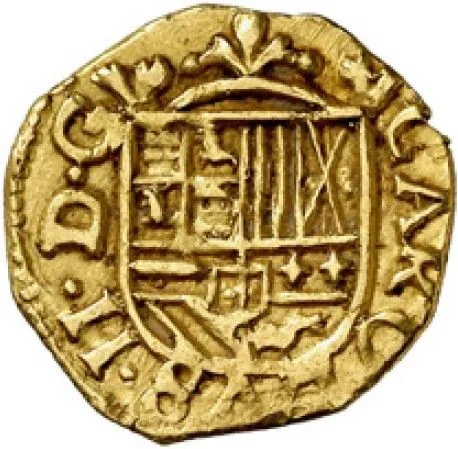
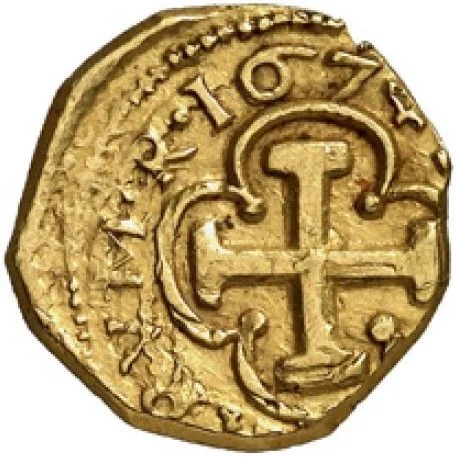
1 Escudo – Spain
Spain
Context

Material
Diameter: 16 mm
Weight: 3.38 g
Gold weight: 3.10 g
Shape: Irregular round
Composition: 91.7% Gold
Magnetic: No
Technique: Hammered
References
KM: #Click to copy to clipboard45
Numista: #427843
Value
Bullion value: $516.33
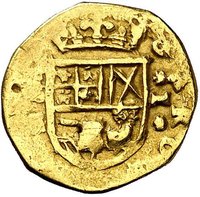
Obverse
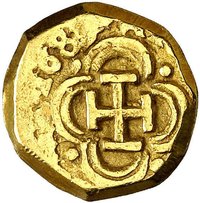
Reverse
Edge
Categories
| Symbols> Coat of Arms |
| Symbol> Cross |
Mints
| Name | Mark |
|---|---|
| Barcelona Mint / La Seca | B |
Mintings
| Year | Mint Mark | Mintage | Quality | Collection |
|---|---|---|---|---|
| 1671 | BA | — | ||
| 1672 | — | — | ||
| 1674 | — | — |
Historical background
In 1671, Spain’s currency system was in a state of profound crisis, a legacy of the "Price Revolution" and decades of fiscal mismanagement. The primary currency, the silver real, had been repeatedly debased by the Crown to finance its vast military commitments across Europe and the Americas. This was compounded by the practice of clipping and counterfeiting, which further eroded public trust. Meanwhile, the influx of precious metals from the New World, while symbolically important, had paradoxically contributed to severe inflation and a drain of high-quality bullion to pay foreign creditors, leaving behind a circulating medium of ever-worsening alloy.
The monetary landscape was chaotic, with a confusing array of coins in circulation, including older full-weight pieces, newer debased issues, and a multitude of foreign currencies. The government's response, under the regency of Mariana of Austria during the minority of Charles II, was largely ineffective. Attempts to fix arbitrary values for different coins failed, as Gresham’s Law took hold: "bad money drove out good." People hoarded the older, purer coins for their intrinsic metal value or for foreign trade, while only the debased currency circulated domestically, stifling economic activity and creating a disconnect between official and market exchange rates.
This instability had severe consequences. It disrupted trade, discouraged investment, and placed a heavy burden on the peasantry and fixed-wage earners. The crown's relentless need for revenue led to further short-term measures like currency manipulations rather than addressing fundamental fiscal reforms. Thus, in 1671, Spain’s currency was not just an economic problem but a symptom of the broader decline of Habsburg power, reflecting an empire struggling to maintain its global stature amidst internal decay and a shrinking, unreliable monetary base.
The monetary landscape was chaotic, with a confusing array of coins in circulation, including older full-weight pieces, newer debased issues, and a multitude of foreign currencies. The government's response, under the regency of Mariana of Austria during the minority of Charles II, was largely ineffective. Attempts to fix arbitrary values for different coins failed, as Gresham’s Law took hold: "bad money drove out good." People hoarded the older, purer coins for their intrinsic metal value or for foreign trade, while only the debased currency circulated domestically, stifling economic activity and creating a disconnect between official and market exchange rates.
This instability had severe consequences. It disrupted trade, discouraged investment, and placed a heavy burden on the peasantry and fixed-wage earners. The crown's relentless need for revenue led to further short-term measures like currency manipulations rather than addressing fundamental fiscal reforms. Thus, in 1671, Spain’s currency was not just an economic problem but a symptom of the broader decline of Habsburg power, reflecting an empire struggling to maintain its global stature amidst internal decay and a shrinking, unreliable monetary base.
✨ Legendary