

1 Rupee – Jaintia Kingdom
India
Context
Year: 1785
Nepal - Saka era Year: 1707
Country: India 
Issuer: Jaintia Kingdom
Ruler: Bijay Narayan Syiem Sutnga
Currency:
Demonetized: Yes
Material
References
KM: #Click to copy to clipboard199
Numista: #420792
Value
Bullion value: $25.21
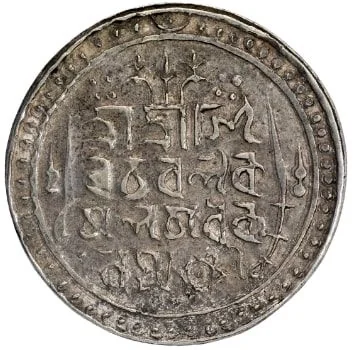
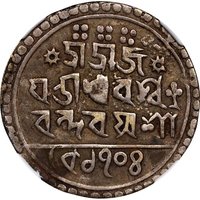
Obverse
Description:
"King" in stylized lettering.
Script: Devanagari
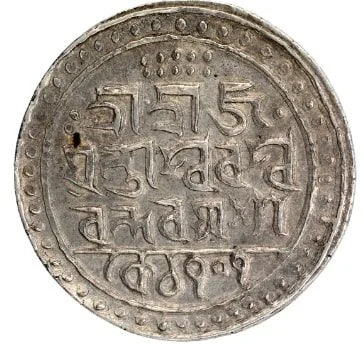
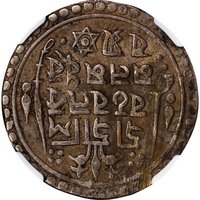
Reverse
Description:
Date and state lettering.
Script: Devanagari
Edge
Plain
Mintings
| Year | Mint Mark | Mintage | Quality | Collection |
|---|---|---|---|---|
| 1785 | — | — |
Historical background
In 1785, the Jaintia Kingdom, nestled in the hills between the Brahmaputra Valley and the Sylhet plains, operated within a complex economic system where currency was not the sole or primary medium of exchange. The kingdom's economy was fundamentally rooted in a barter system, with rice serving as the most common measure of value and medium for everyday transactions, taxes, and trade. This reflected a subsistence agricultural society where coinage was less critical than the exchange of tangible goods like livestock, salt, and handwoven textiles.
However, the Jaintia Kingdom was not isolated from monetary economies. Its strategic location placed it at the crossroads of lucrative trade routes connecting the Mughal Suba of Bengal (and later British territories) with the Ahom Kingdom and the Khasi Hills. Consequently, multiple external currencies circulated within its markets, primarily Mughal and later East India Company silver rupees. These coins were used for larger transactions, long-distance trade, and state dealings with external powers, creating a dual system where barter dominated locally while specie facilitated regional commerce.
This monetary duality was a direct reflection of Jaintia's political stance in 1785. Under the rule of King Chattra Singh, the kingdom was asserting its independence, having recently shaken off the nominal suzerainty of the Ahoms. The reliance on external currencies, especially those from the south, underscored Jaintia's growing economic entanglement with British Bengal, even as it sought political autonomy. The currency situation, therefore, was not one of a standardized mint but of pragmatic adaptation—a hybrid system balancing internal tradition with the pressures and opportunities of regional trade networks.
However, the Jaintia Kingdom was not isolated from monetary economies. Its strategic location placed it at the crossroads of lucrative trade routes connecting the Mughal Suba of Bengal (and later British territories) with the Ahom Kingdom and the Khasi Hills. Consequently, multiple external currencies circulated within its markets, primarily Mughal and later East India Company silver rupees. These coins were used for larger transactions, long-distance trade, and state dealings with external powers, creating a dual system where barter dominated locally while specie facilitated regional commerce.
This monetary duality was a direct reflection of Jaintia's political stance in 1785. Under the rule of King Chattra Singh, the kingdom was asserting its independence, having recently shaken off the nominal suzerainty of the Ahoms. The reliance on external currencies, especially those from the south, underscored Jaintia's growing economic entanglement with British Bengal, even as it sought political autonomy. The currency situation, therefore, was not one of a standardized mint but of pragmatic adaptation—a hybrid system balancing internal tradition with the pressures and opportunities of regional trade networks.

✨ Legendary