

¼ Rupee – Jaintia Kingdom
India
Context
Year: 1790
Nepal - Saka era Year: 1712
Country: India 
Issuer: Jaintia Kingdom
Ruler: Ram Singh Syiem Sutnga II
Currency:
Demonetized: Yes
Material

References
KM: #Click to copy to clipboard204
Numista: #510395
Value
Bullion value: $8.16
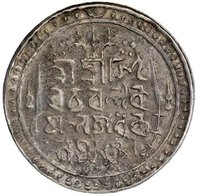
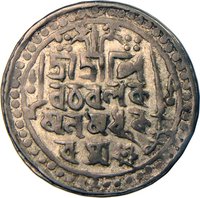
Obverse
Description:
King's titles and blessing in dotted circle.
Script: Devanagari
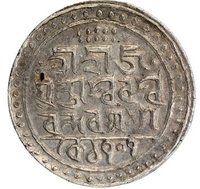
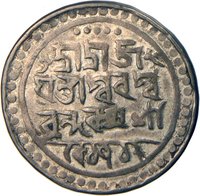
Reverse
Description:
Date and state within dotted circle.
Script: Devanagari
Edge
Plain
Mintings
| Year | Mint Mark | Mintage | Quality | Collection |
|---|---|---|---|---|
| 1790 | — | — |
Historical background
By 1790, the Jaintia Kingdom, nestled in the hills between the Brahmaputra Valley and the Sylhet plains, operated within a complex monetary system shaped by both tradition and regional trade. The core of its internal economy remained rooted in barter and the use of specific commodities, most notably salt, which was mined locally at places like Sutnga and functioned as a key measure of value and medium of exchange for everyday transactions. Alongside salt, other valued items like livestock, rice, and handwoven textiles facilitated local trade and the payment of tributes within the kingdom's hierarchical society.
However, the kingdom's strategic location placed it at the crossroads of major trade routes connecting the Mughal diwani of Bengal (under the East India Company's administration after 1765) and the Ahom kingdom of Assam. This integration into broader networks meant that external coinage was dominant for higher-value and inter-regional commerce. The most prevalent currencies in circulation were the silver rupees of the Mughal Empire and its successor states, alongside coins from neighboring Assam. The East India Company's rupees were also beginning to enter the economic stream, reflecting the growing political and commercial influence of the British in adjacent Bengal.
Thus, the Jaintia monetary landscape was one of duality. While the royal treasury and larger merchants dealt in precious metal coins for external trade and state finance, the hill-based agrarian and clan-based society continued to rely on a pre-monetary system centered on salt. This hybrid model was stable but pointed to the underlying pressures the kingdom faced, caught between its traditional highland economy and the advancing, coin-driven capitalist systems of the plains, a tension that would challenge its autonomy in the coming decades.
However, the kingdom's strategic location placed it at the crossroads of major trade routes connecting the Mughal diwani of Bengal (under the East India Company's administration after 1765) and the Ahom kingdom of Assam. This integration into broader networks meant that external coinage was dominant for higher-value and inter-regional commerce. The most prevalent currencies in circulation were the silver rupees of the Mughal Empire and its successor states, alongside coins from neighboring Assam. The East India Company's rupees were also beginning to enter the economic stream, reflecting the growing political and commercial influence of the British in adjacent Bengal.
Thus, the Jaintia monetary landscape was one of duality. While the royal treasury and larger merchants dealt in precious metal coins for external trade and state finance, the hill-based agrarian and clan-based society continued to rely on a pre-monetary system centered on salt. This hybrid model was stable but pointed to the underlying pressures the kingdom faced, caught between its traditional highland economy and the advancing, coin-driven capitalist systems of the plains, a tension that would challenge its autonomy in the coming decades.
✨ Legendary