


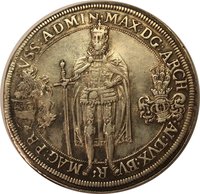
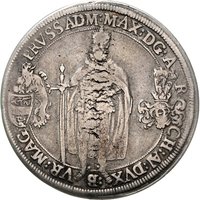
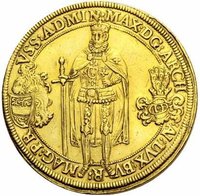
Obverse
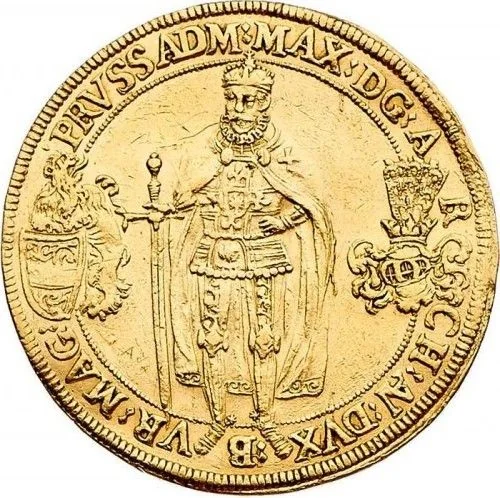
Description:
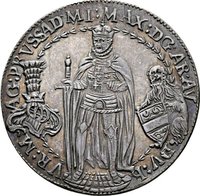
Grandmaster standing, helmet to his right.
Inscription:
MAX DG ARCH AV DVX BVR MAG PRVSS ADM
Script: Latin
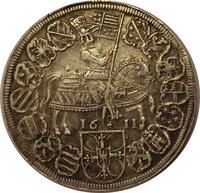
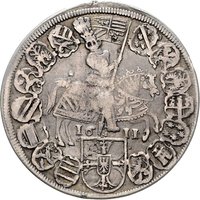
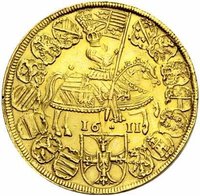
Reverse
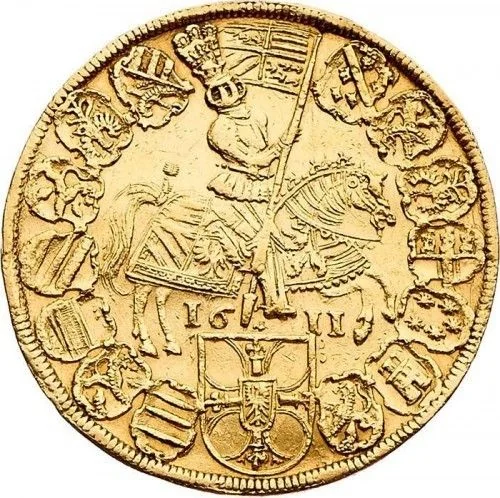
Description:
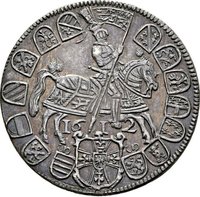
Emperor on horseback within a ring of shields, date beneath.
Inscription:
16 11
Script: Latin
Edge
Mintings
| Year | Mint Mark | Mintage | Quality | Collection |
|---|---|---|---|---|
| 1611 | — | — |
Historical background
In 1611, the Teutonic Order, ruling the Duchy of Prussia as a Polish fief, faced significant monetary instability rooted in its political subordination and regional economic pressures. The state’s currency, the Prussian schilling, was part of a fragmented system where the Order lacked full sovereignty over minting. Crucially, the Polish-Lithuanian Commonwealth, under the monetary reforms of King Sigismund III Vasa, was introducing a new standardized currency, the tymf and solid, which directly impacted Prussia. The Order was compelled to align its monetary policy with the Commonwealth, leading to the recoinage of existing currency and the influx of new Polish coins, causing confusion and devaluation in local markets.
This period was marked by severe currency debasement, a common problem across early modern Europe. To finance military endeavors and state expenses, especially related to the Polish-Swedish conflicts, authorities often reduced the precious metal content in coins while maintaining their face value. In Prussia, this practice, combined with the circulation of underweight foreign coins and counterfeits, led to inflation and a loss of public trust. Merchants and the populace hoarded older, purer coins (Gresham’s Law in action), exacerbating the scarcity of reliable money and disrupting daily trade and taxation.
The monetary turmoil of 1611 reflected the broader existential crisis of the Teutonic Order itself. Once a powerful independent crusading state, it was now a minor duchy under Polish suzerainty, its economic autonomy severely constrained. The currency instability undermined the Duchy’s economic cohesion, increased dependence on Polish monetary policy, and highlighted the Order’s fading power. This situation contributed to the social and financial grievances that would persist until the state's final secularization and integration into Brandenburg-Prussia in the following decades.
This period was marked by severe currency debasement, a common problem across early modern Europe. To finance military endeavors and state expenses, especially related to the Polish-Swedish conflicts, authorities often reduced the precious metal content in coins while maintaining their face value. In Prussia, this practice, combined with the circulation of underweight foreign coins and counterfeits, led to inflation and a loss of public trust. Merchants and the populace hoarded older, purer coins (Gresham’s Law in action), exacerbating the scarcity of reliable money and disrupting daily trade and taxation.
The monetary turmoil of 1611 reflected the broader existential crisis of the Teutonic Order itself. Once a powerful independent crusading state, it was now a minor duchy under Polish suzerainty, its economic autonomy severely constrained. The currency instability undermined the Duchy’s economic cohesion, increased dependence on Polish monetary policy, and highlighted the Order’s fading power. This situation contributed to the social and financial grievances that would persist until the state's final secularization and integration into Brandenburg-Prussia in the following decades.
✨ Legendary