

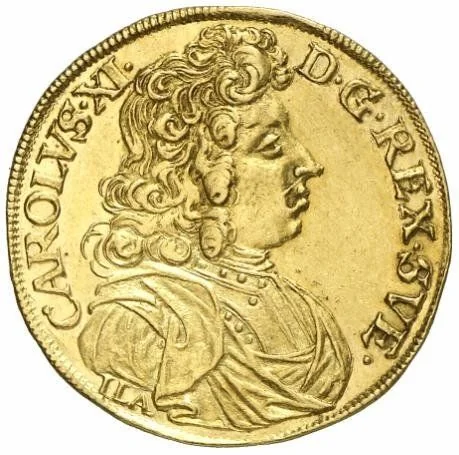
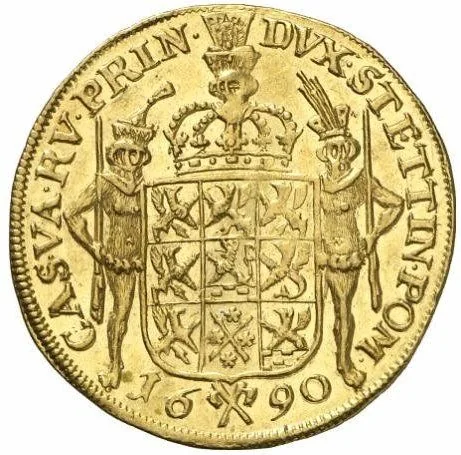
2 Ducats – Swedish dominion of Pomerania
Sweden
Context
Years: 1690–1695
Country: Sweden 
Issuer: Swedish dominion of Pomerania
Ruler: Charles XI
Currency:
(1630—1815)
Demonetized: Yes
References
KM: #Click to copy to clipboard339
Numista: #420123
Value
Bullion value: $1150.80
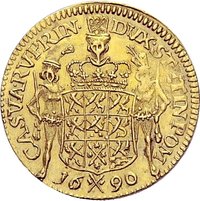
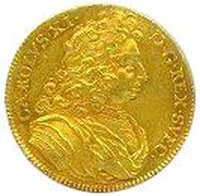
Obverse
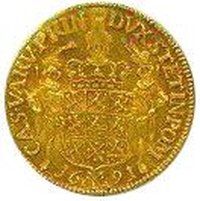
Reverse
Edge
Mints
| Name | Mark |
|---|---|
| Szczecin | — |
Mintings
| Year | Mint Mark | Mintage | Quality | Collection |
|---|---|---|---|---|
| 1690 | — | — | ||
| 1695 | — | — |
Historical background
During the late 17th century, Swedish Pomerania existed within a complex and fragmented monetary landscape, a legacy of the wider Holy Roman Empire. The province did not have a unified currency but operated with a multitude of circulating coins. The official currency was based on the Swedish monetary system, with the riksdaler as the large silver unit, divided into marks and öre. However, these Swedish coins competed directly with a plethora of regional German currencies, particularly the Lübeck mark and various thaler issues from neighbouring states like Brandenburg and Mecklenburg, as well as older Pomeranian coins from before Swedish rule.
This multiplicity created significant practical challenges for trade and daily life. Exchange rates between these different coinages were unstable and often manipulated, leading to confusion and facilitating fraud. The situation was exacerbated by the widespread circulation of debased and clipped coins, which drove good-quality full-weight coins out of circulation—a classic example of Gresham's Law. Swedish authorities struggled to enforce their monetary standards, as the province's deep economic ties to the German hinterland made the use of regional currencies a practical necessity.
The currency chaos was further intensified by the demands of the Nine Years' War (1688-1697), in which Sweden was a participant. War financing typically led to increased pressure on mints, often resulting in currency debasement to generate seigniorage revenue. While Sweden proper experienced a major recoinage in the 1680s, the distant Pomeranian dominion remained a monetary borderland. Consequently, by 1690, the currency situation was characterised by a confusing mix of denominations, uncertain values, and a general lack of trust in coinage, hindering both local commerce and the efficiency of Swedish fiscal administration in the territory.
This multiplicity created significant practical challenges for trade and daily life. Exchange rates between these different coinages were unstable and often manipulated, leading to confusion and facilitating fraud. The situation was exacerbated by the widespread circulation of debased and clipped coins, which drove good-quality full-weight coins out of circulation—a classic example of Gresham's Law. Swedish authorities struggled to enforce their monetary standards, as the province's deep economic ties to the German hinterland made the use of regional currencies a practical necessity.
The currency chaos was further intensified by the demands of the Nine Years' War (1688-1697), in which Sweden was a participant. War financing typically led to increased pressure on mints, often resulting in currency debasement to generate seigniorage revenue. While Sweden proper experienced a major recoinage in the 1680s, the distant Pomeranian dominion remained a monetary borderland. Consequently, by 1690, the currency situation was characterised by a confusing mix of denominations, uncertain values, and a general lack of trust in coinage, hindering both local commerce and the efficiency of Swedish fiscal administration in the territory.
✨ Legendary