

1 Ducat – Swedish dominion of Pomerania
Sweden
Context
Years: 1689–1690
Country: Sweden 
Issuer: Swedish dominion of Pomerania
Ruler: Charles XI
Currency:
(1630—1815)
Demonetized: Yes
References
KM: #Click to copy to clipboard330
Numista: #136754
Value
Bullion value: $572.11
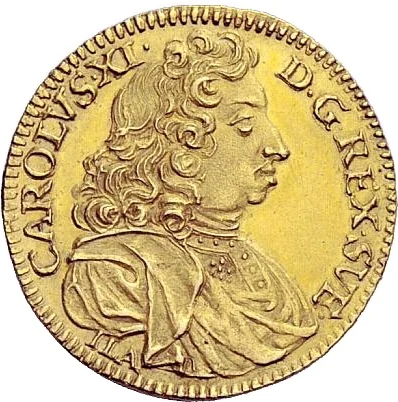
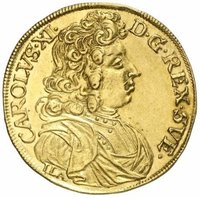
Obverse
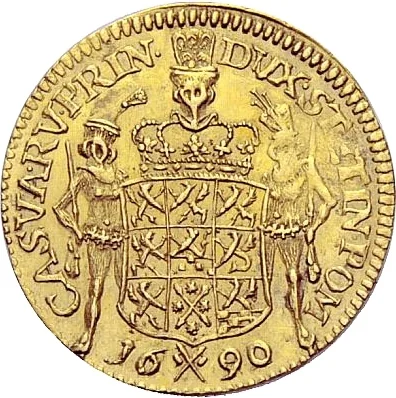
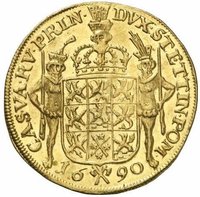
Reverse
Description:
Crowned, helmeted arms with supporters.
Inscription:
DVX • STETIN • POM - CAS VA • RV • PRIN •
Script: Latin
Edge
Mintings
| Year | Mint Mark | Mintage | Quality | Collection |
|---|---|---|---|---|
| 1689 | ILA | — | ||
| 1690 | ILA | — |
Historical background
In 1689, the currency situation in Swedish Pomerania was complex and challenging, characterized by a chaotic multiplicity of circulating coins. The duchy did not have a unified, strong currency of its own. Instead, the monetary landscape was dominated by a flood of foreign coins, particularly low-quality Klippe money (clipped coins) from the neighboring German states, and debased coins from Poland and the Dutch Republic. This proliferation of uneven and often suspect foreign currency undermined local trade and made financial transactions unreliable, as the intrinsic value of coins was constantly in question.
The root of this instability lay in Sweden's own severe financial difficulties following the Thirty Years' War and its later conflicts. The Swedish state, which controlled the Pomeranian minting rights, exploited this privilege for fiscal reasons. Rather than issuing a stable currency for the duchy, the Stockholm government periodically authorized the minting of inferior coinage—often with a lower silver content than its face value—to generate seigniorage revenue for the royal treasury. This practice, combined with the lack of effective control over borders to stem the inflow of foreign coin, created a classic "bad money drives out good" scenario, where higher-value coins were hoarded or melted down.
Consequently, the local economy in 1689 suffered from high transaction costs, price volatility, and a general lack of trust in the monetary medium. This environment hindered commerce and complicated administration, as both authorities and merchants struggled to establish fixed rates for the myriad of coins in circulation. The situation reflected the broader realities of Swedish dominion: Pomerania was valued primarily as a strategic foothold and a source of revenue for the crown, with its internal economic stability often sacrificed to the greater financial and military needs of the Swedish Empire.
The root of this instability lay in Sweden's own severe financial difficulties following the Thirty Years' War and its later conflicts. The Swedish state, which controlled the Pomeranian minting rights, exploited this privilege for fiscal reasons. Rather than issuing a stable currency for the duchy, the Stockholm government periodically authorized the minting of inferior coinage—often with a lower silver content than its face value—to generate seigniorage revenue for the royal treasury. This practice, combined with the lack of effective control over borders to stem the inflow of foreign coin, created a classic "bad money drives out good" scenario, where higher-value coins were hoarded or melted down.
Consequently, the local economy in 1689 suffered from high transaction costs, price volatility, and a general lack of trust in the monetary medium. This environment hindered commerce and complicated administration, as both authorities and merchants struggled to establish fixed rates for the myriad of coins in circulation. The situation reflected the broader realities of Swedish dominion: Pomerania was valued primarily as a strategic foothold and a source of revenue for the crown, with its internal economic stability often sacrificed to the greater financial and military needs of the Swedish Empire.
✨ Legendary