

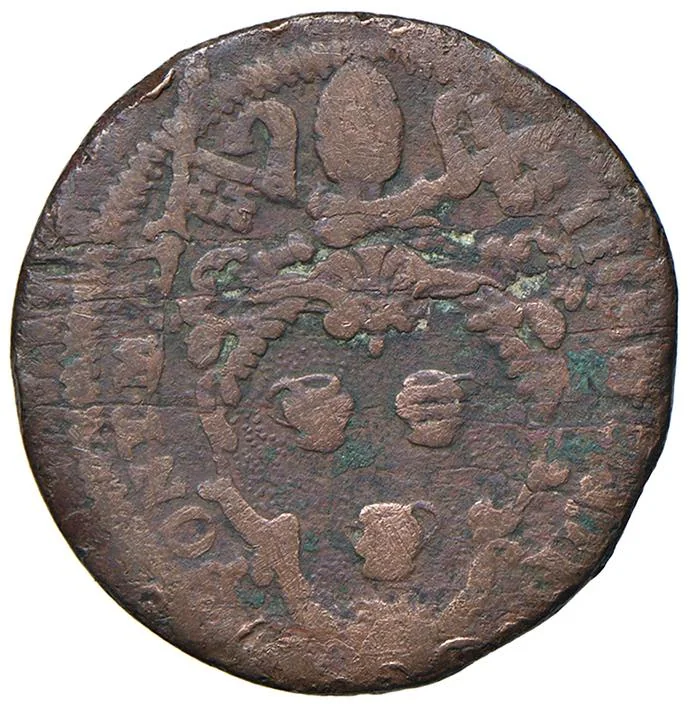
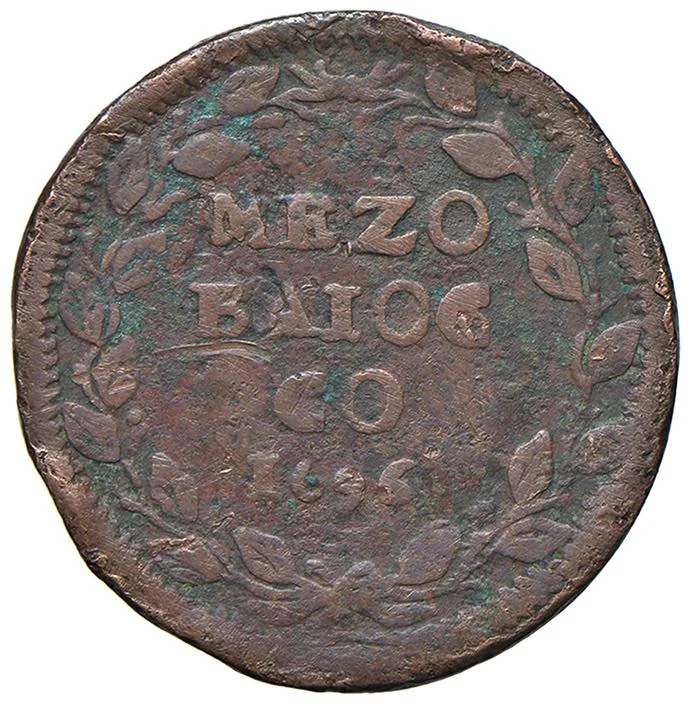
½ baiocco – Gubbio
Add to wishlist
Italy
Context
Material
Diameter: 28 mm
Weight: 7.7 g
Shape: Round
Composition: Copper
Standard: Silver quarter ounce
Magnetic: No
Alignment: Coin alignment
flip
References
KM: #
Numista: #412967
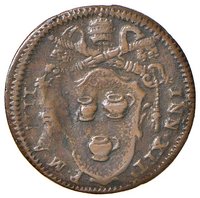
Obverse
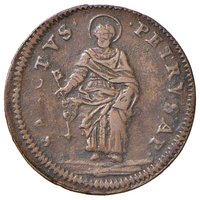
Reverse
Edge
Categories
| Symbols> Coat of Arms |
| Symbol> Wreath |
| Object> Container or tableware |
| Symbol> Crown |
Mints
| Name | Mark |
|---|---|
| Gubbio | — |
Mintings
| Year | Mint Mark | Mintage | Quality | Collection |
|---|---|---|---|---|
| 1696 | — | — |
Historical background
In 1696, the Italian city-state of Gubbio, like much of the Italian peninsula, was navigating a complex and degraded monetary environment. The region was characterized by a bewildering multiplicity of coins, including those issued by various Italian states, Spanish silver reales, and debased local piccioli. This fragmentation was a legacy of Gubbio's political status as part of the Papal States, which exerted sovereign control but struggled to impose a uniform monetary system across its territories. The local economy therefore operated on a daily basis through a system of constant evaluation and exchange of heterogeneous coins, their values fluctuating based on metal content and wear.
The period was marked by a severe shortage of high-value, full-weight coinage, a phenomenon known as the "bad money drives out good" principle (Gresham's Law). Creditors and merchants hoarded older, purer silver coins, while heavily clipped, worn, or intentionally debased coins circulated for daily transactions. This created significant challenges for trade, tax collection, and wage payments, as the nominal and intrinsic values of coins were wildly misaligned. The Papal mint in Rome, preoccupied with its own fiscal crises, provided little relief, leaving subsidiary mints and local authorities to cope with ad-hoc solutions.
Consequently, Gubbio's monetary situation in 1696 was one of practical instability masked by customary practice. Prices were often quoted in imaginary scudi or lire as units of account, while actual payment was made in a mix of physical coins settled by weight and assay. This system bred distrust, facilitated fraud, and constrained economic activity, reflecting the broader monetary malaise of a fragmented Italy operating within the declining economic shadow of the Spanish Empire and under the inconsistent administration of the Papacy.
The period was marked by a severe shortage of high-value, full-weight coinage, a phenomenon known as the "bad money drives out good" principle (Gresham's Law). Creditors and merchants hoarded older, purer silver coins, while heavily clipped, worn, or intentionally debased coins circulated for daily transactions. This created significant challenges for trade, tax collection, and wage payments, as the nominal and intrinsic values of coins were wildly misaligned. The Papal mint in Rome, preoccupied with its own fiscal crises, provided little relief, leaving subsidiary mints and local authorities to cope with ad-hoc solutions.
Consequently, Gubbio's monetary situation in 1696 was one of practical instability masked by customary practice. Prices were often quoted in imaginary scudi or lire as units of account, while actual payment was made in a mix of physical coins settled by weight and assay. This system bred distrust, facilitated fraud, and constrained economic activity, reflecting the broader monetary malaise of a fragmented Italy operating within the declining economic shadow of the Spanish Empire and under the inconsistent administration of the Papacy.
✨ Legendary