

⅔ thaler – Brunswick-Lüneburg-Calenberg-Hannover
Add to wishlist
Germany
Context
Material
References
KM: #
Numista: #407115
Value
Bullion value: $33.59
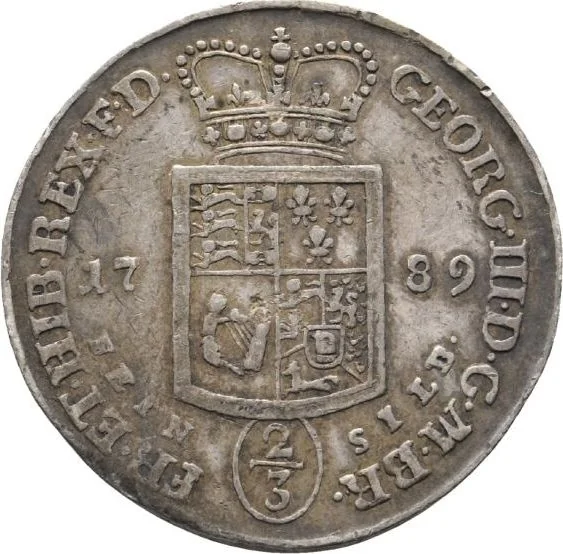
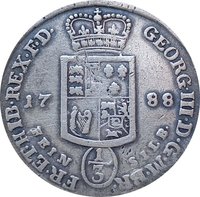
Obverse
Description:
Arms between legend and date, above value.
Inscription:
GEORG·III·D·G·M·BR· FR·ET·HIB·REX·F·D·
17 89
2/3
FEIN SILB·
17 89
2/3
FEIN SILB·
Script: Latin
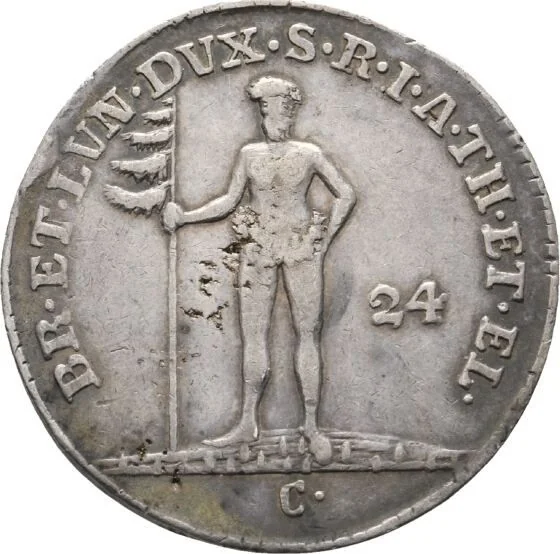
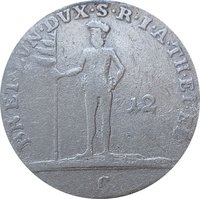
Reverse
Description:
Wildman holding tree, denomination right, mintmark above.
Inscription:
BR·ET·LVN·DVX·S·R·I·A·TH·ET·EL·
24
C·
24
C·
Script: Latin
Edge
Plain
Mints
| Name | Mark |
|---|---|
| Zellerfeld | — |
Mintings
| Year | Mint Mark | Mintage | Quality | Collection |
|---|---|---|---|---|
| 1785 | — | — | ||
| 1786 | — | — | ||
| 1787 | — | — | ||
| 1788 | — | — | ||
| 1789 | — | — |
Historical background
In 1785, the currency situation in the Duchy of Brunswick-Lüneburg, specifically the Principality of Calenberg (with its capital in Hanover), was complex and fragmented, reflecting the broader political structure of the Holy Roman Empire. The territory did not have a single, unified currency. Instead, monetary affairs were governed by the Conventionsthaler standard, established by the Leipzig Coinage Convention of 1753. This treaty aimed to bring order to the myriad of German currencies by defining a common silver standard. The Conventionsthaler was divided into 32 Gute Groschen, each of 12 Pfennige, providing a standardized but not exclusive system.
Alongside the Conventionsthaler, older local units like the Reichsthaler and Mariengroschen remained in everyday accounting and circulation, creating a dual-system prone to confusion. Furthermore, the personal union with Great Britain (since 1714) meant that Hanoverian trade and state finance were influenced by British monetary policy and the influx of foreign coins. This coexistence of domestic convention coins, legacy regional coins, and foreign specie (especially from England and the Netherlands) made daily transactions and commerce administratively cumbersome, requiring constant conversion and fostering a risk of debasement.
The situation was managed, albeit imperfectly, by ducal decrees that periodically published exchange rates (Kurantparitäten) between the various circulating mediums. For the state, revenue collection and military expenditures required careful reckoning in specie, while the populace dealt with a mix of silver and small divisional coins. Thus, in 1785, the currency landscape was one of formal standardization on paper, overshadowed by the practical reality of monetary plurality—a system straining under the weight of pre-modern fragmentation on the cusp of the Napoleonic upheavals that would soon force sweeping financial reforms.
Alongside the Conventionsthaler, older local units like the Reichsthaler and Mariengroschen remained in everyday accounting and circulation, creating a dual-system prone to confusion. Furthermore, the personal union with Great Britain (since 1714) meant that Hanoverian trade and state finance were influenced by British monetary policy and the influx of foreign coins. This coexistence of domestic convention coins, legacy regional coins, and foreign specie (especially from England and the Netherlands) made daily transactions and commerce administratively cumbersome, requiring constant conversion and fostering a risk of debasement.
The situation was managed, albeit imperfectly, by ducal decrees that periodically published exchange rates (Kurantparitäten) between the various circulating mediums. For the state, revenue collection and military expenditures required careful reckoning in specie, while the populace dealt with a mix of silver and small divisional coins. Thus, in 1785, the currency landscape was one of formal standardization on paper, overshadowed by the practical reality of monetary plurality—a system straining under the weight of pre-modern fragmentation on the cusp of the Napoleonic upheavals that would soon force sweeping financial reforms.
✨ Legendary