Logo Title
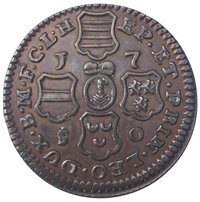
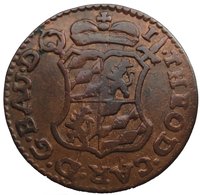
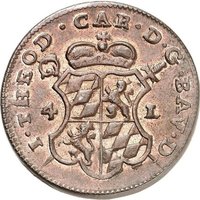
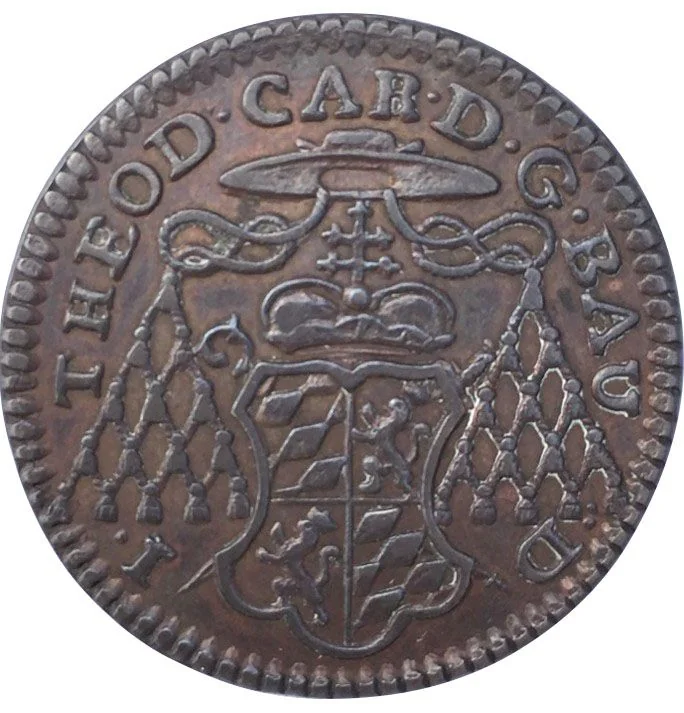
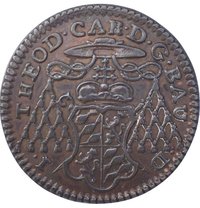
obverse
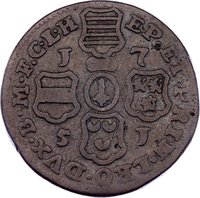
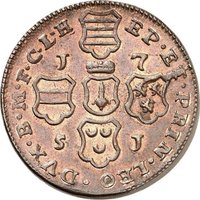
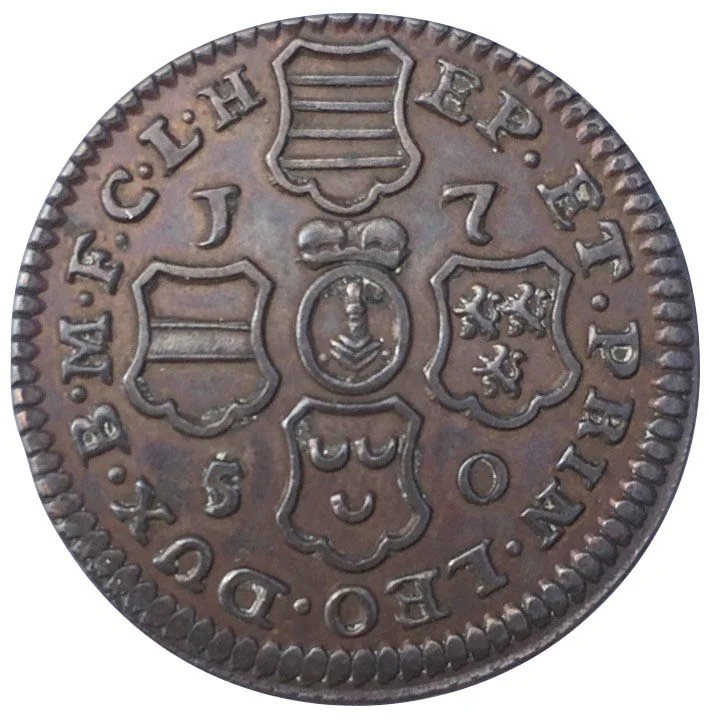
reverse
ThiLiege CC BY-SA
Context
Year: 1750
Country: Belgium Country flag
Currency:
(1650—1795)
Demonetization: 17 February 1840
Material
Diameter: 28.1 mm
Weight: 7.44 g
Shape: Round
Composition: Copper
Magnetic: No
Technique: Milled
Alignment: Coin alignment
Obverse
OBVERSE ↑
flip
Reverse
REVERSE ↓
References
KM: #Click to copy to clipboard156
Numista: #400219

Obverse

Description:
Bavarian-Palatinate arms under a cardinal's hat.
Inscription:
I · THEOD · CAR · D · G · BAU · D
Script: Latin

Reverse

Description:
Five coats of arms in a cross, date digits in corners.
Inscription:
EP · ET · PRIN · LEO · DUX · B · M · F · C · L · H

1750
Script: Latin

Edge

Mints

NameMark
Liège

Mintings

YearMint MarkMintageQualityCollection
1750

Historical background

In the mid-18th century, the Prince-Bishopric of Liège, a sovereign ecclesiastical state within the Holy Roman Empire, grappled with a complex and chaotic monetary system. The situation was defined by the simultaneous circulation of numerous foreign coins alongside local issues. Dutch guilders, Brabant patards, French écus, and Austrian kronenthalers all competed for use in daily transactions, their values fluctuating based on metal content and the volatile international exchange rates. This proliferation was a direct result of Liège's strategic location at a commercial crossroads and its politically fragmented neighbors, whose currencies naturally flowed across its borders.

The core of the problem lay in the bishopric's own weak minting authority. While the Prince-Bishops minted their own currency, notably the liard and the florin, these issues were often insufficient in quantity and quality to dominate the market. Debasement—reducing the precious metal content in coins—was a frequent temptation for the treasury, especially under the rule of Prince-Bishop Jean-Théodore of Bavaria (1744-1763), eroding public trust in local coinage. Consequently, merchants and the public preferred heavier, more reliable foreign specie, leading to Gresham's Law in action: "bad" local money drove "good" foreign money out of circulation or into hoards.

This monetary disorder created significant economic friction, hindering trade, complicating tax collection, and causing daily inconvenience for the population. Prices were unstable, and simple transactions required expert knowledge of coin values. While there were periodic ordinances attempting to fix exchange rates for the myriad of coins, these were largely ineffective without a fundamental reform of the minting system. Thus, in 1750, Liège's currency was not a tool of unified economic policy but a reflection of the state's political and administrative limitations, a persistent problem that would only be addressed by more forceful rulers later in the century.

Series: 1750 Prince-bishopric of Liege circulation coins

1 Liard obverse
1 Liard reverse
1 Liard
1750-1752
2 Liards obverse
2 Liards reverse
2 Liards
1750
2 Liards obverse
2 Liards reverse
2 Liards
1750-1752
4 Liards obverse
4 Liards reverse
4 Liards
1750-1752
Legendary