

60 centavos – Portuguese India
Add to wishlist
India
Context
Years: 1958–1959
Country: India
Issuer: Portuguese India
Period:
(1910—1961)
Currency:
(1958—1961)
Demonetization: 15 May 1962
Total mintage: 5,000,000
Material
References
KM: #
Numista: #11767
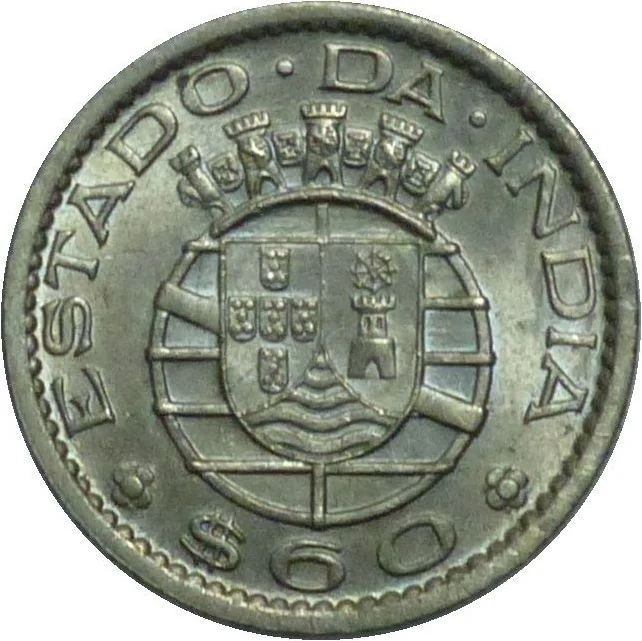
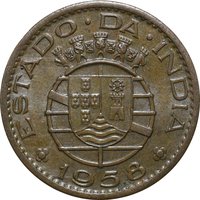
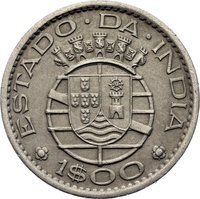
Obverse
Inscription:
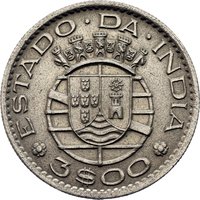
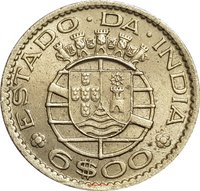
ESTADO·DA·INDIA
$60
$60
Translation:
STATE OF INDIA
$60
$60
Script: Latin
Languages: Portuguese, English
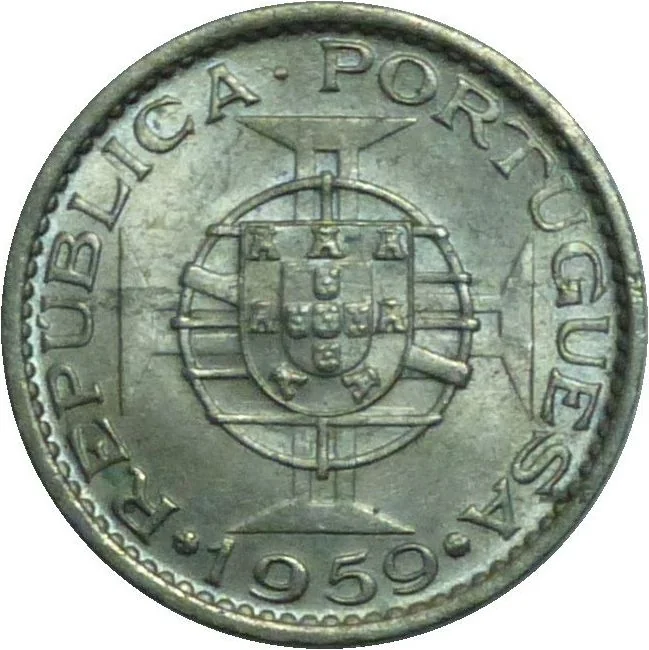
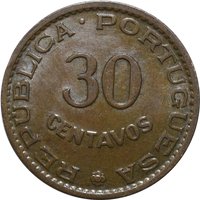
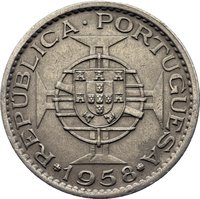
Reverse
Inscription:
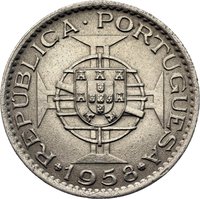
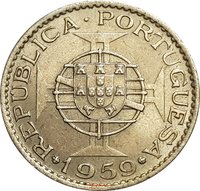
REPUBLICA · PORTUGUESA
1959
1959
Translation:
PORTUGUESE REPUBLIC
1959
1959
Script: Latin
Language: Portuguese
Edge
Plain
Mints
| Name | Mark |
|---|---|
| Imprensa Nacional - Casa da Moeda | — |
Mintings
| Year | Mint Mark | Mintage | Quality | Collection |
|---|---|---|---|---|
| 1958 | — | 5,000,000 | ||
| 1959 | — | — |
Historical background
In 1958, the currency situation in Portuguese India (Goa, Daman, and Diu) was a complex reflection of its contested political status. The official currency was the Portuguese Indian rupia (INPR), which was pegged at par with the Indian rupee (INR) and issued by the Banco Nacional Ultramarino. However, this parity was largely theoretical and administrative. In practice, the vast majority of currency in circulation and used for daily commerce was the Indian rupee, introduced by the neighbouring Republic of India. This created a de facto dual-currency system, where the Portuguese rupia served primarily for government salaries and official transactions within the territory, while the Indian rupee dominated the broader economy.
This monetary duality was a direct consequence of geography and overwhelming economic reality. Landlocked within India and with its economy deeply integrated with the surrounding Indian states, Portuguese India was dependent on India for trade, food, and communication links. The Indian rupee was essential for this cross-border commerce. Furthermore, the Portuguese Indian rupia was not freely convertible outside the territory, making the widely accepted Indian rupee a more practical and stable store of value for the local population. The Portuguese administration tacitly accepted this reality, as attempting to enforce sole use of their currency would have crippled the local economy.
The year 1958 fell within a period of escalating tension, as India increased diplomatic and economic pressure to force Portugal's decolonisation. The currency situation became a point of friction. India viewed the circulation of Portuguese currency on what it considered its sovereign soil as a provocation, while Portugal insisted it was a symbol of its legitimate authority. This unstable monetary arrangement, underpinned by political conflict, would persist until the end of Portuguese rule. It was ultimately resolved in December 1961 following India's military annexation, when the Portuguese Indian rupia was immediately demonetised and replaced entirely by the Indian rupee.
This monetary duality was a direct consequence of geography and overwhelming economic reality. Landlocked within India and with its economy deeply integrated with the surrounding Indian states, Portuguese India was dependent on India for trade, food, and communication links. The Indian rupee was essential for this cross-border commerce. Furthermore, the Portuguese Indian rupia was not freely convertible outside the territory, making the widely accepted Indian rupee a more practical and stable store of value for the local population. The Portuguese administration tacitly accepted this reality, as attempting to enforce sole use of their currency would have crippled the local economy.
The year 1958 fell within a period of escalating tension, as India increased diplomatic and economic pressure to force Portugal's decolonisation. The currency situation became a point of friction. India viewed the circulation of Portuguese currency on what it considered its sovereign soil as a provocation, while Portugal insisted it was a symbol of its legitimate authority. This unstable monetary arrangement, underpinned by political conflict, would persist until the end of Portuguese rule. It was ultimately resolved in December 1961 following India's military annexation, when the Portuguese Indian rupia was immediately demonetised and replaced entirely by the Indian rupee.
Series: Decimal System
🌱 Common