

1 soldo – Castiglione Delle Stiviere
Add to wishlist
Italy
Context
Year: 1666
Country: Italy
Issuer: Castiglione Delle Stiviere
Ruler: Ferdinando I
Currency:
Demonetized: Yes
Material
Diameter: 21 mm
Weight: 1.5 g
Shape: Irregular round
Composition: Billon
Technique: Hammered
Alignment: Medal alignment
flip
References
KM: #
Numista: #396300
Obverse
Description:
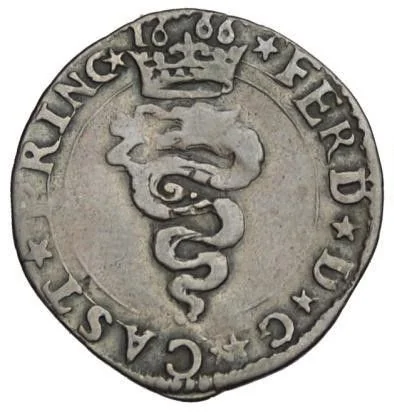
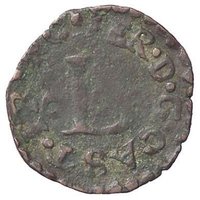
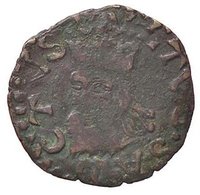
Crowned biscione snake with date above crown.
Inscription:
FERD • D • G • CAST • PRIN
Script: Latin
Reverse
Edge
Categories
| Animal> Reptile |
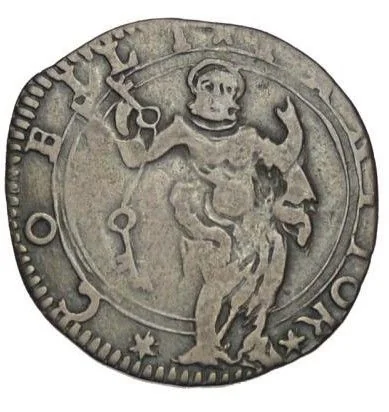
| Person> Religious figure |
Mints
| Name | Mark |
|---|---|
| Castiglione delle Stiviere | — |
Mintings
| Year | Mint Mark | Mintage | Quality | Collection |
|---|---|---|---|---|
| 1666 | — | — |
Historical background
In 1666, Castiglione delle Stiviere, a small but significant town in the Duchy of Mantua, operated within a complex and fragmented monetary landscape typical of the Italian peninsula. The official currency was the Mantuan lira, subdivided into soldi and denari, issued under the authority of Duke Carlo II. However, the town’s practical economic life was dominated by a plethora of foreign coins. Spanish reales and doubloons, Venetian ducats and lire, and even Florentine florins circulated widely due to trade, military movements, and the region's political ties. This created a constant challenge of exchange rates and valuation, as the intrinsic silver or gold content of each coin type determined its real worth.
The situation was further complicated by the recent history of the Mantuan state, which had been severely weakened by war, succession crises, and foreign occupation earlier in the century. This led to periods of currency debasement, where the silver content of local coinage was reduced to fund state expenses. Consequently, merchants and citizens in Castiglione delle Stiviere were highly attentive to the quality and origin of coins, often preferring trusted foreign specie for significant transactions. The local authorities would periodically publish "tariffe" (official exchange lists) to fix the value of the myriad coins in circulation, attempting to bring order to the marketplace.
For the average artisan or farmer in the town, this monetary diversity meant daily transactions required careful scrutiny. A purchase at the market might involve weighing coins, checking for clipping, and calculating conversions between denominations. The system was inefficient and prone to dispute, but it functioned within the broader context of regional trade networks that connected Castiglione to Venice, Milan, and beyond. Thus, the currency situation in 1666 was one of pragmatic chaos—a blend of local authority and international reality, where a purse contained not just the currency of the Duke, but the tangible evidence of the town’s place in a wider European economy.
The situation was further complicated by the recent history of the Mantuan state, which had been severely weakened by war, succession crises, and foreign occupation earlier in the century. This led to periods of currency debasement, where the silver content of local coinage was reduced to fund state expenses. Consequently, merchants and citizens in Castiglione delle Stiviere were highly attentive to the quality and origin of coins, often preferring trusted foreign specie for significant transactions. The local authorities would periodically publish "tariffe" (official exchange lists) to fix the value of the myriad coins in circulation, attempting to bring order to the marketplace.
For the average artisan or farmer in the town, this monetary diversity meant daily transactions required careful scrutiny. A purchase at the market might involve weighing coins, checking for clipping, and calculating conversions between denominations. The system was inefficient and prone to dispute, but it functioned within the broader context of regional trade networks that connected Castiglione to Venice, Milan, and beyond. Thus, the currency situation in 1666 was one of pragmatic chaos—a blend of local authority and international reality, where a purse contained not just the currency of the Duke, but the tangible evidence of the town’s place in a wider European economy.
✨ Legendary