

1 Quattrino – Castiglione Delle Stiviere
Italy
Context
Year: 1665
Country: Italy 
Issuer: Castiglione Delle Stiviere
Ruler: Ferdinando I
Currency:
Demonetized: Yes
Material
References
KM: #Click to copy to clipboard63
Numista: #396578
Obverse
Description:
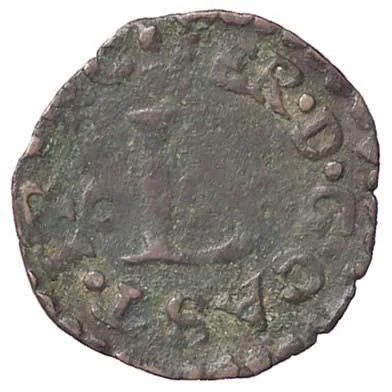
Large L dividing two-digit date.
Inscription:
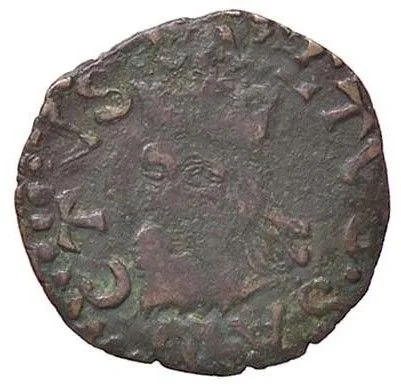
FER · D · G · CAST · PRINC
6 L 5
6 L 5
Script: Latin
Reverse
Edge
Categories
| Person> Religious figure |
Mints
| Name | Mark |
|---|---|
| Castiglione delle Stiviere | — |
Mintings
| Year | Mint Mark | Mintage | Quality | Collection |
|---|---|---|---|---|
| 1665 | — | — |
Historical background
In 1665, Castiglione delle Stiviere was a small, autonomous commune within the Duchy of Mantua, a minor Italian state whose fortunes were deeply intertwined with the complex monetary landscape of the Italian Peninsula and the wider Holy Roman Empire. The town itself, while locally governed, did not mint its own coinage. Its monetary system was therefore subject to the policies of the Gonzaga rulers in Mantua and, more broadly, to the circulation of a bewildering variety of foreign coins. The primary unit of account was the lira (divided into 20 soldi or 240 denari), but this was a theoretical benchmark against which a physical mosaic of actual coins was valued.
The currency in daily use was a heterogeneous mix. Alongside Mantuan scudi, lire, and soldi, there circulated coins from other Italian states like the Venetian ducat and the Florentine florin, as well as Spanish reales and even Imperial thalers from German lands. This proliferation created constant challenges. The value of these coins was not fixed by their face value but by their precious metal content (silver or gold), which was often clipped or debased. Consequently, exchange rates fluctuated, and money changers (campsores) held significant power in the marketplace, determining the local value of any given coin on a daily basis.
This situation was further strained by the economic and political fragility of the Duchy of Mantua itself. The devastating War of the Mantuan Succession (1628–1631) had left the region depopulated and impoverished, and the subsequent decades saw slow recovery. In 1665, Duke Carlo II was a weak ruler presiding over a depleted treasury. This context meant that monetary stability was a low priority, and the authorities had limited power to control the circulation of foreign or debased coinage. For the merchants and residents of Castiglione delle Stiviere, trade and daily transactions required careful negotiation and a keen eye for the weight and wear of each coin, making the local economy one of practical complexity and inherent instability.
The currency in daily use was a heterogeneous mix. Alongside Mantuan scudi, lire, and soldi, there circulated coins from other Italian states like the Venetian ducat and the Florentine florin, as well as Spanish reales and even Imperial thalers from German lands. This proliferation created constant challenges. The value of these coins was not fixed by their face value but by their precious metal content (silver or gold), which was often clipped or debased. Consequently, exchange rates fluctuated, and money changers (campsores) held significant power in the marketplace, determining the local value of any given coin on a daily basis.
This situation was further strained by the economic and political fragility of the Duchy of Mantua itself. The devastating War of the Mantuan Succession (1628–1631) had left the region depopulated and impoverished, and the subsequent decades saw slow recovery. In 1665, Duke Carlo II was a weak ruler presiding over a depleted treasury. This context meant that monetary stability was a low priority, and the authorities had limited power to control the circulation of foreign or debased coinage. For the merchants and residents of Castiglione delle Stiviere, trade and daily transactions required careful negotiation and a keen eye for the weight and wear of each coin, making the local economy one of practical complexity and inherent instability.

✨ Legendary