

20 Kreuzer – Kingdom of Bohemia
Context
Years: 1754–1765
Country: Bohemia
Issuer: Kingdom of Bohemia
Ruler: Maria Theresa
Currency:
(1754—1857)
Subdivision: 20 Kreuzer = ⅙ Konventionsthaler = ⅓ Austrian gulden
Demonetized: Yes
Total mintage: 11,189,000
Material
References
KM: #Click to copy to clipboard768
Numista: #39188
Value
Bullion value: $18.57
Obverse
Description:
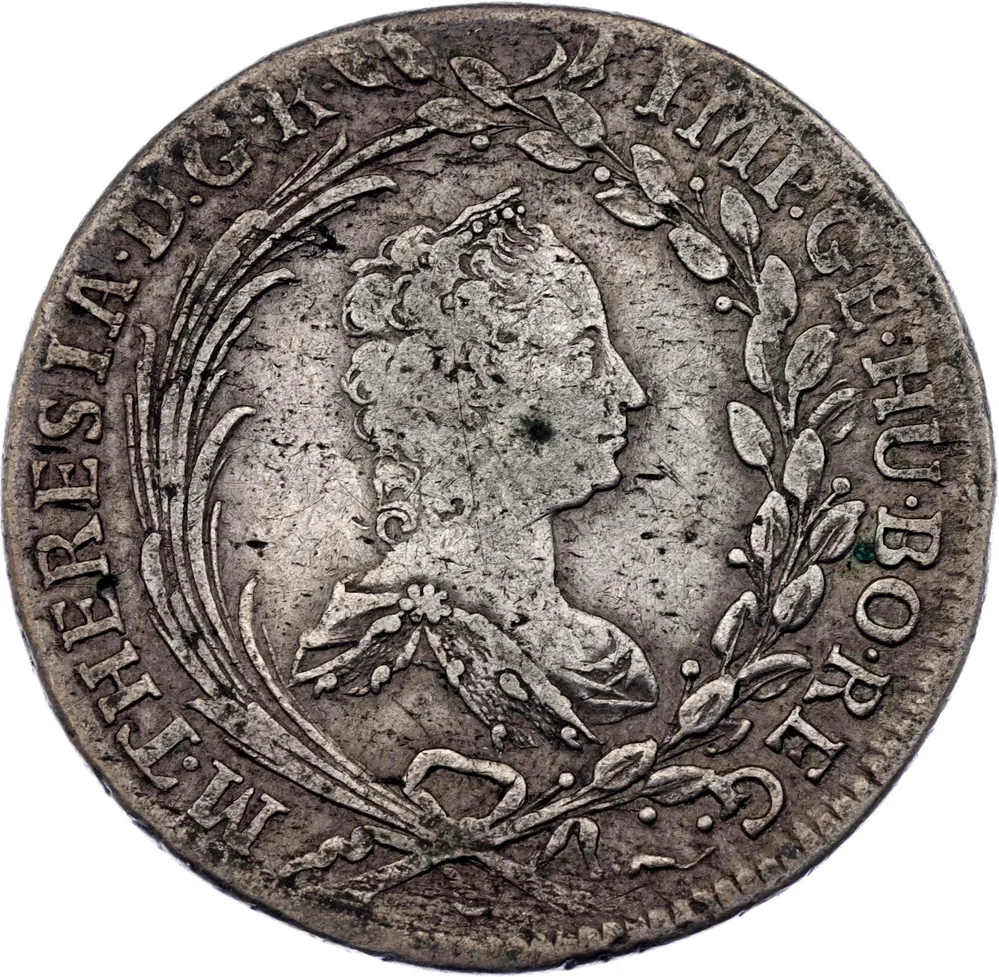
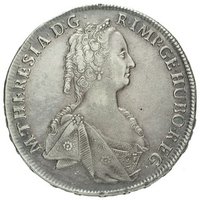
Maria Theresia of Habsburg, curly-haired and facing right, within a wreath and encircling legend.
Inscription:
M.THERESIA.D.G.R. IMP.GE.HU.BO.REG.
Script: Latin
Reverse
Description:
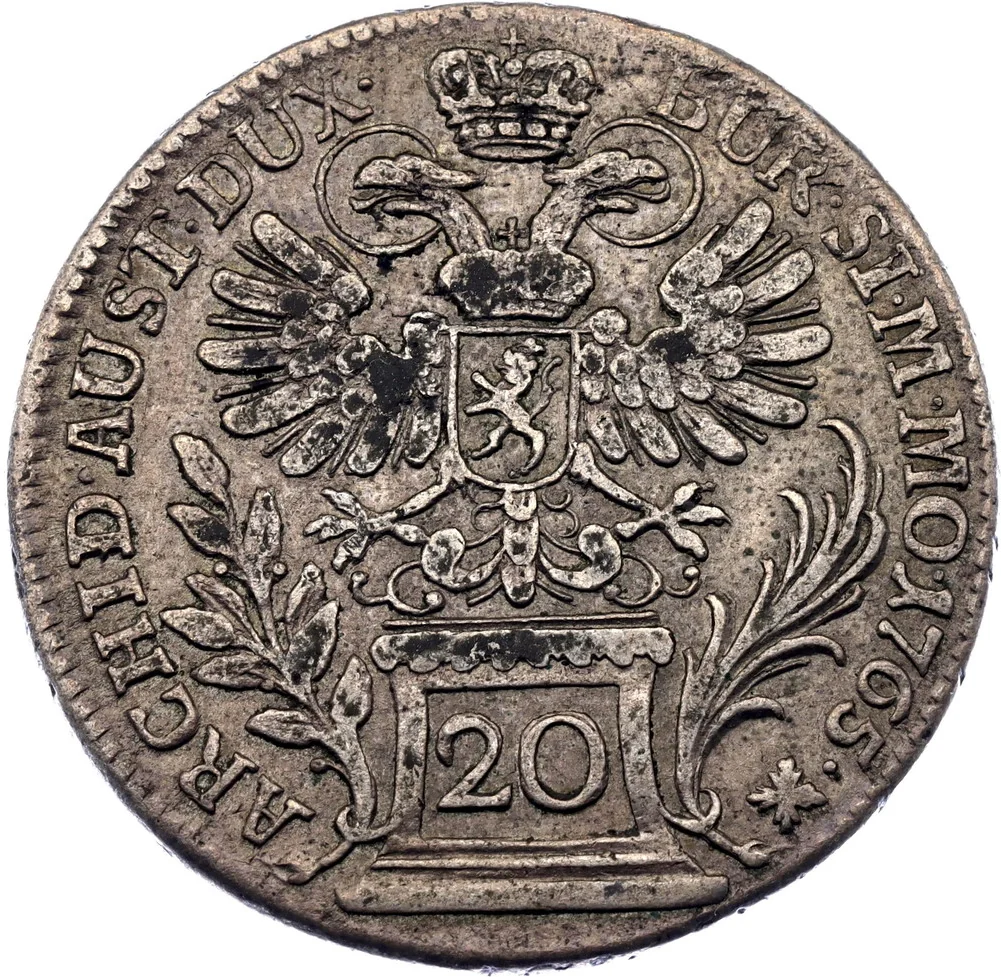
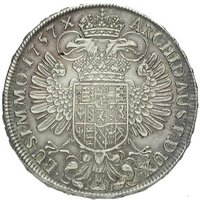
Value 20; imperial eagle with Bohemian lion shield. Legend and date around.
Inscription:
ARCHID.AUST.DUX BURG.SI.M.MO.1760 X
Script: Latin
Edge
Milled.
Categories
| Person> Monarch |
| Symbols> Coat of Arms |
| Symbol> Double-headed eagle |
Mints
| Name | Mark |
|---|---|
| Prague | — |
Mintings
| Year | Mint Mark | Mintage | Quality | Collection |
|---|---|---|---|---|
| 1754 | — | 251,000 | ||
| 1755 | — | 521,000 | ||
| 1756 | — | 822,000 | ||
| 1757 | — | 840,000 | ||
| 1758 | — | 1,413,000 | ||
| 1759 | — | 615,000 | ||
| 1760 | — | 832,000 | ||
| 1761 | — | 1,123,000 | ||
| 1763 | — | 2,485,000 | ||
| 1764 | — | 1,353,000 | ||
| 1765 | — | 934,000 |
Historical background
In 1754, the Kingdom of Bohemia, a core crown land of the Habsburg Monarchy, operated within a complex and often chaotic currency system. The official currency was the Conventionsthaler, established by the Vienna Convention of 1753, which standardized the silver content of large coins across the Habsburg Empire and southern Germany. This reform aimed to bring order, as Bohemia had long suffered from a proliferation of debased domestic and foreign coins, including various Kreuzer and Groschen, leading to chronic uncertainty in trade and daily transactions.
Despite the new convention standard, the monetary reality in Bohemia remained fragmented. Older, inferior coins from the previous Reichsthaler standard and regional issues from neighboring states like Saxony and Prussia still circulated widely, forcing merchants and the public to constantly calculate exchange rates and silver values. Furthermore, the state's frequent fiscal demands, driven by Empress Maria Theresa's military preparations for what would become the Seven Years' War (1756-1763), created persistent pressure to raise revenue, often at the risk of future debasement.
The situation was further complicated by Bohemia's advanced economy, home to significant silver mining, textile manufacturing, and commercial agriculture. This economic activity required reliable high-value currency for large transactions, which the Conventionsthaler provided, but also a trustworthy small coinage for wages and market purchases, which was often scarce. Consequently, in 1754, Bohemia stood at a precarious point between the new imperial monetary order and the lingering instability of old practices, with the looming costs of war threatening to undermine the recent reforms.
Despite the new convention standard, the monetary reality in Bohemia remained fragmented. Older, inferior coins from the previous Reichsthaler standard and regional issues from neighboring states like Saxony and Prussia still circulated widely, forcing merchants and the public to constantly calculate exchange rates and silver values. Furthermore, the state's frequent fiscal demands, driven by Empress Maria Theresa's military preparations for what would become the Seven Years' War (1756-1763), created persistent pressure to raise revenue, often at the risk of future debasement.
The situation was further complicated by Bohemia's advanced economy, home to significant silver mining, textile manufacturing, and commercial agriculture. This economic activity required reliable high-value currency for large transactions, which the Conventionsthaler provided, but also a trustworthy small coinage for wages and market purchases, which was often scarce. Consequently, in 1754, Bohemia stood at a precarious point between the new imperial monetary order and the lingering instability of old practices, with the looming costs of war threatening to undermine the recent reforms.
⭐ Somewhat Rare