

1 Thaler – Kingdom of Bohemia
Context
Years: 1751–1760
Country: Bohemia
Issuer: Kingdom of Bohemia
Ruler: Maria Theresa
Currency:
(1754—1857)
Demonetized: Yes
References
KM: #Click to copy to clipboard765
Numista: #105988
Obverse
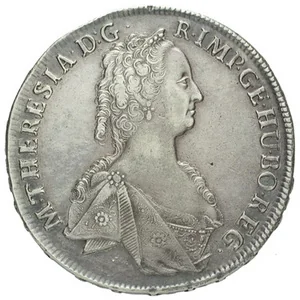
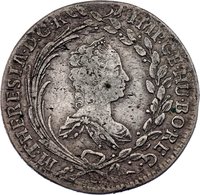
Description:
Portrait right, legend begins at 8 o'clock.
Inscription:
M·THERESIA·D:G· R·IMP·GE·HU·BO·REG·
Script: Latin
Reverse
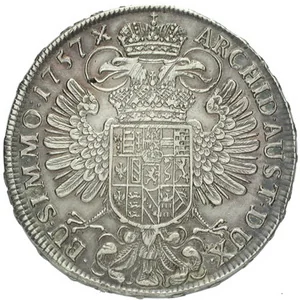
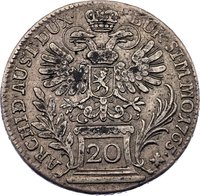
Description:
"X" post-date. Legend begins at 1h.
Inscription:
ARCHID·AUST·DUX· · BU·SI·M·MO: 1757 X
Script: Latin
Edge
Mints
| Name | Mark |
|---|---|
| Prague | — |
Mintings
| Year | Mint Mark | Mintage | Quality | Collection |
|---|---|---|---|---|
| 1751 | — | — | ||
| 1752 | — | — | ||
| 1753 | — | — | ||
| 1754 | — | — | ||
| 1755 | — | — | ||
| 1757 | — | — | ||
| 1759 | — | — | ||
| 1760 | — | — |
Historical background
In 1751, the currency situation in the Kingdom of Bohemia was characterized by a complex and unstable system, a legacy of the wider Habsburg monetary reforms of the previous decades. The primary unit was the Conventionsthaler (or Konventionsthaler), established by the monetary convention of 1750/1753 between Austria and Bavaria, which set a standard of 20 Gulden to a Cologne Mark of fine silver. However, in daily circulation, people more commonly used lower-denomination coins like kreuzers and groschen, with 60 kreuzers to a Gulden and 3 kreuzers to a Groschen. This multi-tiered system was cumbersome and prone to regional variation.
The instability stemmed from decades of debasement and fiscal pressure, particularly from the wars of Empress Maria Theresa, including the ongoing War of the Austrian Succession (1740-1748). To finance these conflicts, the state had often reduced the silver content in coinage, leading to a flood of inferior domestic coins and an influx of foreign and counterfeit money. This resulted in a severe loss of public confidence, Gresham's Law in action ("bad money drives out good"), where older, higher-value coins were hoarded or melted down, leaving the economy to function with unreliable currency.
Consequently, the year 1751 fell within a critical period of attempted stabilization. Maria Theresa's government was actively working to implement the new convention standard and restore trust by minting high-quality, uniform silver thalers and gulden at the central mint in Vienna. These efforts, however, were a gradual process. For Bohemian merchants, peasants, and nobles, the reality was a daily monetary landscape of confusion, where the value of coins was often disputed and the exchange between various regional and legacy issues remained a persistent challenge to commerce and taxation.
The instability stemmed from decades of debasement and fiscal pressure, particularly from the wars of Empress Maria Theresa, including the ongoing War of the Austrian Succession (1740-1748). To finance these conflicts, the state had often reduced the silver content in coinage, leading to a flood of inferior domestic coins and an influx of foreign and counterfeit money. This resulted in a severe loss of public confidence, Gresham's Law in action ("bad money drives out good"), where older, higher-value coins were hoarded or melted down, leaving the economy to function with unreliable currency.
Consequently, the year 1751 fell within a critical period of attempted stabilization. Maria Theresa's government was actively working to implement the new convention standard and restore trust by minting high-quality, uniform silver thalers and gulden at the central mint in Vienna. These efforts, however, were a gradual process. For Bohemian merchants, peasants, and nobles, the reality was a daily monetary landscape of confusion, where the value of coins was often disputed and the exchange between various regional and legacy issues remained a persistent challenge to commerce and taxation.
✨ Legendary