

1 denier – Hungary
Add to wishlist
Hungary
Context
Material
Diameter: 15 mm
Weight: 0.45 g
Silver Weight:: 0.45 g
Shape: Irregular round
Composition: Silver
Magnetic: No
References
KM: #
Numista: #38915
Value
Bullion value: $1.12
Obverse
Description:
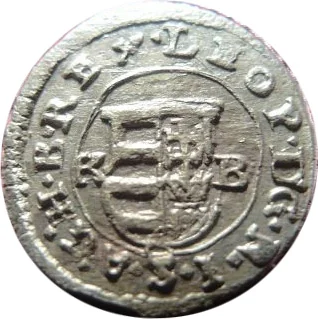
Hungarian coat of arms between K•B mintmark, surrounded by pearl circle inscription.
Inscription:
LEOP · D · G · R · I · S · A · G · H · B · REX ·
Script: Latin
Reverse
Description:
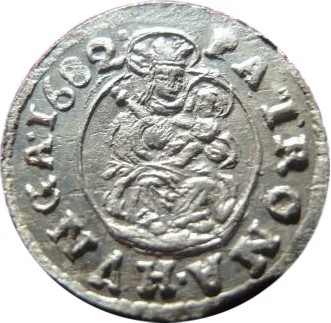
Madonna and child within a pearl circle, above the date.
Inscription:
PATRONA · HVNGA · 1682 ·
Script: Latin
Edge
Plain
Mints
| Name | Mark |
|---|---|
| Kremnica | KB |
Mintings
Historical background
In 1659, the Kingdom of Hungary was in a state of profound monetary instability, a direct consequence of the ongoing wars and political fragmentation following the Ottoman conquest. The country was effectively divided into three parts: the Ottoman-occupied central region, the Habsburg-ruled Royal Hungary in the north and west, and the semi-independent Principality of Transylvania in the east. This tripartite division meant there was no unified monetary policy, leading to a chaotic circulation of various coins of different origins and intrinsic values.
The primary currency in circulation, especially in Habsburg territories, was the silver thaler. However, the constant financial strain of the Long Turkish War (1593-1606) and subsequent conflicts had led the Viennese court to repeatedly debase the lower-denomination copper and billon coins, such as the denars and krajczárs, that were minted for use in Hungary. This practice, which increased the face value of coins while reducing their silver content, created a severe discrepancy between the "good money" (full-value thalers) and "bad money" (debased coins). According to Gresham's Law, good silver thalers were hoarded or exported, while the debased coins flooded the market, causing rampant inflation and a loss of public trust in the currency.
Furthermore, the monetary landscape was cluttered with a vast array of foreign coins, including Ottoman akçes, Dutch thalers, and Polish groschens, which circulated alongside domestic issues. This confusion was exacerbated by the activities of money-changers and counterfeiters, who thrived in the unstable environment. For the peasantry and soldiers paid in the debased coinage, the result was a drastic reduction in purchasing power, deepening economic hardship and social tension throughout the kingdom. The currency situation of 1659 was thus a clear reflection of a war-torn, partitioned state struggling with the fiscal demands of continual military defense.
The primary currency in circulation, especially in Habsburg territories, was the silver thaler. However, the constant financial strain of the Long Turkish War (1593-1606) and subsequent conflicts had led the Viennese court to repeatedly debase the lower-denomination copper and billon coins, such as the denars and krajczárs, that were minted for use in Hungary. This practice, which increased the face value of coins while reducing their silver content, created a severe discrepancy between the "good money" (full-value thalers) and "bad money" (debased coins). According to Gresham's Law, good silver thalers were hoarded or exported, while the debased coins flooded the market, causing rampant inflation and a loss of public trust in the currency.
Furthermore, the monetary landscape was cluttered with a vast array of foreign coins, including Ottoman akçes, Dutch thalers, and Polish groschens, which circulated alongside domestic issues. This confusion was exacerbated by the activities of money-changers and counterfeiters, who thrived in the unstable environment. For the peasantry and soldiers paid in the debased coinage, the result was a drastic reduction in purchasing power, deepening economic hardship and social tension throughout the kingdom. The currency situation of 1659 was thus a clear reflection of a war-torn, partitioned state struggling with the fiscal demands of continual military defense.
💎 Very Rare