

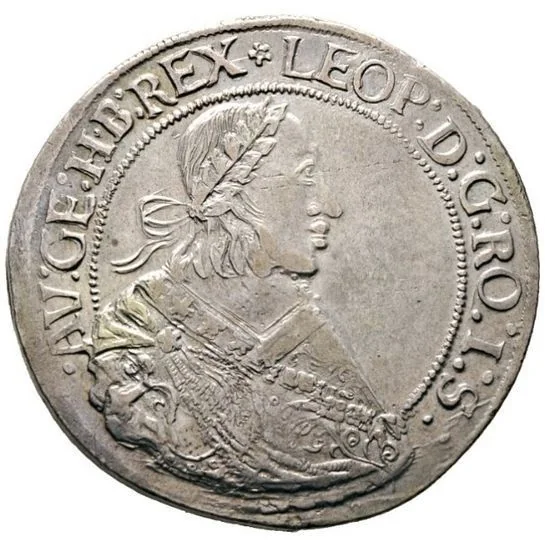
Obverse
Description:
Laureate bust right, breaking legend. Hungarian shield and Madonna with child break inner inscription.
Inscription:
LEOP : D : G : RO : I : S · AV : GE : H · B : REX *
Script: Latin
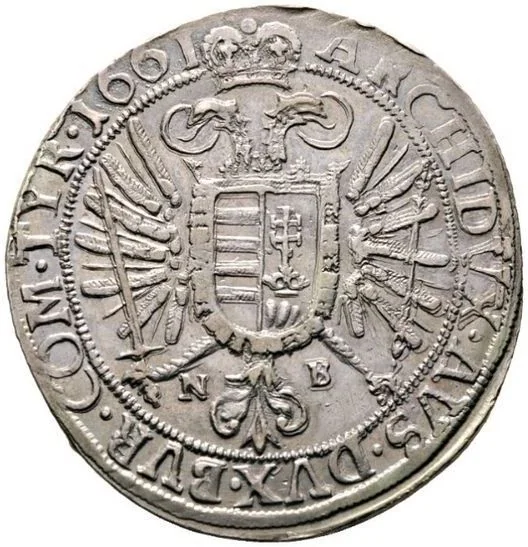
Reverse
Description:
Imperial eagle in circle, date in legend, KB mintmark split by eagle’s tail. Double-crowned Hungarian arms in U-shaped cartouche, no central shield.
Inscription:
ARCHIDVX · AV · DVX · BVRG · COM · TYR · 1661
N B
N B
Script: Latin
Edge
Plain
Mints
| Name | Mark |
|---|---|
| Baia Mare | NB |
Mintings
| Year | Mint Mark | Mintage | Quality | Collection |
|---|---|---|---|---|
| 1660 | N | — | ||
| 1661 | N | — | ||
| 1662 | N | — |
Historical background
In 1660, the Kingdom of Hungary was in a state of profound monetary instability, a direct consequence of its political fragmentation and ongoing warfare. Following the Ottoman conquest of central Hungary in the previous century, the realm was divided into three parts: Ottoman-occupied territories, the Habsburg-ruled Royal Hungary in the north and west, and the semi-independent Principality of Transylvania in the east. Each of these entities issued its own coinage—Habsburg thalers and kreutzers, Ottoman akçes, and Transylvanian denars—leading to a chaotic circulation of currencies of varying metallic content and value within the war-torn region.
This period, part of the broader "Kipper- und Wipperzeit" (a era of coinage debasement across Central Europe), saw rampant currency manipulation. The Habsburg authorities, desperate to finance continuous military campaigns against both the Ottomans and Transylvanian forces, systematically debased their silver coinage. By reducing the precious metal content and increasing the minting of copper-based coins, they created short-term revenue but triggered severe inflation and a loss of public trust. Counterfeiting was widespread, and the market was flooded with inferior coins, causing good-quality full-weight coins to be hoarded or melted down.
The economic consequences for the population were dire. Peasants and soldiers, often paid in debased copper coins, found their purchasing power evaporating as prices for essential goods soared. This monetary crisis exacerbated the hardships caused by constant military raids, displacement, and heavy taxation. The currency situation of 1660 thus reflects not merely a financial collapse, but a key symptom of the broader societal devastation endured by Hungary during its long struggle for survival and reunification.
This period, part of the broader "Kipper- und Wipperzeit" (a era of coinage debasement across Central Europe), saw rampant currency manipulation. The Habsburg authorities, desperate to finance continuous military campaigns against both the Ottomans and Transylvanian forces, systematically debased their silver coinage. By reducing the precious metal content and increasing the minting of copper-based coins, they created short-term revenue but triggered severe inflation and a loss of public trust. Counterfeiting was widespread, and the market was flooded with inferior coins, causing good-quality full-weight coins to be hoarded or melted down.
The economic consequences for the population were dire. Peasants and soldiers, often paid in debased copper coins, found their purchasing power evaporating as prices for essential goods soared. This monetary crisis exacerbated the hardships caused by constant military raids, displacement, and heavy taxation. The currency situation of 1660 thus reflects not merely a financial collapse, but a key symptom of the broader societal devastation endured by Hungary during its long struggle for survival and reunification.

✨ Legendary