


Obverse
Description:
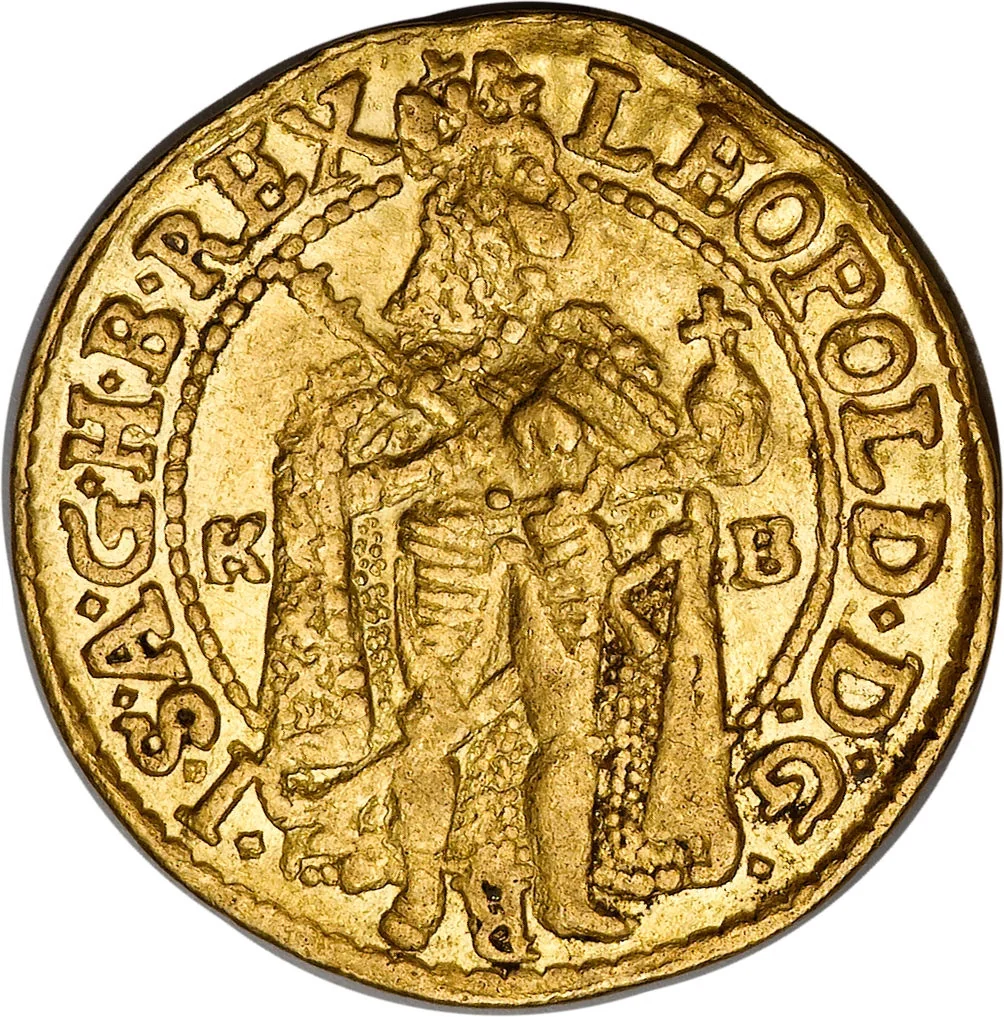
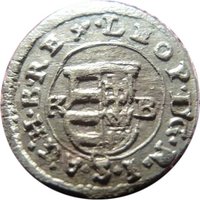
Hungarian ducat type. Crowned monarch facing front, holding orb and scepter, divides mintmark. Inscription within inner pearl circle.
Inscription:
LEOPOLD · D · G · R · I · S · A · G · H · B · REX
K B
K B
Script: Latin
Reverse
Description:
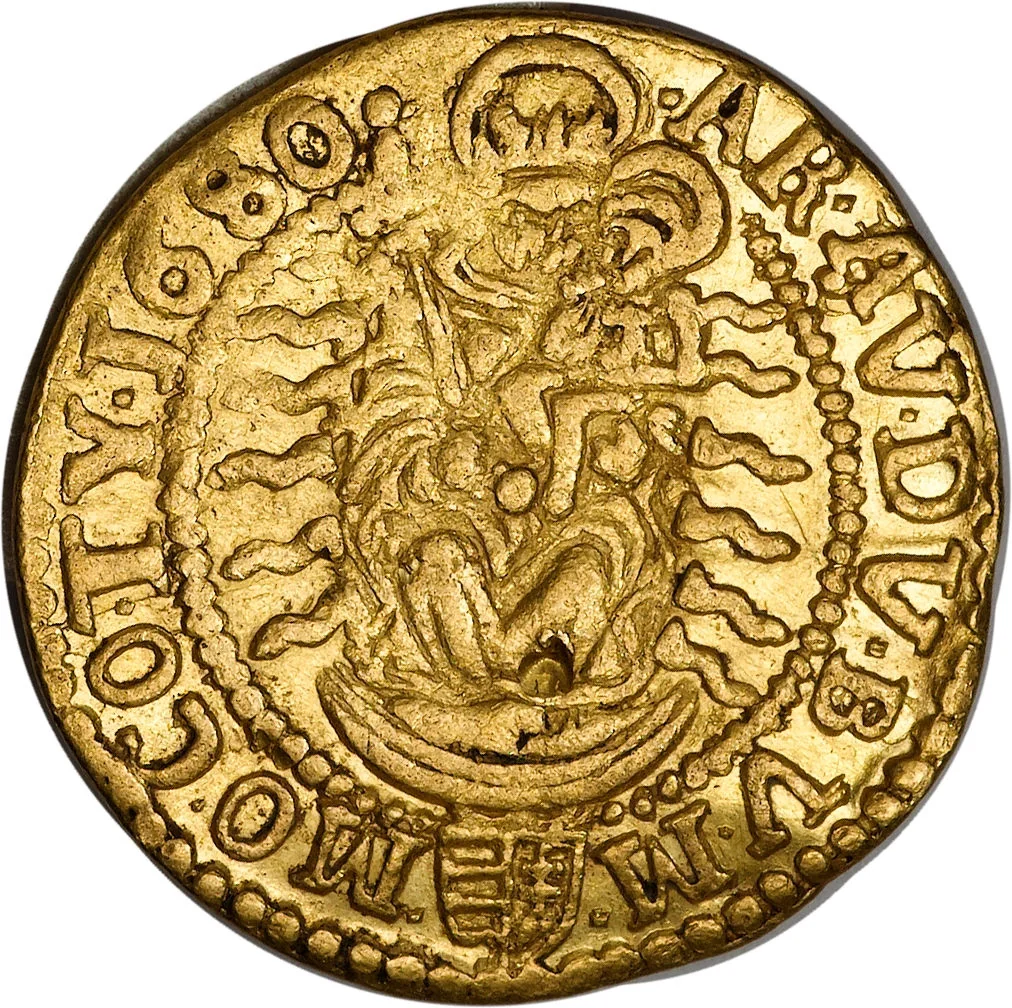
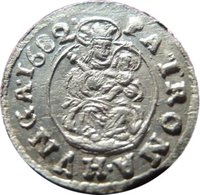
Radiant crowned Madonna seated on a crescent, holding a scepter in her right hand and a child on her left arm. An inscription encircles her within a pearl border, ending with a date.
Inscription:
AR · AV ·DV · BV · M · MO · CO · TY · 1680 ·
Script: Latin
Edge
Plain
Mints
| Name | Mark |
|---|---|
| Kremnica | KB |
Mintings
| Year | Mint Mark | Mintage | Quality | Collection |
|---|---|---|---|---|
| 1658 | KB | — | ||
| 1659 | KB | — | ||
| 1660 | KB | — | ||
| 1661 | KB | — | ||
| 1662 | KB | — | ||
| 1663 | KB | — | ||
| 1664 | KB | — | ||
| 1665 | KB | — | ||
| 1666 | KB | — | ||
| 1667 | KB | — | ||
| 1668 | KB | — | ||
| 1669 | KB | — | ||
| 1670 | KB | — | ||
| 1671 | KB | — | ||
| 1672 | KB | — | ||
| 1673 | KB | — | ||
| 1674 | KB | — | ||
| 1675 | KB | — | ||
| 1676 | KB | — | ||
| 1677 | KB | — | ||
| 1678 | KB | — | ||
| 1679 | KB | — | ||
| 1680 | KB | — | ||
| 1681 | KB | — | ||
| 1682 | KB | — | ||
| 1683 | KB | — | ||
| 1684 | KB | — | ||
| 1685 | KB | — | ||
| 1686 | KB | — | ||
| 1687 | KB | 64,000 | ||
| 1688 | KB | 55,000 | ||
| 1689 | - | — | ||
| 1689 | KB | 55,000 | ||
| 1690 | KB | 70,000 | ||
| 1691 | KB | 108,000 | ||
| 1692 | KB | — | ||
| 1693 | KB | 83,000 | ||
| 1694 | KB | 87,000 | ||
| 1695 | KB | — | ||
| 1696 | KB | — | ||
| 1697 | KB | — | ||
| 1698 | KB | — | ||
| 1699 | KB | — | ||
| 1700 | KB | — | ||
| 1701 | KB | — | ||
| 1702 | - | — | ||
| 1702 | KB | — | ||
| 1703 | KB | — | ||
| 1704 | KB | — |
Historical background
In 1658, Hungary’s currency situation was chaotic and deeply unstable, a direct consequence of the ongoing wars and political fragmentation that had plagued the region for decades. The country was divided into three parts: Royal Hungary under Habsburg rule, the Ottoman-occupied central territories, and the semi-independent Principality of Transylvania. Each entity issued its own coinage—Habsburg thalers and denars, Ottoman akçes, and Transylvanian denars—leading to a confusing mix of currencies circulating at wildly fluctuating values. This monetary disunity crippled trade and made economic planning nearly impossible.
The primary driver of instability was the relentless debasement of coinage, particularly by the Habsburg authorities in Vienna. To finance continuous warfare against the Ottomans and internal rebellions, the Habsburgs repeatedly reduced the silver content of coins minted for Hungary, such as the so-called "kriegsgeld" (war money). This practice, akin to a hidden tax, caused severe inflation and a loss of public trust. People hoarded older, purer coins (Gresham’s Law in action), while the rapidly depreciating new coins fueled price increases and economic hardship for soldiers, peasants, and townsfolk alike.
Furthermore, the circulation was flooded with worn, clipped, and counterfeit coins from across Europe, exacerbating the crisis. There was no effective central authority to regulate currency or enforce standards across the divided kingdom. The result was a dysfunctional monetary system where the value of coins was determined more by their metal weight and perceived origin than their face value, creating a barter economy in many areas. This financial turmoil reflected the broader devastation of the Long Turkish War and the struggle for control of Hungary, hindering recovery and deepening the region’s economic decline.
The primary driver of instability was the relentless debasement of coinage, particularly by the Habsburg authorities in Vienna. To finance continuous warfare against the Ottomans and internal rebellions, the Habsburgs repeatedly reduced the silver content of coins minted for Hungary, such as the so-called "kriegsgeld" (war money). This practice, akin to a hidden tax, caused severe inflation and a loss of public trust. People hoarded older, purer coins (Gresham’s Law in action), while the rapidly depreciating new coins fueled price increases and economic hardship for soldiers, peasants, and townsfolk alike.
Furthermore, the circulation was flooded with worn, clipped, and counterfeit coins from across Europe, exacerbating the crisis. There was no effective central authority to regulate currency or enforce standards across the divided kingdom. The result was a dysfunctional monetary system where the value of coins was determined more by their metal weight and perceived origin than their face value, creating a barter economy in many areas. This financial turmoil reflected the broader devastation of the Long Turkish War and the struggle for control of Hungary, hindering recovery and deepening the region’s economic decline.
💎 Extremely Rare