

15 kreuzers – Hungary
Add to wishlist
Hungary
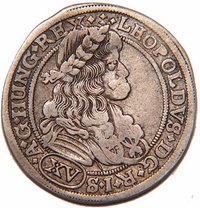
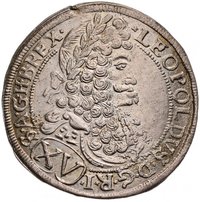
Obverse
Description:
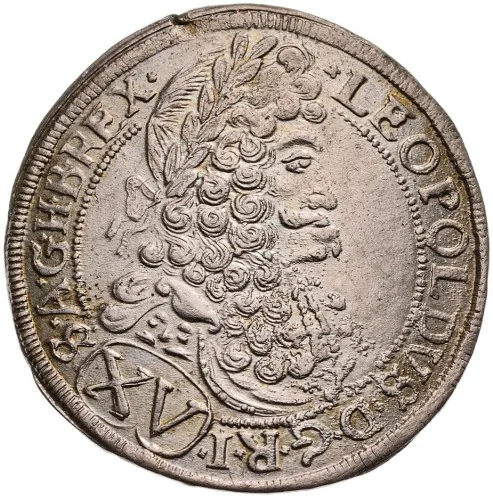
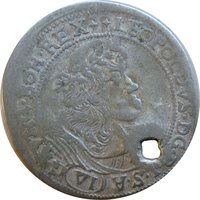
Leopold, younger, facing right in curly wig. Denomination "XV" in circle below.
Inscription:
LEOPOLDVS · D · G · R · I · S · A · G · H · B · REX
Script: Latin
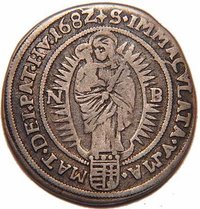
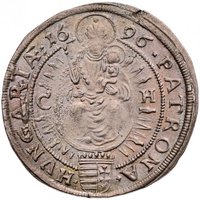
Reverse
Description:
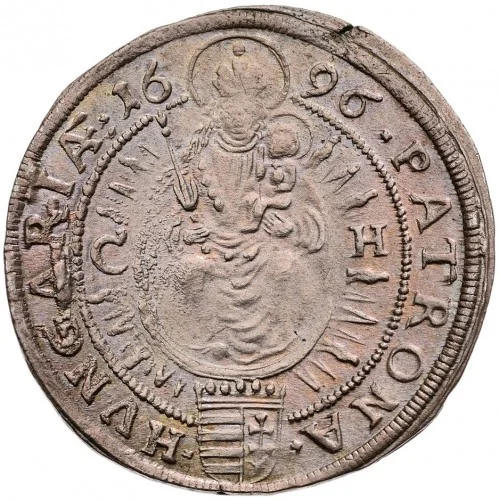
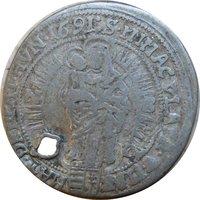
Madonna and child in a mandorla, encircled by pearls. Below: a small Hungarian shield flanked by a castle (right) and a crescent (left).
Inscription:
PATRONA · HVNGARIÆ · 16 74 ·
Script: Latin
Edge
Plain
Mintings
| Year | Mint Mark | Mintage | Quality | Collection |
|---|---|---|---|---|
| 1674 | — | — | BU | |
| 1675 | — | — | BU | |
| 1676 | — | — | BU | |
| 1695 | C-H | — | BU | |
| 1696 | C-H | — | BU | |
| 1696 | C-H | — |
Historical background
In 1674, Hungary was a fractured kingdom caught in the crossfire of the Habsburg-Ottoman wars, a reality deeply reflected in its chaotic currency situation. The country was effectively divided into three parts: the Habsburg-controlled Royal Hungary in the north and west, the Ottoman-occupied central territories, and the semi-independent Principality of Transylvania in the east. Each region circulated its own mix of coins, leading to a complex and unstable monetary environment. The Habsburgs, ruling from Vienna, primarily minted and circulated silver thalers (Tallér) and smaller silver denars, but the constant financial strain of warfare led to repeated debasements. This meant the silver content of coins was reduced, causing inflation and eroding public trust in the currency.
Alongside official Habsburg coinage, a plethora of other money circulated freely. Older, higher-quality Hungarian silver coins from pre-Ottoman times, known as madéj or krajcár, were still in use but increasingly scarce. More problematically, a flood of underweight and debased copper coins, often produced to pay soldiers and war contractors, swamped the market. Furthermore, Ottoman akçe and Turkish thalers circulated in the occupied zones, while Transylvania minted its own coins. This created a bewildering system where exchange rates fluctuated wildly, and merchants had to constantly weigh and assess the actual metal content of coins from different origins.
The result was severe economic hardship and market distortion. The Habsburg government's attempts to regulate exchange rates by decree were largely ineffective against market forces. Trust in coinage was low, leading to hoarding of good silver and the rapid passing-on of debased coins, a classic example of Gresham's Law ("bad money drives out good"). This monetary chaos stifled trade, complicated tax collection for the war effort, and placed an additional burden on a population already suffering from the devastation of conflict, making the currency crisis a key symptom of the kingdom's profound political and social instability.
Alongside official Habsburg coinage, a plethora of other money circulated freely. Older, higher-quality Hungarian silver coins from pre-Ottoman times, known as madéj or krajcár, were still in use but increasingly scarce. More problematically, a flood of underweight and debased copper coins, often produced to pay soldiers and war contractors, swamped the market. Furthermore, Ottoman akçe and Turkish thalers circulated in the occupied zones, while Transylvania minted its own coins. This created a bewildering system where exchange rates fluctuated wildly, and merchants had to constantly weigh and assess the actual metal content of coins from different origins.
The result was severe economic hardship and market distortion. The Habsburg government's attempts to regulate exchange rates by decree were largely ineffective against market forces. Trust in coinage was low, leading to hoarding of good silver and the rapid passing-on of debased coins, a classic example of Gresham's Law ("bad money drives out good"). This monetary chaos stifled trade, complicated tax collection for the war effort, and placed an additional burden on a population already suffering from the devastation of conflict, making the currency crisis a key symptom of the kingdom's profound political and social instability.
Series: 1674 Hungary circulation coins

💎 Extremely Rare