

5 Öre – Sweden
Sweden
Context
Years: 1690–1715
Issuer: Sweden 
Ruler: Charles XI
Currency:
(1665—1715)
Demonetized: Yes
Total mintage: 20,363,792
Material
References
KM: #Click to copy to clipboard310
Numista: #37936
Obverse
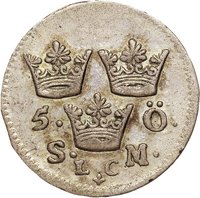
Description:
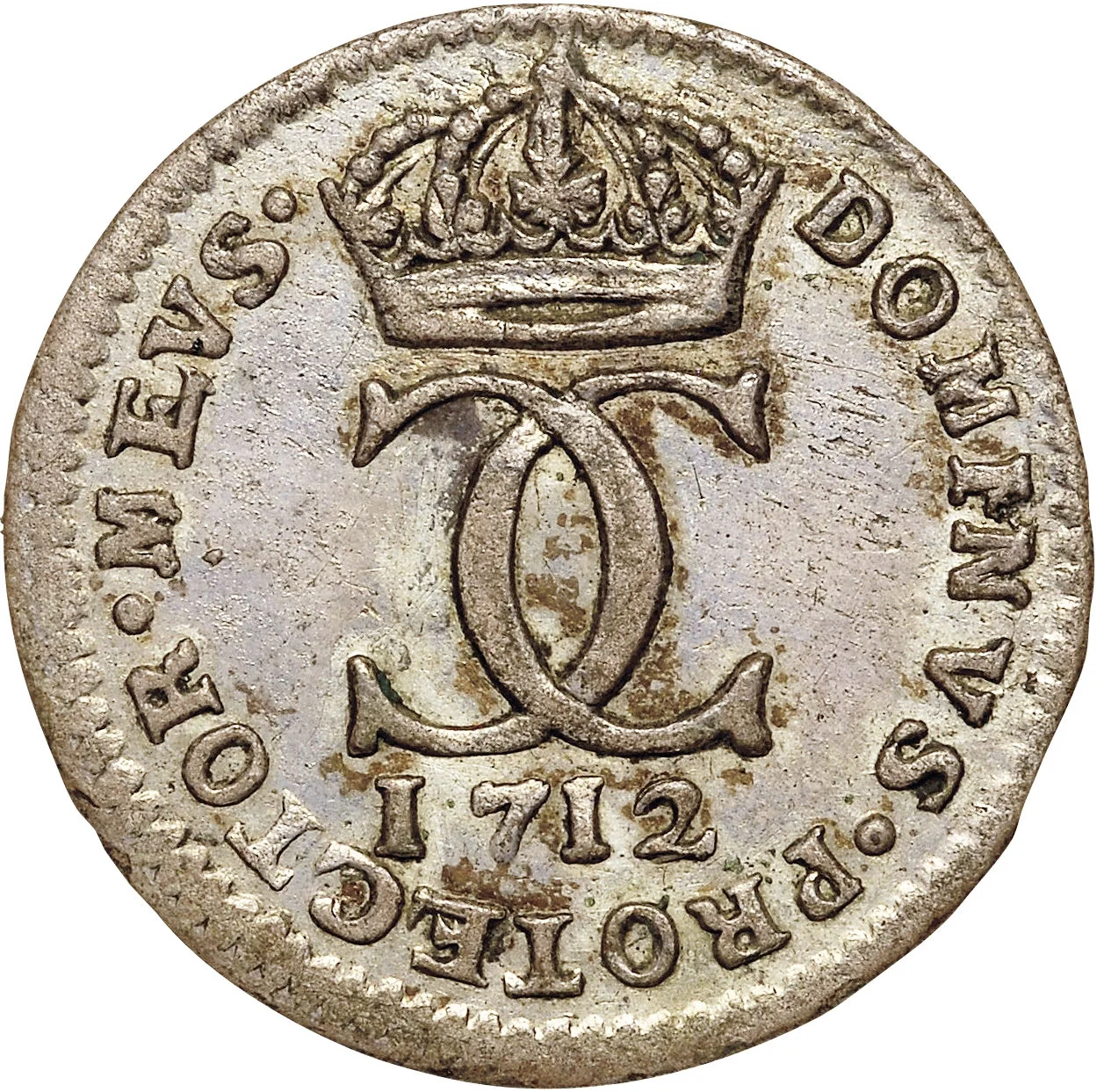
Crowned double C monogram, date beneath.
Inscription:
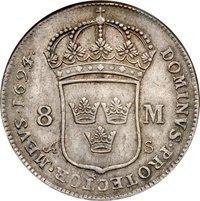
DOMINVS.PROTECOR.MEVS.
1712
1712
Script: Latin
Reverse
Edge
Mintings
| Year | Mint Mark | Mintage | Quality | Collection |
|---|---|---|---|---|
| 1690 | — | 1,677,615 | ||
| 1691 | — | 2,563,038 | ||
| 1692 | — | 1,857,058 | ||
| 1693 | — | 2,367,544 | ||
| 1694 | — | 2,257,285 | ||
| 1699 | — | 1,271,024 | ||
| 1700 | — | 2,195,139 | ||
| 1702 | — | 355,361 | ||
| 1703 | — | 417,183 | ||
| 1704 | — | 629,155 | ||
| 1705 | — | 968,156 | ||
| 1706 | HZ | 443,740 | ||
| 1706 | LC | — | ||
| 1707 | LC | — | ||
| 1708 | LC | 454,607 | ||
| 1709 | LC | 424,727 | ||
| 1710 | LC | 1,255,634 | ||
| 1711 | LC | 838,617 | ||
| 1712 | LC | 240,153 | ||
| 1713 | LC | 100,734 | ||
| 1714 | LC | 47,022 | ||
| 1715 | LC | — |
Historical background
In 1690, Sweden was grappling with the severe economic and monetary consequences of its era as a European great power. The kingdom’s finances had been stretched to the limit by decades of warfare, most notably the Thirty Years' War and the ongoing conflicts of the Scanian War and the Great Northern War. To fund these immense military expenditures, the state, under the absolutist rule of King Charles XI, had resorted to repeated debasements of the copper currency—the klipping—and had issued excessive amounts of credit notes, leading to rampant inflation and a profound loss of confidence in the monetary system.
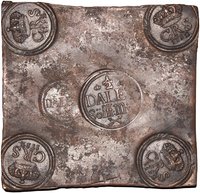
The situation was uniquely complicated by Sweden’s dual-currency system of copper and silver. While international trade was conducted in silver daler, the domestic economy heavily relied on bulky copper plate money (plåtmynt), which was intrinsically valuable but cumbersome. The chronic shortage of silver, exacerbated by the costs of war, forced the state to mint more and more copper coins with a face value far exceeding their metal content. This resulted in a disastrous divergence between the two metals' values, with copper money trading at a steep discount, causing price chaos and hampering both commerce and tax collection.
Recognizing the crisis, the government was in the midst of a major monetary reform. The pivotal myntrealisationen (coinage realization) of 1681 had begun the process of recalling and reminting the debased copper currency to restore its intrinsic value, but the work was ongoing and painful in 1690. The goal was to stabilize the currency by tying it firmly to its metal content, a necessary but difficult step to restore fiscal order and state credit. Thus, 1690 represents a critical juncture—a point of severe monetary distress, yet also one of active, state-driven reform aimed at salvaging the kingdom’s financial foundations.
The situation was uniquely complicated by Sweden’s dual-currency system of copper and silver. While international trade was conducted in silver daler, the domestic economy heavily relied on bulky copper plate money (plåtmynt), which was intrinsically valuable but cumbersome. The chronic shortage of silver, exacerbated by the costs of war, forced the state to mint more and more copper coins with a face value far exceeding their metal content. This resulted in a disastrous divergence between the two metals' values, with copper money trading at a steep discount, causing price chaos and hampering both commerce and tax collection.
Recognizing the crisis, the government was in the midst of a major monetary reform. The pivotal myntrealisationen (coinage realization) of 1681 had begun the process of recalling and reminting the debased copper currency to restore its intrinsic value, but the work was ongoing and painful in 1690. The goal was to stabilize the currency by tying it firmly to its metal content, a necessary but difficult step to restore fiscal order and state credit. Thus, 1690 represents a critical juncture—a point of severe monetary distress, yet also one of active, state-driven reform aimed at salvaging the kingdom’s financial foundations.
🌟 Limited