

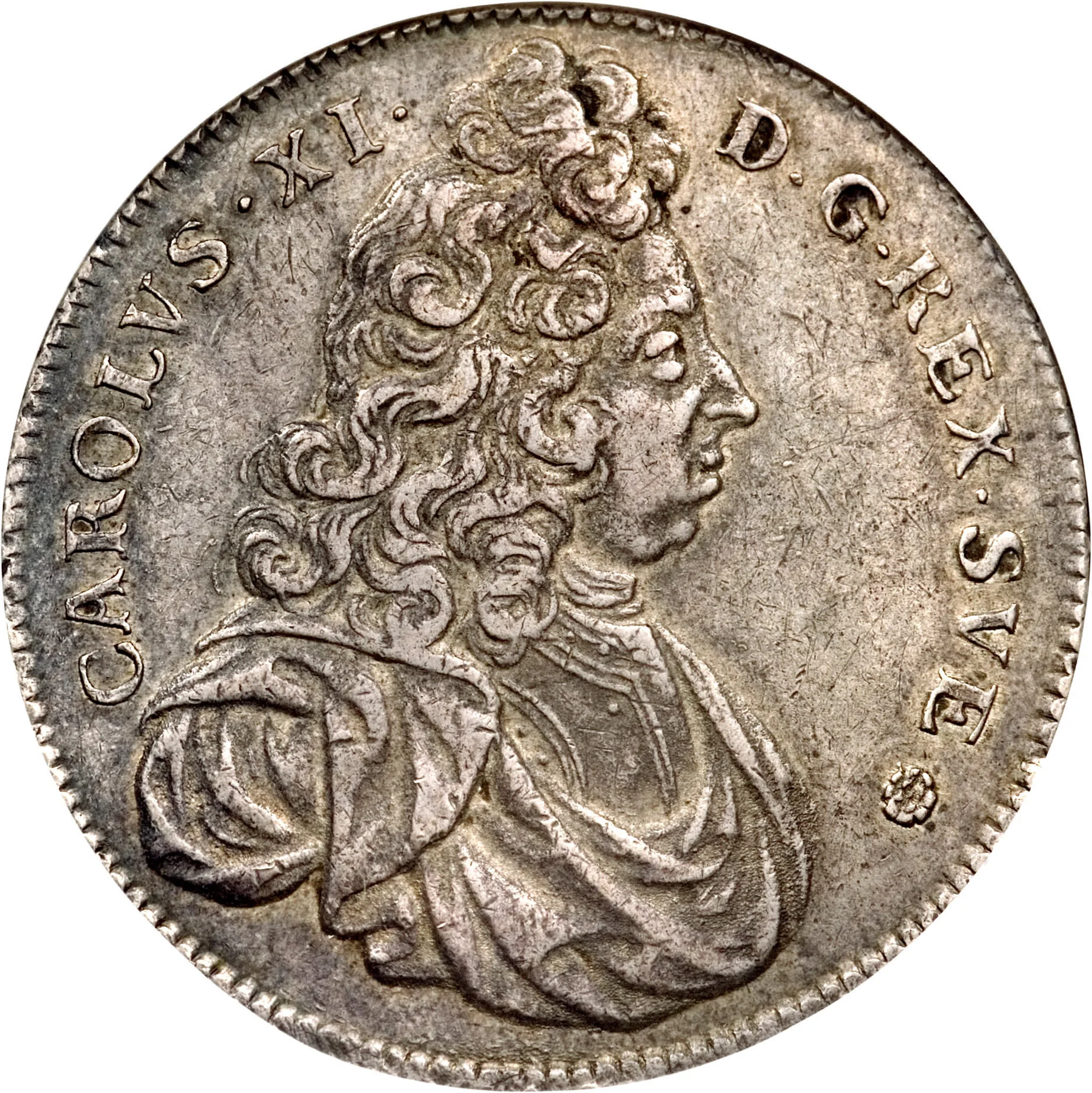
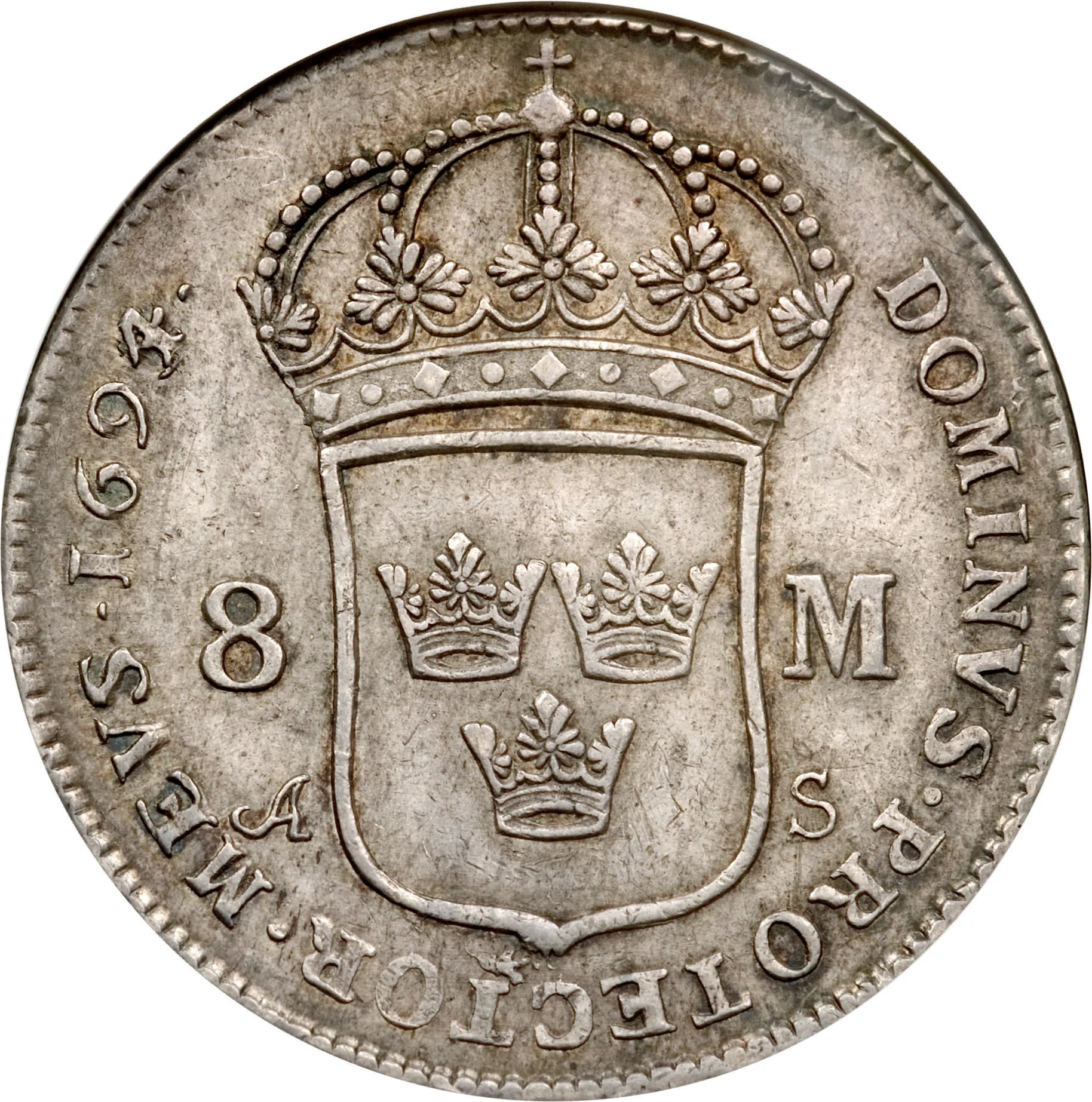
8 Mark – Sweden
Sweden
Context
Years: 1692–1696
Issuer: Sweden 
Ruler: Charles XI
Currency:
(1665—1715)
Demonetized: Yes
Total mintage: 185,542
Material
Diameter: 41.5 mm
Weight: 31.35 g
Silver weight: 28.90 g
Shape: Round
Composition: 92.2% Silver
Standard: Silver ounce
Magnetic: No
References
KM: #Click to copy to clipboard311
Numista: #37563
Value
Bullion value: $82.68
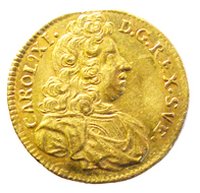
Obverse
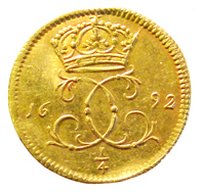
Reverse
Description:
Shield with three crowns divides value and mintmark. Legend around rim.
Inscription:
DOMINVS.PROTECTOR.MEVS.1694.
8 M
A S
8 M
A S
Script: Latin
Edge
Mintings
| Year | Mint Mark | Mintage | Quality | Collection |
|---|---|---|---|---|
| 1692 | AS | 50,507 | ||
| 1693 | AS | 52,176 | ||
| 1694 | AS | 50,682 | ||
| 1695 | AS | 23,747 | ||
| 1696 | AS | 8,430 |
Historical background
In 1692, Sweden was grappling with a severe monetary crisis rooted in decades of aggressive foreign policy and the costly ambitions of maintaining a great power status. The kingdom, under the absolutist rule of Charles XI, was still recovering from the financial exhaustion of multiple wars, most notably the Scanian War (1675–1679). To fund these conflicts, the state had heavily debased the copper currency, which alongside silver formed the basis of Sweden's unique dual-metallism system. This resulted in a chaotic circulation of coins with intrinsic metal values far below their face value, undermining public trust and causing rampant inflation.
The situation was exacerbated by the widespread use of klippmynt ("clipped coins"), emergency money physically cut from large copper plate money (plåtmynt) to represent smaller denominations during shortages. By 1692, the monetary system was fragmented and inefficient, with a vast disparity between the official value of coins and their market worth in precious metal. This instability hampered both domestic trade and international commerce, as foreign merchants were reluctant to accept Sweden's depreciated currency.
In response, Charles XI and his advisors were in the process of implementing sweeping reforms. The pivotal myntrealisationen (monetary realization) of 1681 had begun the process of recalling old debased coins and introducing a new, standardized silver-based currency. By 1692, this reform was ongoing, aiming to restore the crown's fiscal credibility and stabilize the economy by tying the currency's value directly to its silver content. Thus, the year represents a critical point of transition, caught between the lingering chaos of a broken system and the rigorous, state-driven effort to impose monetary order and solvency.
The situation was exacerbated by the widespread use of klippmynt ("clipped coins"), emergency money physically cut from large copper plate money (plåtmynt) to represent smaller denominations during shortages. By 1692, the monetary system was fragmented and inefficient, with a vast disparity between the official value of coins and their market worth in precious metal. This instability hampered both domestic trade and international commerce, as foreign merchants were reluctant to accept Sweden's depreciated currency.
In response, Charles XI and his advisors were in the process of implementing sweeping reforms. The pivotal myntrealisationen (monetary realization) of 1681 had begun the process of recalling old debased coins and introducing a new, standardized silver-based currency. By 1692, this reform was ongoing, aiming to restore the crown's fiscal credibility and stabilize the economy by tying the currency's value directly to its silver content. Thus, the year represents a critical point of transition, caught between the lingering chaos of a broken system and the rigorous, state-driven effort to impose monetary order and solvency.
✨ Legendary