

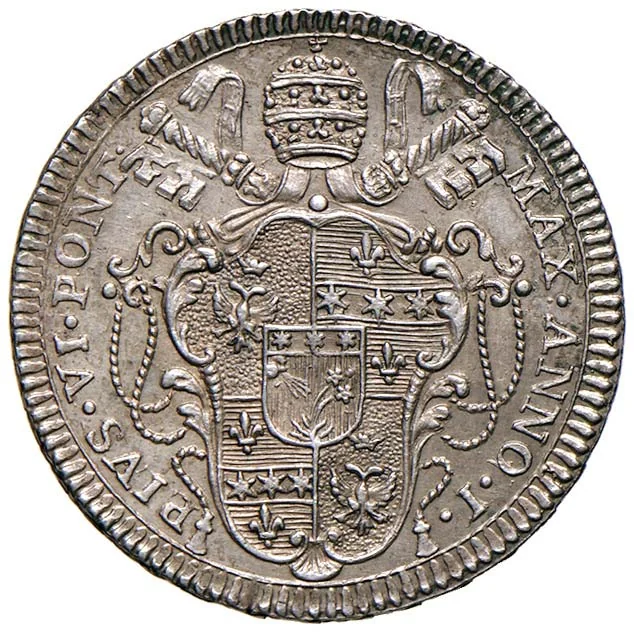
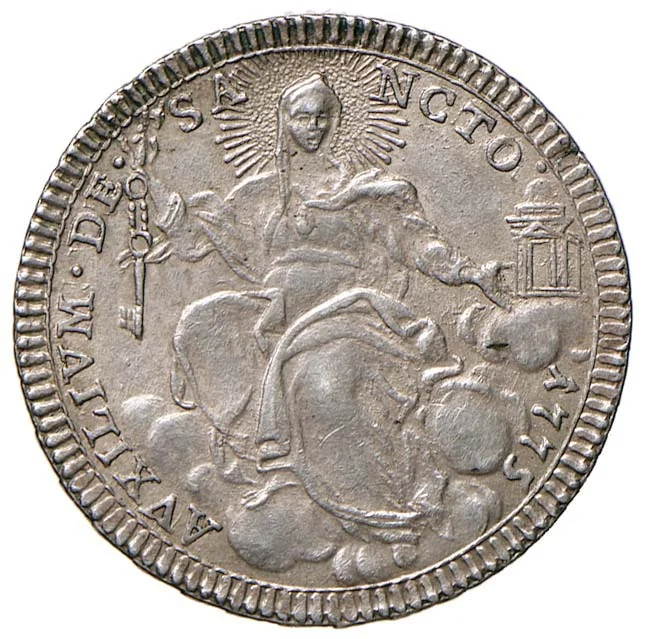
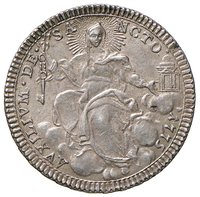
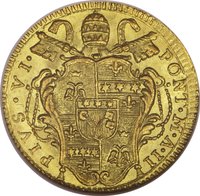
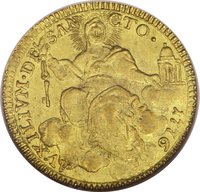
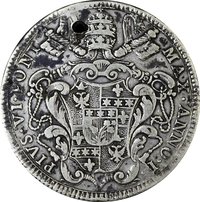
2 Giuli – Papal States
Vatican City
Context
Year: 1775
Country: Vatican City 
Issuer: Papal States
Ruler: Pius VI
Currency:
(1534—1835)
Demonetized: Yes
Material
References
KM: #Click to copy to clipboard1028
Numista: #377855
Value
Bullion value: $13.90
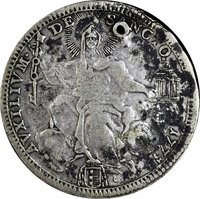
Obverse
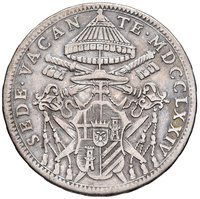
Reverse
Edge
Embossed leaves
Mints
| Name | Mark |
|---|---|
| Rome | — |
Mintings
| Year | Mint Mark | Mintage | Quality | Collection |
|---|---|---|---|---|
| 1775 | — | — |
Historical background
In 1775, the Papal States faced a complex and deteriorating currency situation, a legacy of chronic fiscal weakness and monetary fragmentation. The state’s finances were perpetually strained by a reliance on inefficient taxes, the costs of administering central Italy, and the loss of revenue from the decline of the public debt (Monte). To meet expenses, the Apostolic Chamber had long resorted to debasing the coinage, particularly the low-denomination baiocco and quattrino, which were essential for daily transactions. This practice led to a severe divergence between the official face value of coins and their intrinsic silver or copper content, creating a chaotic system of multiple, fluctuating valuations.
The monetary landscape was characterized by a confusing duality: a theoretical system of moneta di conto (money of account, like the scudo) used for bookkeeping and contracts, and the physical moneta effettiva (effective money) in circulation. The value of circulating coins was often set by proclamation, bearing little relation to their metal worth. Consequently, widespread hoarding of older, purer coins and the influx of foreign and counterfeit coins further destabilized the economy. This environment bred public mistrust, market inefficiencies, and hardship for the poor, whose wages and purchases relied on the increasingly worthless small coinage.
Pope Pius VI, who ascended to the papacy in 1775, inherited this crisis and would make monetary reform an early priority. His attempts, including a brief issuance of new, purer coins in 1776, ultimately failed to address the structural fiscal deficits. The reforms were undermined by the continued pressure to generate seigniorage revenue, leading to further debasement. Thus, the currency situation of 1775 was a symptomatic crisis of the ancien régime papal government, highlighting its administrative limitations and setting the stage for continued financial instability that would persist until the Napoleonic invasions.
The monetary landscape was characterized by a confusing duality: a theoretical system of moneta di conto (money of account, like the scudo) used for bookkeeping and contracts, and the physical moneta effettiva (effective money) in circulation. The value of circulating coins was often set by proclamation, bearing little relation to their metal worth. Consequently, widespread hoarding of older, purer coins and the influx of foreign and counterfeit coins further destabilized the economy. This environment bred public mistrust, market inefficiencies, and hardship for the poor, whose wages and purchases relied on the increasingly worthless small coinage.
Pope Pius VI, who ascended to the papacy in 1775, inherited this crisis and would make monetary reform an early priority. His attempts, including a brief issuance of new, purer coins in 1776, ultimately failed to address the structural fiscal deficits. The reforms were undermined by the continued pressure to generate seigniorage revenue, leading to further debasement. Thus, the currency situation of 1775 was a symptomatic crisis of the ancien régime papal government, highlighting its administrative limitations and setting the stage for continued financial instability that would persist until the Napoleonic invasions.
✨ Legendary