

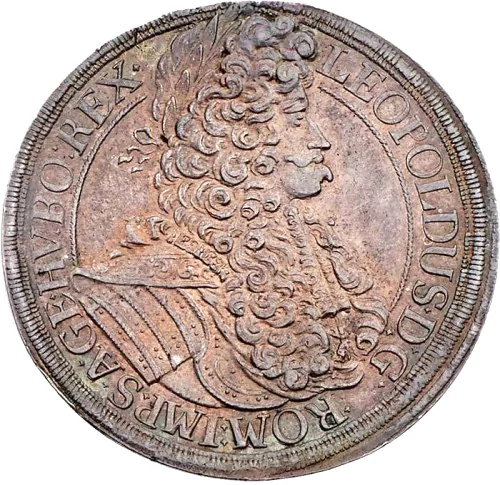
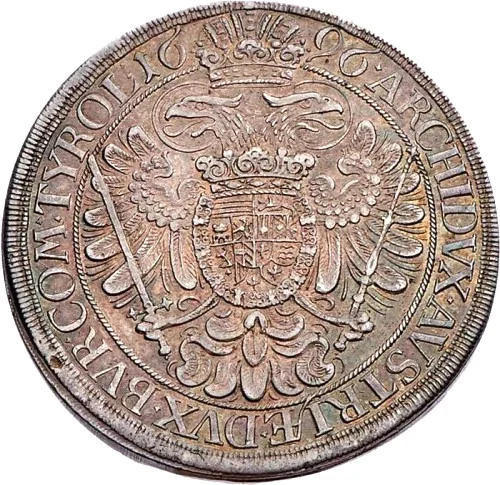
1 Thaler – Austrian Empire
Austria
Context
Years: 1696–1699
Country: Austria 
Issuer: Austrian Empire
Ruler: Leopold I
Currency:
(1520—1754)
Demonetized: Yes
Material
References
KM: #Click to copy to clipboard1275.5
Numista: #37473
Value
Bullion value: $81.78
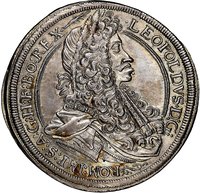
Obverse
Description:
Wider portrait than KM#1275.
Inscription:
LEOPOLDUS D G // ROM IMP S A GE HV BO REX
Script: Latin
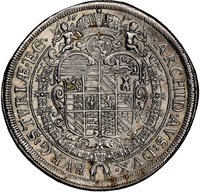
Reverse
Description:
Imperial double-headed eagle, holding a sword and scepter. Crown above date.
Inscription:
ARCHIDVX AVSTRIÆ DVX BVR COM TYROL 1696
Script: Latin
Edge
Mints
| Name | Mark |
|---|---|
| Münze Österreich | — |
Mintings
| Year | Mint Mark | Mintage | Quality | Collection |
|---|---|---|---|---|
| 1696 | — | — | ||
| 1698 | — | — | ||
| 1699 | — | — |
Historical background
In 1696, the currency situation within the Habsburg-ruled Austrian Empire was one of profound crisis and complexity, stemming directly from the immense financial strain of the ongoing Great Turkish War (1683-1699) and the parallel Nine Years' War (1688-1697). The imperial treasury, drained by decades of continuous conflict on multiple fronts, resorted to severe debasement of the coinage. The primary silver coin, the Reichsthaler, and its smaller denominations were systematically minted with reduced silver content, while copper coinage was issued in excessive quantities to fund military payrolls and state obligations. This led to a classic and severe inflation, where the face value of coins drastically outstripped their intrinsic metal worth, causing prices to soar and undermining both public trust and market stability.
The monetary landscape was further fragmented by the empire's decentralized political structure. While the Habsburg court in Vienna attempted to set standards, numerous constituent territories and even individual cities retained the right to mint their own coins. This resulted in a chaotic multitude of circulating currencies, including Kreuzers, Guldens, and Talers from various origins, each with fluctuating and often disputed exchange rates. The proliferation of debased "emergency coinage" (Kippermünze) from both official and opportunistic counterfeit mints exacerbated the turmoil, creating a bewildering and unreliable monetary environment for trade and taxation.
Consequently, the year 1696 represents a low point in the financial credibility of the Habsburg monarchy. Economic activity was hampered by the uncertainty, and the social contract was strained as soldiers and civilians alike were paid in increasingly worthless metal. This crisis set the stage for future, though initially unsuccessful, attempts at monetary reform under Emperor Leopold I. The dire situation underscored a central weakness of the empire: the tension between the centralized fiscal demands of warfare and the decentralized, feudal realities of its governance, a challenge that would persist for centuries.
The monetary landscape was further fragmented by the empire's decentralized political structure. While the Habsburg court in Vienna attempted to set standards, numerous constituent territories and even individual cities retained the right to mint their own coins. This resulted in a chaotic multitude of circulating currencies, including Kreuzers, Guldens, and Talers from various origins, each with fluctuating and often disputed exchange rates. The proliferation of debased "emergency coinage" (Kippermünze) from both official and opportunistic counterfeit mints exacerbated the turmoil, creating a bewildering and unreliable monetary environment for trade and taxation.
Consequently, the year 1696 represents a low point in the financial credibility of the Habsburg monarchy. Economic activity was hampered by the uncertainty, and the social contract was strained as soldiers and civilians alike were paid in increasingly worthless metal. This crisis set the stage for future, though initially unsuccessful, attempts at monetary reform under Emperor Leopold I. The dire situation underscored a central weakness of the empire: the tension between the centralized fiscal demands of warfare and the decentralized, feudal realities of its governance, a challenge that would persist for centuries.
✨ Legendary