

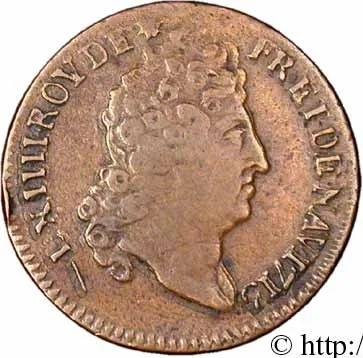
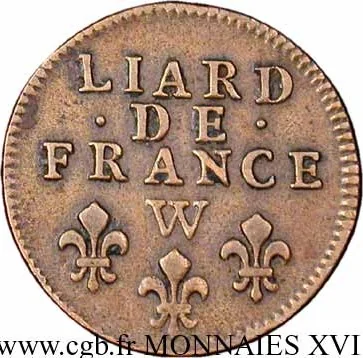

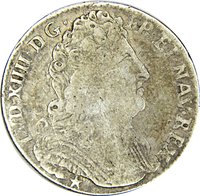
Obverse
Description:
Right-facing bust.
Inscription:
L. XIIII. ROY. DE. FR. ET. DE. NAV. 1715.
Script: Latin
Engraver: Joseph Roëttiers
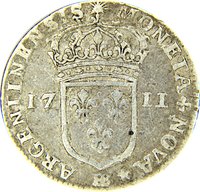
Reverse
Description:
Three fleurs-de-lis below a 3-line inscription.
Inscription:
LIARD
· DE ·
FRANCE
W
· DE ·
FRANCE
W
Script: Latin
Engraver: Joseph Roëttiers
Edge
Plain
Mints
| Name | Mark |
|---|---|
| Lille | W |
Historical background
In 1713, France’s currency was in a state of profound crisis, a direct legacy of King Louis XIV’s relentless wars, most notably the War of the Spanish Succession. To finance these conflicts, the royal government had resorted to a series of desperate financial manipulations, most damagingly the repeated debasement of the coinage. The Conseil des Finances would issue edicts recalling the kingdom's gold and silver coins, only to re-mint them with a higher face value but the same precious metal content, or sometimes with reduced metal. This practice, known as augmentation, artificially increased the nominal money supply but sparked rampant inflation, crippling trade and sowing public mistrust.
The situation was further destabilized by the actions of Finance Minister Michel Chamillart and his successor Nicolas Desmarets, who also resorted to creating and selling offices, borrowing at exorbitant rates, and issuing billets de monnaie—paper notes backed by future minting profits. These notes quickly depreciated, becoming nearly worthless. By 1713, the livre tournois (the accounting unit) had lost significant real value against metal, and a complex system of exchange rates existed between old, "strong" coins and new, debased ones, paralyzing commerce. The treasury was essentially bankrupt, with a staggering debt of approximately 2.8 billion livres.
The signing of the Treaty of Utrecht in 1713, ending the war, provided a political respite but no immediate monetary solution. The urgent task for the regency government that would follow Louis XIV's death in 1715 was to restore fiscal and monetary order. This dire financial landscape set the stage for the radical and disastrous experiments of the Scottish economist John Law in the subsequent Regency period, as France sought a dramatic escape from the monetary chaos inherited from the Sun King's final years.
The situation was further destabilized by the actions of Finance Minister Michel Chamillart and his successor Nicolas Desmarets, who also resorted to creating and selling offices, borrowing at exorbitant rates, and issuing billets de monnaie—paper notes backed by future minting profits. These notes quickly depreciated, becoming nearly worthless. By 1713, the livre tournois (the accounting unit) had lost significant real value against metal, and a complex system of exchange rates existed between old, "strong" coins and new, debased ones, paralyzing commerce. The treasury was essentially bankrupt, with a staggering debt of approximately 2.8 billion livres.
The signing of the Treaty of Utrecht in 1713, ending the war, provided a political respite but no immediate monetary solution. The urgent task for the regency government that would follow Louis XIV's death in 1715 was to restore fiscal and monetary order. This dire financial landscape set the stage for the radical and disastrous experiments of the Scottish economist John Law in the subsequent Regency period, as France sought a dramatic escape from the monetary chaos inherited from the Sun King's final years.
💎 Very Rare