

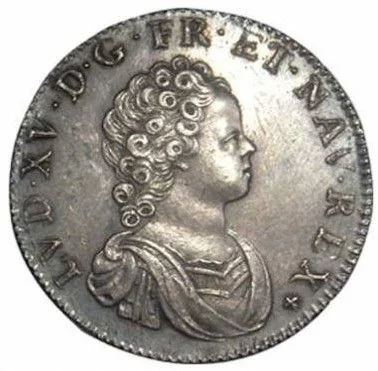
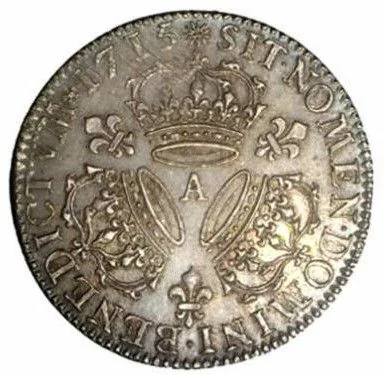
¼ silver ecu – France
Add to wishlist
France
Context
Material
Weight: 7.65 g
Silver Weight:: 7.02 g
Shape: Round
Composition: 91.7% Silver
Standard: Silver quarter ounce
Magnetic: No
Technique: Milled
References
KM: #
Numista: #360469
Value
Bullion value: $17.86
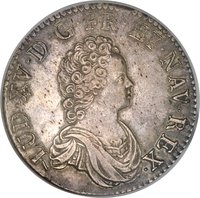
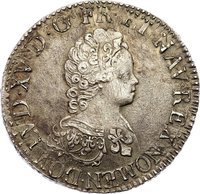
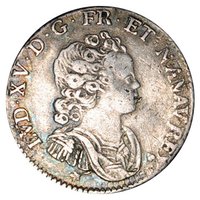
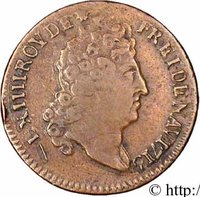
Obverse
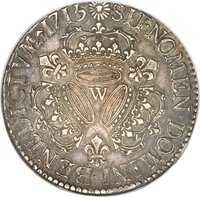
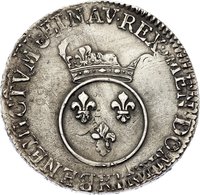
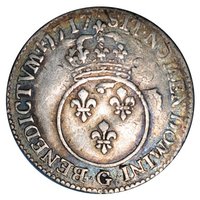
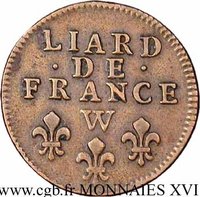
Reverse
Description:
Three crowns triangle mintmark, fleurs-de-lis in angles.
Inscription:
SIT.NOMEN.DOMINI.BENEDICTVM 1715
Script: Latin
Edge
Corded.
Mints
| Name | Mark |
|---|---|
| Aix-en-Provence | & |
| Monnaie de Paris | A |
Historical background
In 1715, France stood on the precipice of a profound monetary crisis, a direct legacy of the extravagant wars and spending of Louis XIV. The Sun King’s final years had left the treasury effectively bankrupt, with a staggering national debt estimated at between 2.4 and 3 billion livres. The state’s credit was exhausted, and much of its anticipated revenue for years ahead had already been spent in advance through the sale of offices and annuities (rentes). This fiscal abyss created an urgent and desperate need for financial restructuring as the king died and the regency for the five-year-old Louis XV began.
The currency itself was in a state of dangerous instability due to repeated manipulations. To generate short-term cash, the government had engaged in frequent augmentations (raising the official face value of coins) and diminutions (lowering it), as well as recoinages. This practice, known as "crying up" or "crying down" the coinage, created widespread confusion, eroded public trust in money, and disrupted commerce. Merchants and the populace were deeply suspicious of the coin in their hands, never certain of its future official worth, which fostered hoarding and economic paralysis.
Consequently, the primary financial challenge facing the Regent, Philippe d’Orléans, was twofold: to manage the crushing sovereign debt and to restore confidence in the monetary system itself. The immediate response would famously involve the radical schemes of Scottish economist John Law, whose System would soon attempt to solve both problems by replacing metallic currency with paper banknotes and consolidating debt into shares of the Mississippi Company. Thus, the currency situation of 1715 set the stage for one of history’s most dramatic experiments in financial engineering and its subsequent, spectacular collapse.
The currency itself was in a state of dangerous instability due to repeated manipulations. To generate short-term cash, the government had engaged in frequent augmentations (raising the official face value of coins) and diminutions (lowering it), as well as recoinages. This practice, known as "crying up" or "crying down" the coinage, created widespread confusion, eroded public trust in money, and disrupted commerce. Merchants and the populace were deeply suspicious of the coin in their hands, never certain of its future official worth, which fostered hoarding and economic paralysis.
Consequently, the primary financial challenge facing the Regent, Philippe d’Orléans, was twofold: to manage the crushing sovereign debt and to restore confidence in the monetary system itself. The immediate response would famously involve the radical schemes of Scottish economist John Law, whose System would soon attempt to solve both problems by replacing metallic currency with paper banknotes and consolidating debt into shares of the Mississippi Company. Thus, the currency situation of 1715 set the stage for one of history’s most dramatic experiments in financial engineering and its subsequent, spectacular collapse.
Series: 1715 France circulation coins
✨ Legendary