

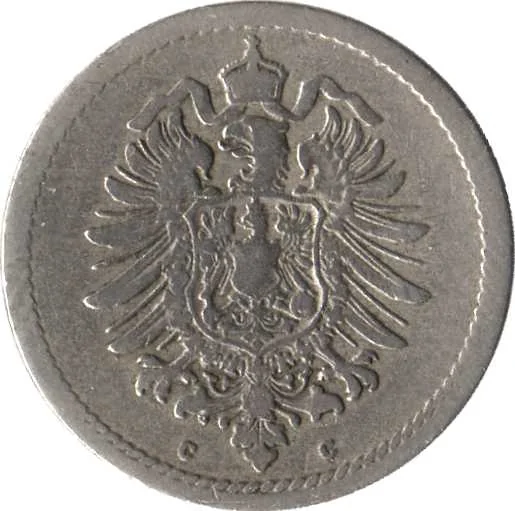
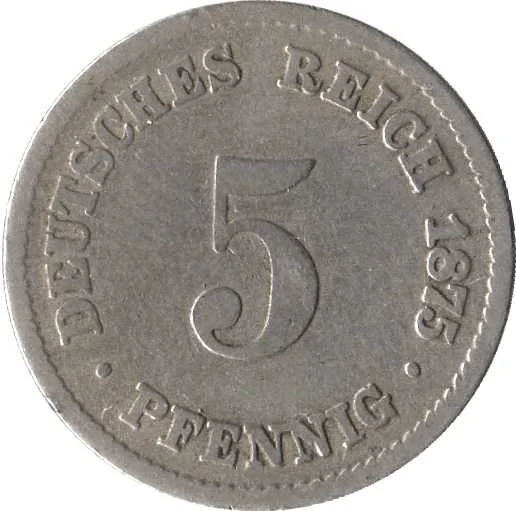
5 Pfennigs – Germany
Germany

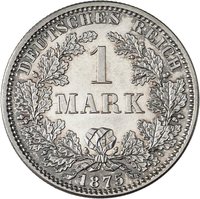
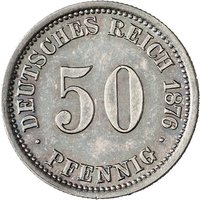
Obverse
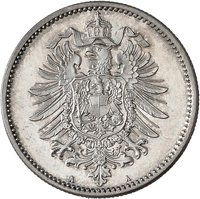
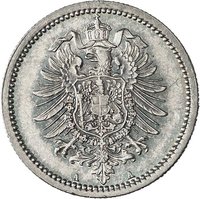
Reverse
Edge
Plain
Mints
| Name | Mark |
|---|---|
| Berlin | A |
| Hanover | B |
| Frankfurt am Main | C |
| Munich | D |
| Muldenhütten | E |
| Staatliche Münze Baden-Württemberg | F |
| Staatliche Münze Baden-Württemberg | G |
| Darmstadt | H |
| Hamburgische Münze | J |
Mintings
| Year | Mint Mark | Mintage | Quality | Collection |
|---|---|---|---|---|
| 1874 | A | 10,002,784 | ||
| 1874 | B | 5,053,546 | ||
| 1874 | C | 3,707,307 | ||
| 1874 | D | 2,446,704 | ||
| 1874 | E | 5,465,183 | ||
| 1874 | F | 3,561,996 | ||
| 1874 | G | 2,721,200 | ||
| 1875 | C | 18,082,108 | ||
| 1875 | D | 12,379,786 | ||
| 1875 | E | 6,745,038 | ||
| 1875 | F | 9,757,616 | ||
| 1875 | G | 10,219,581 | ||
| 1875 | H | 702,960 | ||
| 1875 | A | 30,843,718 | ||
| 1875 | B | 11,657,720 | ||
| 1875 | J | 9,780,610 | ||
| 1876 | E | 6,898,569 | ||
| 1876 | F | 6,826,290 | ||
| 1876 | G | 6,942,400 | ||
| 1876 | H | 3,026,784 | ||
| 1876 | D | 14,467,300 | ||
| 1876 | J | 11,920,232 | ||
| 1876 | A | 22,342,088 | ||
| 1876 | B | 8,924,980 | ||
| 1876 | C | 8,679,793 | ||
| 1888 | A | 7,366,059 | ||
| 1888 | D | 1,966,613 | ||
| 1888 | E | 1,016,064 | ||
| 1888 | F | 1,412,182 | ||
| 1888 | G | 853,413 | ||
| 1888 | J | 1,129,613 | ||
| 1889 | A | 10,803,727 | ||
| 1889 | D | 2,816,310 | ||
| 1889 | E | 1,491,926 | ||
| 1889 | F | 2,010,214 | ||
| 1889 | G | 1,220,829 | ||
| 1889 | J | 1,635,778 |
Historical background
By 1874, Germany was in the midst of a profound monetary transformation, transitioning from a fragmented system of multiple regional currencies to a unified national one. The driving force was the political unification of the German Empire in 1871, which necessitated economic integration. Prior to this, over seven different thalers, gulden, and other local coins circulated, creating complexity for trade and administration. The new Reich government, empowered by the war indemnity from France, moved decisively to establish a single, stable currency as a cornerstone of national unity and economic strength.
The legal foundation was the Mint Law of December 1871, which introduced the Goldmark as the Empire's sole currency, defined as 0.358423 grams of fine gold. This was followed by the Coinage Act of July 1873, which came into full effect, demonetizing the old silver-based thalers and establishing a gold standard. The year 1874 was thus a critical implementation phase, marked by the mass minting of new gold 10 and 20 Mark coins and the logistical challenge of withdrawing old silver currencies. The Reichsbank, founded in 1875, was being planned to centralize note issuance and manage this new system.
This shift was not merely technical; it represented a strategic alignment with the gold-standard-based international financial system, dominated by Great Britain, to facilitate German industrial expansion and global trade. However, the transition caused some short-term disruption and deflationary pressure, as the supply of the new gold-backed money was initially tight. Furthermore, the demonetization of silver contributed to a fall in global silver prices, impacting nations still on silver standards. By the end of 1874, Germany was firmly on the path to becoming a modern monetary state, with the Goldmark symbolizing its emergence as a major economic power.
The legal foundation was the Mint Law of December 1871, which introduced the Goldmark as the Empire's sole currency, defined as 0.358423 grams of fine gold. This was followed by the Coinage Act of July 1873, which came into full effect, demonetizing the old silver-based thalers and establishing a gold standard. The year 1874 was thus a critical implementation phase, marked by the mass minting of new gold 10 and 20 Mark coins and the logistical challenge of withdrawing old silver currencies. The Reichsbank, founded in 1875, was being planned to centralize note issuance and manage this new system.
This shift was not merely technical; it represented a strategic alignment with the gold-standard-based international financial system, dominated by Great Britain, to facilitate German industrial expansion and global trade. However, the transition caused some short-term disruption and deflationary pressure, as the supply of the new gold-backed money was initially tight. Furthermore, the demonetization of silver contributed to a fall in global silver prices, impacting nations still on silver standards. By the end of 1874, Germany was firmly on the path to becoming a modern monetary state, with the Goldmark symbolizing its emergence as a major economic power.
🌱 Very Common