

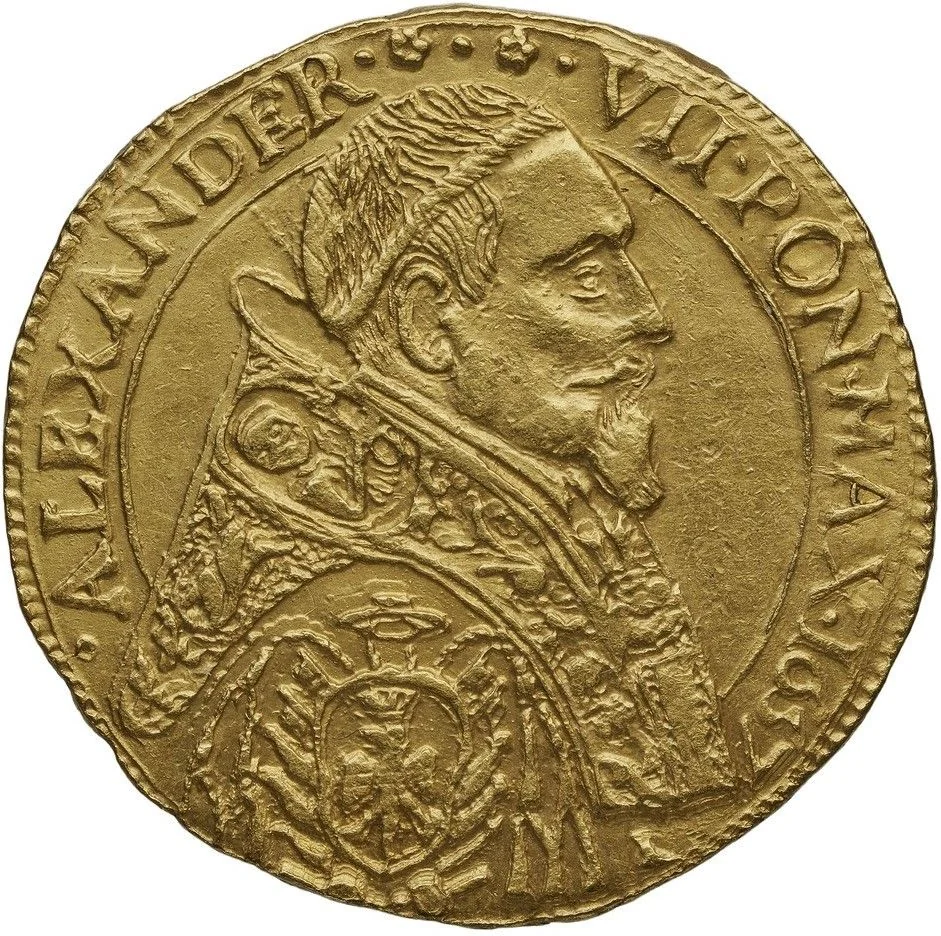
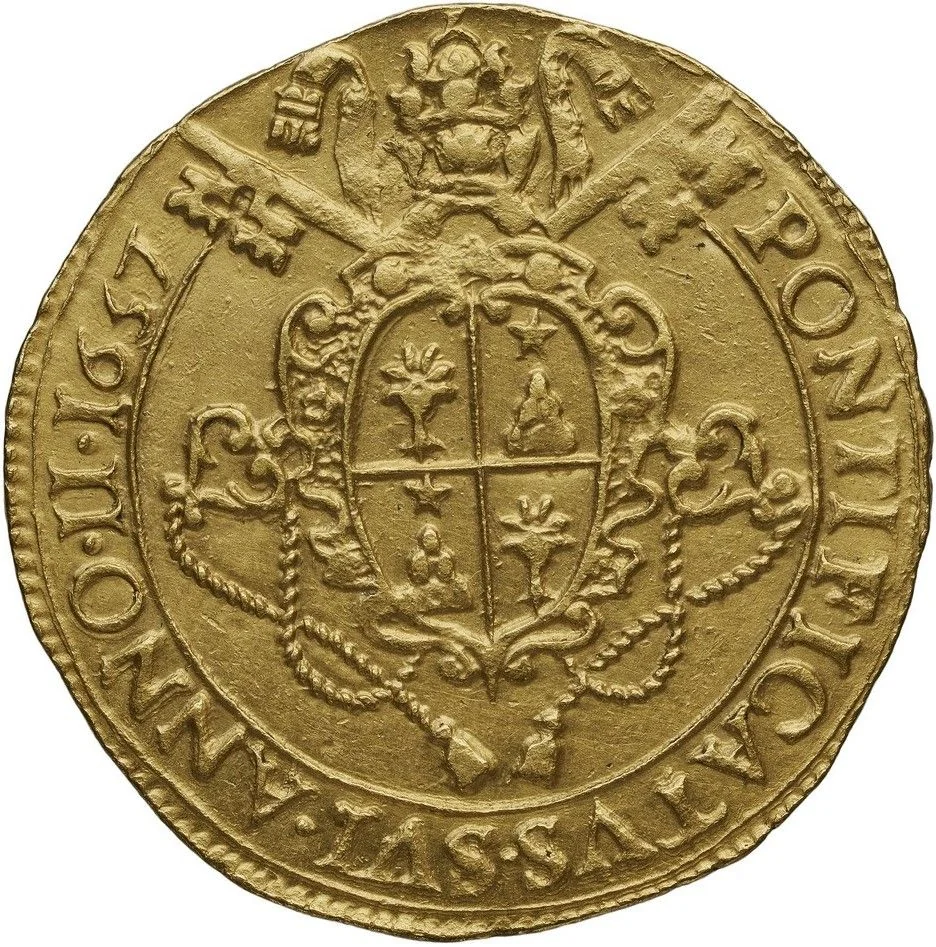
4 Gold Ecus – Comtat Venaissin
Vatican City
Context
Years: 1657–1658
Country: Vatican City 
Issuer: Comtat Venaissin
Ruler: Alexander VII
Currency:
Demonetized: Yes
References
KM: #Click to copy to clipboard89
Numista: #366780
Value
Bullion value: $2301.01
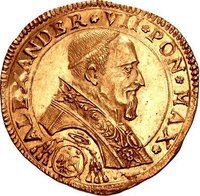
Obverse
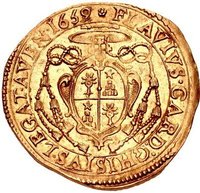
Reverse
Edge
Categories
| Symbols> Coat of Arms |
Mints
| Name | Mark |
|---|---|
| Avignon | — |
Mintings
| Year | Mint Mark | Mintage | Quality | Collection |
|---|---|---|---|---|
| 1657 | — | — | ||
| 1658 | — | — |
Historical background
In 1657, the currency situation in the Comtat Venaissin, a Papal territory enclaved within France, was characterized by a complex and often chaotic multiplicity of circulating coins. As a major commercial crossroads, the region saw a constant influx of currency from neighboring France, the Italian states, Spain, and other trading partners. This resulted in a monetary environment where papal scudi and giuli circulated alongside French livres, écus, and Spanish reales, each with fluctuating values and metal contents. Local authorities, under the Papal Legate in Avignon, struggled to maintain order by periodically issuing official exchange rates (tarifs) to fix the value of these foreign coins against the local standard.
The primary challenge was the frequent debasement and clipping of coins, particularly from France, which destabilized trade and public trust. Merchants and money-changers exploited the discrepancies, leading to Gresham’s Law in practice: bad, debased money drove out the good, full-weight coinage, which was often hoarded or exported. This inflationary pressure created significant economic tension, especially for the poor and for fixed-wage workers. The Papal administration's reactive tarifs often lagged behind market realities, creating a gap between official and street exchange rates that further fueled speculation and uncertainty.
Ultimately, the monetary disarray of 1657 was a direct reflection of the Comtat Venaissin’s political and geographic position. Its sovereignty under the Pope placed it outside the French royal monetary reforms, yet its economy was inextricably tied to the Kingdom of France. This created a dysfunctional hybrid system where local authority was insufficient to control a monetary sphere dominated by external forces. The situation would persist until the annexation of the Comtat by revolutionary France in 1791, which finally brought it into a single, unified currency zone.
The primary challenge was the frequent debasement and clipping of coins, particularly from France, which destabilized trade and public trust. Merchants and money-changers exploited the discrepancies, leading to Gresham’s Law in practice: bad, debased money drove out the good, full-weight coinage, which was often hoarded or exported. This inflationary pressure created significant economic tension, especially for the poor and for fixed-wage workers. The Papal administration's reactive tarifs often lagged behind market realities, creating a gap between official and street exchange rates that further fueled speculation and uncertainty.
Ultimately, the monetary disarray of 1657 was a direct reflection of the Comtat Venaissin’s political and geographic position. Its sovereignty under the Pope placed it outside the French royal monetary reforms, yet its economy was inextricably tied to the Kingdom of France. This created a dysfunctional hybrid system where local authority was insufficient to control a monetary sphere dominated by external forces. The situation would persist until the annexation of the Comtat by revolutionary France in 1791, which finally brought it into a single, unified currency zone.
✨ Legendary