

4 Gold Ecus – Comtat Venaissin
Vatican City
Context
Years: 1658–1662
Country: Vatican City 
Issuer: Comtat Venaissin
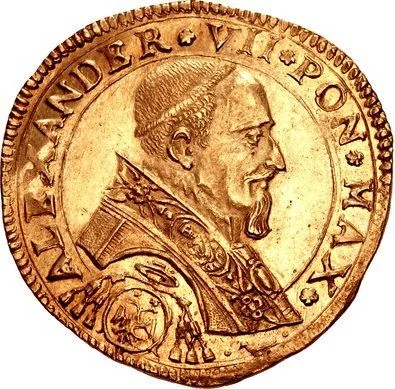
Ruler: Alexander VII
Currency:
Demonetized: Yes
Material
References
KM: #Click to copy to clipboard90
Numista: #365507
Value
Bullion value: $2301.01
Obverse
Reverse
Description:
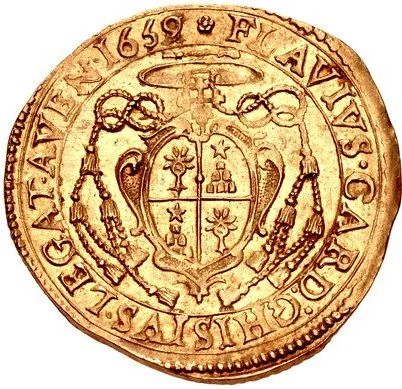
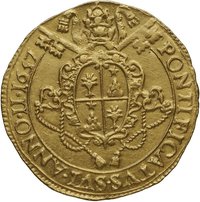
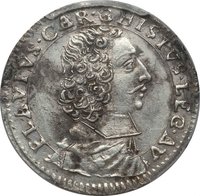
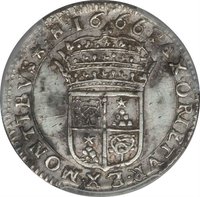
Arms of papal legate Fabio Chigi.
Inscription:
FLAVIVS · CARD : GHISIVS · LEGAT · AVEN · I659
Script: Latin
Edge
Mints
| Name | Mark |
|---|---|
| Avignon | — |
Mintings
| Year | Mint Mark | Mintage | Quality | Collection |
|---|---|---|---|---|
| 1658 | — | — | ||
| 1659 | — | — | ||
| 1662 | — | — |
Historical background
In 1658, the Comtat Venaissin (the region around Avignon) operated under a unique and complex monetary system, a direct consequence of its political status. As a Papal territory enclaved within the Kingdom of France, it was not subject to French royal monetary edicts. Instead, its currency was governed by the Papal legate in Avignon, creating a distinct monetary zone where various coins circulated simultaneously. The primary official unit of account was the écu papal (papal crown), but in daily practice, a multitude of physical coins from neighboring states—including French livres, sous, and deniers, as well as Spanish reales and Italian scudi—were used in commerce, their values fixed by periodic papal ordinance.
This proliferation of foreign coinage, particularly from France, was a source of both necessity and constant difficulty. The Comtat's economy was deeply intertwined with that of Provence and the broader French kingdom, making French currency ubiquitous. However, the fluctuating intrinsic value of these coins (based on their silver content) against the official papal rates led to frequent arbitrage, confusion, and localized inflation. The papal authorities regularly issued tarifs (official exchange lists) to stabilize the situation, but these were often reactive and struggled to keep pace with market realities and the monetary manipulations of neighboring sovereigns.
Thus, the currency situation in 1658 was characterized by administrative duality and practical disorder. While the Papacy asserted its sovereign right to mint and regulate money, economic gravity pulled the enclave into the French monetary orbit. This tension created a fragile environment where the value of money was less stable than in larger kingdoms, complicating trade and taxation. The system functioned, but it was inherently vulnerable to the monetary policies of France, highlighting the Comtat's precarious position as a small papal state surviving within the sphere of a major European power.
This proliferation of foreign coinage, particularly from France, was a source of both necessity and constant difficulty. The Comtat's economy was deeply intertwined with that of Provence and the broader French kingdom, making French currency ubiquitous. However, the fluctuating intrinsic value of these coins (based on their silver content) against the official papal rates led to frequent arbitrage, confusion, and localized inflation. The papal authorities regularly issued tarifs (official exchange lists) to stabilize the situation, but these were often reactive and struggled to keep pace with market realities and the monetary manipulations of neighboring sovereigns.
Thus, the currency situation in 1658 was characterized by administrative duality and practical disorder. While the Papacy asserted its sovereign right to mint and regulate money, economic gravity pulled the enclave into the French monetary orbit. This tension created a fragile environment where the value of money was less stable than in larger kingdoms, complicating trade and taxation. The system functioned, but it was inherently vulnerable to the monetary policies of France, highlighting the Comtat's precarious position as a small papal state surviving within the sphere of a major European power.
✨ Legendary