

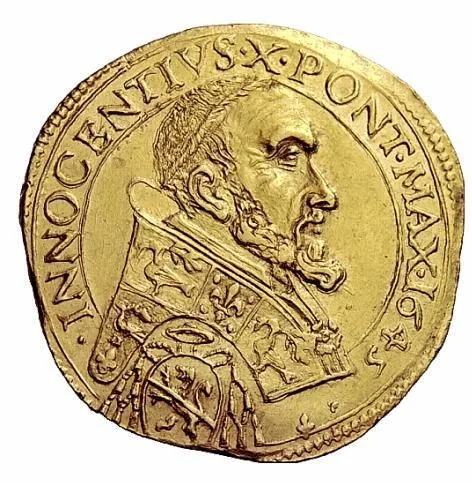
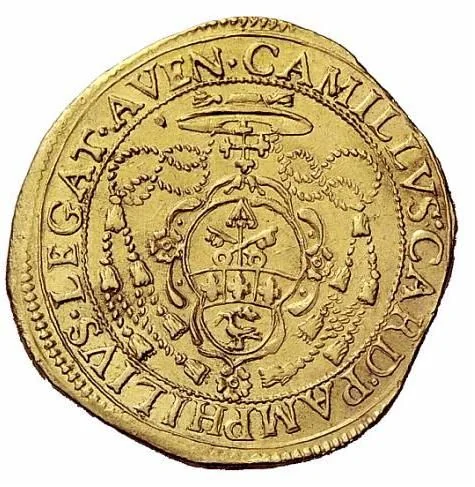
4 gold ecus – Comtat Venaissin
Add to wishlist
Vatican City
Context
Year: 1645
Country: Vatican City
Issuer: Comtat Venaissin
Ruler: Innocent X
Currency:
Demonetized: Yes
References
KM: #
Numista: #365897
Value
Bullion value: $1990.83
Obverse
Description:
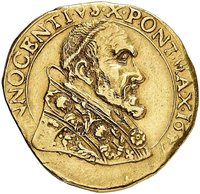
Innocent X bust with papal arms, date in legend.
Inscription:
INNOCENTIVS • X • PONT • MAX • 1645
Script: Latin
Reverse
Description:
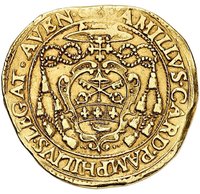
Arms of papal legate Camillo Pamphili.
Inscription:
CAMILLVS • CARD • PAMPHILIVS • LEGAT • AVEN •
Script: Latin
Edge
Categories
| Symbols> Coat of Arms |
Mints
| Name | Mark |
|---|---|
| Avignon | — |
Mintings
| Year | Mint Mark | Mintage | Quality | Collection |
|---|---|---|---|---|
| 1645 | — | — |
Historical background
In 1645, the currency situation in the Comtat Venaissin, a Papal territory enclaved within the Kingdom of France, was defined by monetary duality and external pressure. Officially, the Comtat operated on a monetary standard tied to the Papal écu and its subdivisions (liards, sols), which were minted in the capital, Avignon. However, due to its geographic and economic integration with surrounding French provinces, especially Provence and Dauphiné, French coinage—particularly the louis d'or, écus d'argent, and various copper deniers—circulated widely and was essential for daily commerce. This created a complex bimetallic system where exchange rates between the two monetary realms were fluid and often a source of dispute.
The period was marked by significant instability, largely imported from France, which was in the throes of the Fronde rebellions (beginning in 1648) and severe fiscal crisis. French royal edicts frequently altered the nominal value of French coinage to raise state revenue, a practice known as augmentation. Each devaluation or revaluation in France caused immediate disruption in the Comtat, as the value of the ubiquitous French coins in local markets would shift abruptly. This led to price inflation, confusion in trade contracts, and a tendency for older, full-weight coins to be hoarded or exported, leaving a poorer circulating medium.
Local authorities, under the Papal Legate, struggled to manage this turbulence through periodic tarifs—official ordinances that fixed the acceptable exchange rates for the plethora of foreign and domestic coins. These decrees, however, were often reactive and difficult to enforce, as economic reality was dictated by the powerful market forces of neighboring France. Thus, in 1645, the Comtat Venaissin’s currency system was inherently unstable, caught between its formal papal allegiance and the inescapable gravitational pull of the French monetary and political crisis.
The period was marked by significant instability, largely imported from France, which was in the throes of the Fronde rebellions (beginning in 1648) and severe fiscal crisis. French royal edicts frequently altered the nominal value of French coinage to raise state revenue, a practice known as augmentation. Each devaluation or revaluation in France caused immediate disruption in the Comtat, as the value of the ubiquitous French coins in local markets would shift abruptly. This led to price inflation, confusion in trade contracts, and a tendency for older, full-weight coins to be hoarded or exported, leaving a poorer circulating medium.
Local authorities, under the Papal Legate, struggled to manage this turbulence through periodic tarifs—official ordinances that fixed the acceptable exchange rates for the plethora of foreign and domestic coins. These decrees, however, were often reactive and difficult to enforce, as economic reality was dictated by the powerful market forces of neighboring France. Thus, in 1645, the Comtat Venaissin’s currency system was inherently unstable, caught between its formal papal allegiance and the inescapable gravitational pull of the French monetary and political crisis.
✨ Legendary