

1 Quattrino – Ferrara
Italy
Context

Material
Diameter: 21 mm
Weight: 2.8 g
Shape: Irregular round
Composition: Copper
Magnetic: No
Technique: Hammered
References
KM: #Click to copy to clipboard60
Numista: #364017
Obverse
Description:
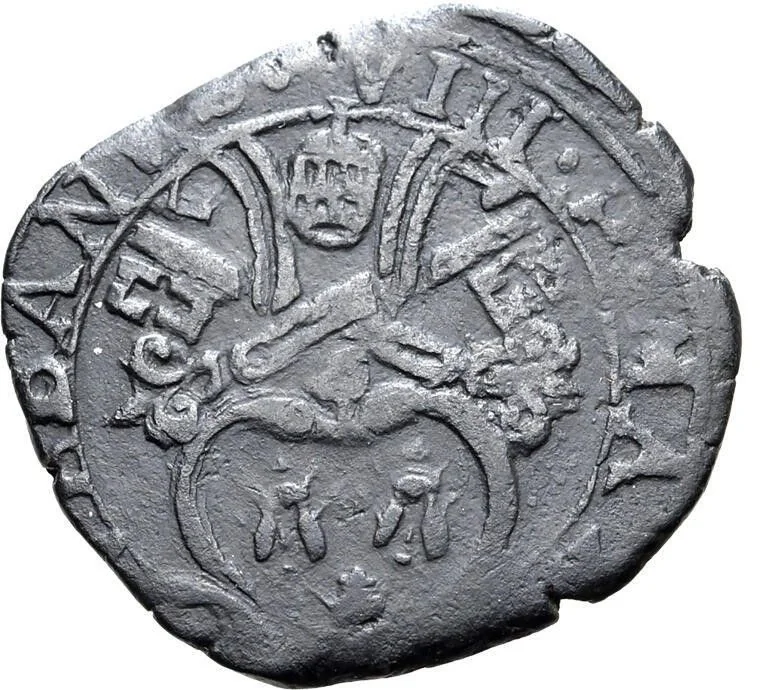
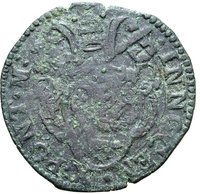
Barberini arms with Papal tiara and crossed keys.
Inscription:
✿ VRBANVS ⠂VIII ⠂P ⠂MAX
Script: Latin
Reverse
Description:
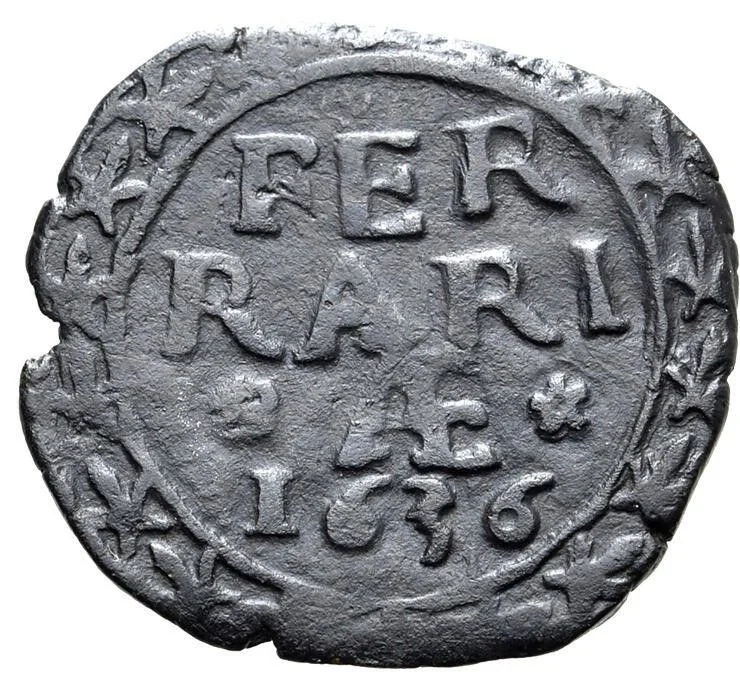
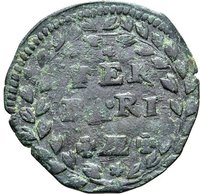
Three-line inscription, date below, within beaded wreath.
Inscription:
FER
RARI
Æ
1636
RARI
Æ
1636
Script: Latin
Edge
Mints
| Name | Mark |
|---|---|
| Ferrara | — |
Mintings
| Year | Mint Mark | Mintage | Quality | Collection |
|---|---|---|---|---|
| 1636 | — | — |
Historical background
In 1636, the Duchy of Ferrara was navigating a complex monetary landscape under the rule of the Papal States, having been formally annexed by Pope Clement VIII in 1598. The city no longer minted its own sovereign currency, but its economy operated within a fragmented Italian and international context where multiple coinages circulated simultaneously. The primary unit of account was the Papal scudo, a large silver coin, but daily transactions were heavily reliant on a bewildering array of physical coins: local papal issues, older Ferrarese and Estense coins from before the annexation, silver giuli and grossi, and low-denomination copper baiocchi and quattrini. Furthermore, Spanish silver reales and gold coins from Venice, Florence, and beyond were present for larger commercial dealings, creating a constant challenge of valuation and exchange.
This multiplicity led to significant practical problems. The intrinsic metal value of a coin often differed from its official face value, leading to frequent clipping, counterfeiting, and the hoarding of "good" high-silver coins (Gresham's Law in action). Money changers (banchieri) held essential positions in the marketplace, setting daily exchange rates between these myriad currencies and charging fees for their conversion. For the average artisan or labourer in Ferrara, this meant wages and small purchases were negotiated in a fog of unstable values, where the purchasing power of a handful of copper coins could fluctuate based on distant bullion markets and papal monetary decrees.
The broader economic context exacerbated these difficulties. The 1630s were a period of hardship across Italy, marked by the devastating plague of 1630-31, which had sharply reduced Ferrara's population and disrupted its agrarian economy. Papal fiscal demands were high to fund military engagements in the Thirty Years' War, increasing local tax burdens. Consequently, the currency confusion intersected with broader inflationary pressures and scarcity. Thus, in 1636, Ferrara's currency situation was not merely one of numismatic variety but a source of daily economic insecurity, reflecting the city's diminished political autonomy and the wider European crises of the seventeenth century.
This multiplicity led to significant practical problems. The intrinsic metal value of a coin often differed from its official face value, leading to frequent clipping, counterfeiting, and the hoarding of "good" high-silver coins (Gresham's Law in action). Money changers (banchieri) held essential positions in the marketplace, setting daily exchange rates between these myriad currencies and charging fees for their conversion. For the average artisan or labourer in Ferrara, this meant wages and small purchases were negotiated in a fog of unstable values, where the purchasing power of a handful of copper coins could fluctuate based on distant bullion markets and papal monetary decrees.
The broader economic context exacerbated these difficulties. The 1630s were a period of hardship across Italy, marked by the devastating plague of 1630-31, which had sharply reduced Ferrara's population and disrupted its agrarian economy. Papal fiscal demands were high to fund military engagements in the Thirty Years' War, increasing local tax burdens. Consequently, the currency confusion intersected with broader inflationary pressures and scarcity. Thus, in 1636, Ferrara's currency situation was not merely one of numismatic variety but a source of daily economic insecurity, reflecting the city's diminished political autonomy and the wider European crises of the seventeenth century.
✨ Legendary