

1 Piastra – Ferrara
Italy
Context
Material
Diameter: 44 mm
Weight: 31.43 g
Silver weight: 31.43 g
Shape: Round
Composition: Silver
Standard: Silver ounce
Magnetic: No
References
KM: #Click to copy to clipboard54
Numista: #295071
Value
Bullion value: $91.17
Obverse
Description:
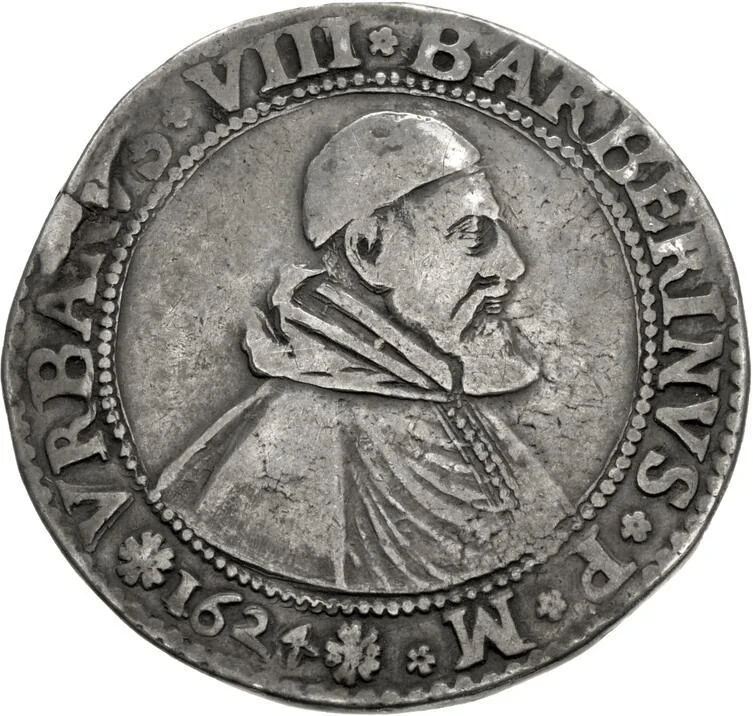
Urban VIII, bust right, capped.
Inscription:
BARBERINVS P M VRBANVS VIII
1624
1624
Script: Latin
Reverse
Description:
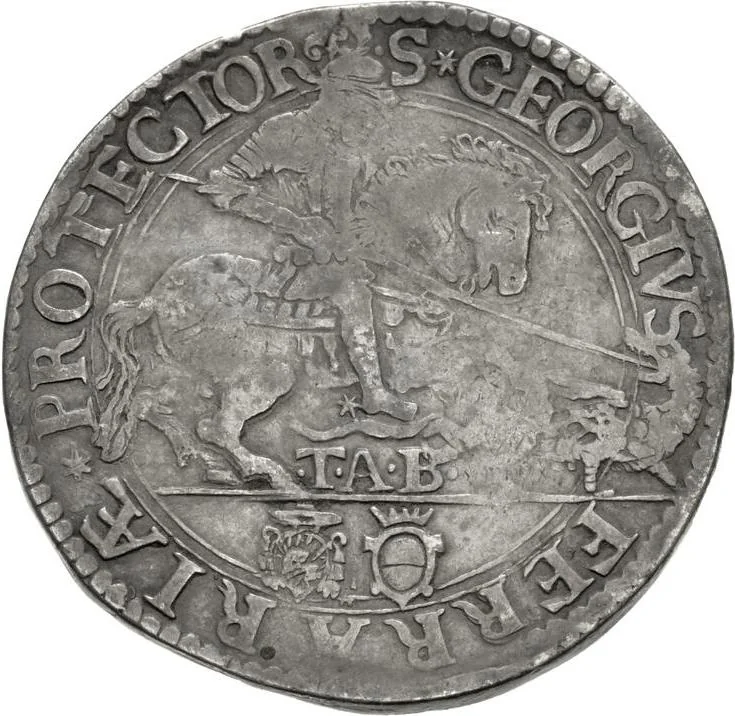
St. George right on horseback, slaying dragon; two coats-of-arms below.
Inscription:
S GEORGIVS FERRARIÆ PROPTECTOR
T A B
T A B
Script: Latin
Edge
Mintings
| Year | Mint Mark | Mintage | Quality | Collection |
|---|---|---|---|---|
| 1624 | TAB | — |
Historical background
In 1624, the currency situation in the Duchy of Ferrara was one of instability and transition, deeply influenced by its political status. Since the death of the last Este duke, Alfonso II, in 1597, Ferrara had been incorporated directly into the Papal States after Pope Clement VIII refused to recognize the illegitimate heir, Cesare d'Este. By 1624, the city had been under direct papal administration for nearly three decades, which meant its monetary system was increasingly integrated with and subordinate to that of the broader Papal States, centered in Rome. Local Ferrarese minting had significantly declined, and the circulating medium became a complex mixture of foreign and papal coins.
The practical economy in Ferrara's markets was characterized by a proliferation of various coins, creating chronic problems. Alongside the official papal scudo and giulio, there was a heavy circulation of coins from neighboring states, particularly Venetian ducats and lire, Milanese scudi, and even Spanish silver reales. This multiplicity led to constant difficulties in exchange rates, frequent clipping and debasement of coins, and widespread confusion in everyday transactions. Merchants and money-changers had to navigate a tangled web of official and market values, which hampered trade and fostered distrust.
Furthermore, this period fell within the wider European phenomenon known as the "Price Revolution," where an influx of precious metals from the Americas caused sustained inflation. In Ferrara, this was compounded by papal fiscal policies aimed at extracting revenue. The authorities struggled to enforce monetary ordinances and fix exchange rates, but with limited success. Consequently, by 1624, the city's currency situation reflected a loss of economic autonomy: it was a satellite in the papal monetary orbit, grappling with inflationary pressures and the practical headaches of a heterogeneous and unreliable coinage in daily use.
The practical economy in Ferrara's markets was characterized by a proliferation of various coins, creating chronic problems. Alongside the official papal scudo and giulio, there was a heavy circulation of coins from neighboring states, particularly Venetian ducats and lire, Milanese scudi, and even Spanish silver reales. This multiplicity led to constant difficulties in exchange rates, frequent clipping and debasement of coins, and widespread confusion in everyday transactions. Merchants and money-changers had to navigate a tangled web of official and market values, which hampered trade and fostered distrust.
Furthermore, this period fell within the wider European phenomenon known as the "Price Revolution," where an influx of precious metals from the Americas caused sustained inflation. In Ferrara, this was compounded by papal fiscal policies aimed at extracting revenue. The authorities struggled to enforce monetary ordinances and fix exchange rates, but with limited success. Consequently, by 1624, the city's currency situation reflected a loss of economic autonomy: it was a satellite in the papal monetary orbit, grappling with inflationary pressures and the practical headaches of a heterogeneous and unreliable coinage in daily use.
✨ Legendary