

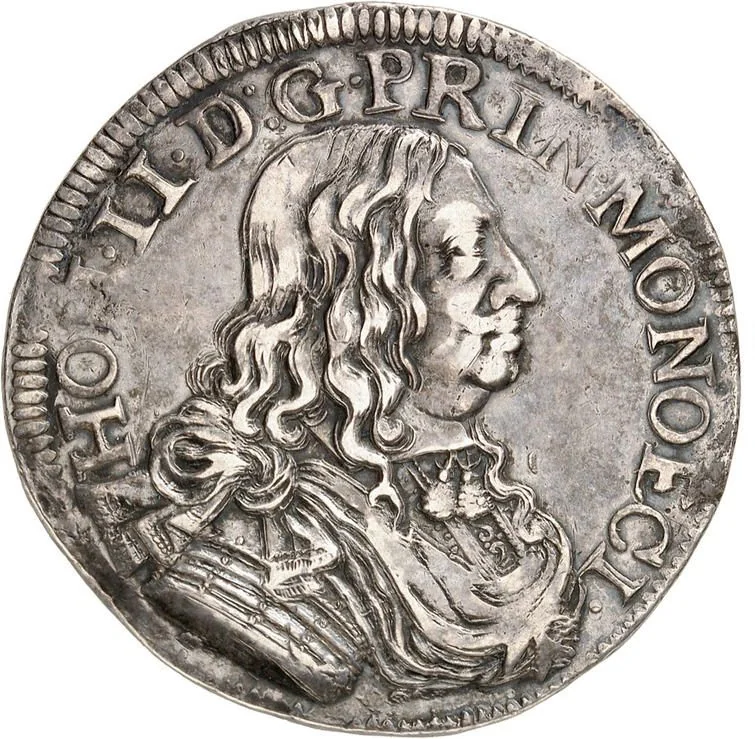
1 Ecu – Monaco
Monaco

Material
Diameter: 42 mm
Weight: 27 g
Silver weight: 27.00 g
Shape: Irregular round
Composition: Silver
Magnetic: No
References
KM: #Click to copy to clipboard32
Numista: #360572
Value
Bullion value: $78.00
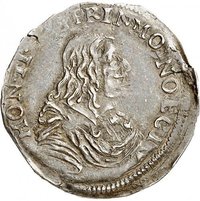
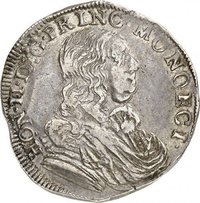
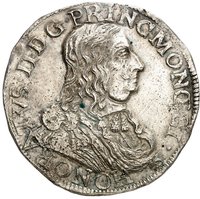
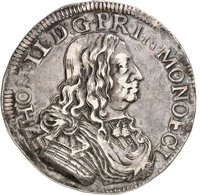
Obverse
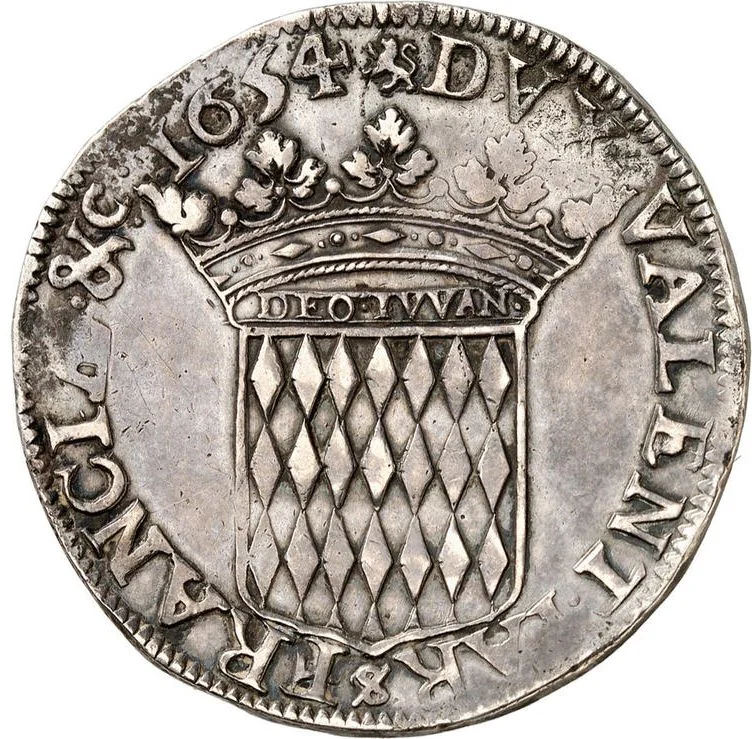
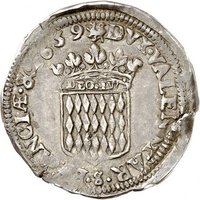
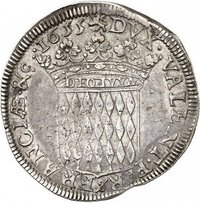
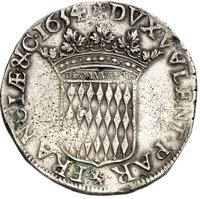
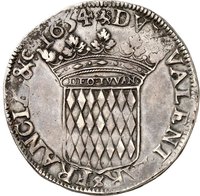
Reverse
Description:
Crowned arms with seven diamonds.
Inscription:
DVX.VALENT.PAR Ꞩ FRANCIÆ.&c. 1654
Script: Latin
Engraver: Jean Solignac
Edge
Plain
Mints
| Name | Mark |
|---|---|
| Monaco | — |
Mintings
| Year | Mint Mark | Mintage | Quality | Collection |
|---|---|---|---|---|
| 1654 | — | — | ||
| 1655 | — | — | ||
| 1656 | — | — | ||
| 1657 | — | — | ||
| 1658 | — | — | ||
| 1659 | — | — | ||
| 1660 | — | — | ||
| 1661 | — | — | ||
| 1662 | — | — |
Historical background
In 1654, Monaco existed as a sovereign principality under the protective, yet financially demanding, umbrella of France. Its currency situation was inherently complex and subordinate to external powers. The principality did not mint its own coins; instead, it relied almost entirely on the circulation of foreign currencies. The primary legal tender was the French livre tournois, a system of account, alongside the physical coins of the French realm. However, due to Monaco's strategic port and trade links, Spanish silver reales and Italian coins, particularly from Genoa and Savoy, also circulated widely, reflecting its position at the crossroads of major Mediterranean commercial routes.
This monetary plurality created chronic practical difficulties. The fluctuating values and metallic contents of these various coins led to confusion in daily transactions and made the principality vulnerable to the monetary manipulations of its larger neighbors. Of particular concern was the persistent shortage of high-quality specie (coin), as good silver and gold coins tended to be hoarded or exported, leaving a circulation often dominated by worn or debased foreign coins. This environment was ripe for seigniorage, where authorities could profit by manipulating exchange rates between the official livre tournois and the physical coins in circulation.
The situation was further strained by the financial obligations of Prince Honoré II, who had spent decades transforming his fortress into a princely court, accruing significant debt. While the year 1654 itself was not marked by a specific monetary crisis, the ongoing reliance on unstable foreign coinage limited Monaco's economic autonomy and complicated fiscal management. The currency landscape of 1654 was thus one of dependency and fragmentation, a direct reflection of the principality's precarious political position, caught between the gravitational pull of French power and the practical realities of Mediterranean commerce.
This monetary plurality created chronic practical difficulties. The fluctuating values and metallic contents of these various coins led to confusion in daily transactions and made the principality vulnerable to the monetary manipulations of its larger neighbors. Of particular concern was the persistent shortage of high-quality specie (coin), as good silver and gold coins tended to be hoarded or exported, leaving a circulation often dominated by worn or debased foreign coins. This environment was ripe for seigniorage, where authorities could profit by manipulating exchange rates between the official livre tournois and the physical coins in circulation.
The situation was further strained by the financial obligations of Prince Honoré II, who had spent decades transforming his fortress into a princely court, accruing significant debt. While the year 1654 itself was not marked by a specific monetary crisis, the ongoing reliance on unstable foreign coinage limited Monaco's economic autonomy and complicated fiscal management. The currency landscape of 1654 was thus one of dependency and fragmentation, a direct reflection of the principality's precarious political position, caught between the gravitational pull of French power and the practical realities of Mediterranean commerce.
Series: 1654 Monaco circulation coins

✨ Legendary