

1⁄12 silver ecu – France
Add to wishlist
France
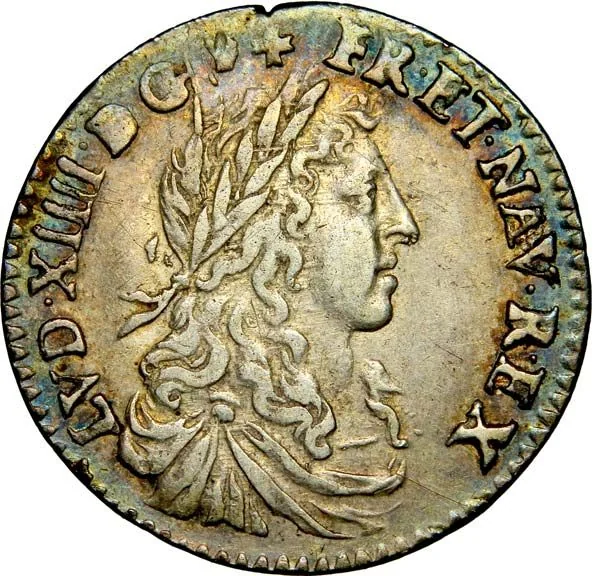
Obverse
Description:
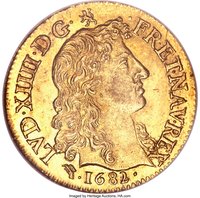
Juvenile Louis XIV bust, right-facing.
Inscription:
LVD. XIIII. D G FR. ET. NAV. REX
Script: Latin
Engraver: Jean Warin
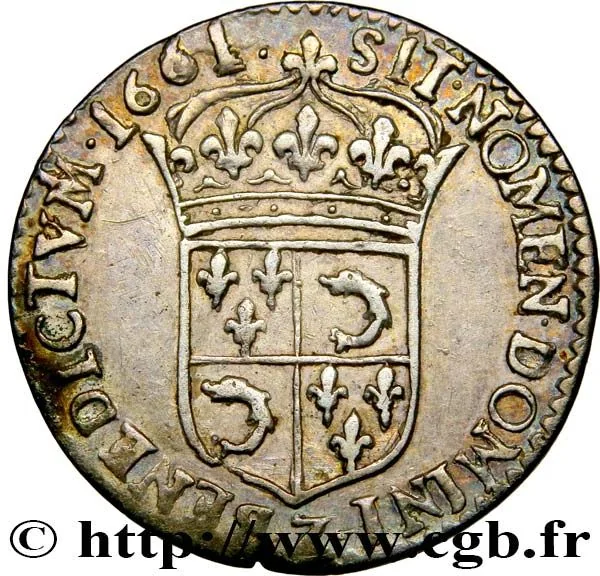
Reverse
Description:
Shield quartered of Dauphiné and France.
Inscription:
SIT. NOMEN. DOMINI. - Z - .BENEDICTVM. 1661
Script: Latin
Engraver: Jean Warin
Edge
Plain
Categories
| Symbol> Fleur-de-lis |
| Object> Armour |
| Symbol> Crown |
| Person> Monarch |
| Symbols> Coat of Arms |
Mints
| Name | Mark |
|---|---|
| Grenoble | Z |
Historical background
In 1660, France was on the cusp of a new financial era under the young King Louis XIV, but its currency system remained a complex and archaic patchwork. The realm operated on a bimetallic standard, with both gold (louis d'or) and silver (écu) coins in circulation, but their values were not fixed by a simple ratio. Instead, the royal government frequently issued edicts to alter the official livre tournois (a money of account) value of the physical coins. This practice, known as augmentation (raising the coin's face value) or diminution (lowering it), was a crude tool for fiscal manipulation, often used to extract wealth for the treasury or manage state debt, but it created chronic uncertainty in commerce.
The system was further complicated by widespread monetary chaos from the preceding decades. The Thirty Years' War and the domestic upheaval of the Fronde had left royal finances in disarray, leading to debasements and the circulation of countless worn, clipped, and counterfeit coins from both domestic and foreign mints. In many regions, particularly remote provinces, older coins and even barter persisted, undermining the Crown's desire for a uniform national currency. This fragmentation hindered trade, as merchants and money changers had to navigate a bewildering array of values.
Recognizing this instability as an obstacle to both economic prosperity and royal authority, Louis XIV and his finance minister, Jean-Baptiste Colbert, would soon initiate sweeping reforms. The year 1660 itself was a transitional point, with the monarchy preparing to assert greater control. Within a few years, Colbert would standardize coinage, establish a more reliable mint, and crack down on fraud, aiming to replace the inherited monetary disorder with a stable, centrally managed system worthy of an absolute monarch and a burgeoning mercantile state.
The system was further complicated by widespread monetary chaos from the preceding decades. The Thirty Years' War and the domestic upheaval of the Fronde had left royal finances in disarray, leading to debasements and the circulation of countless worn, clipped, and counterfeit coins from both domestic and foreign mints. In many regions, particularly remote provinces, older coins and even barter persisted, undermining the Crown's desire for a uniform national currency. This fragmentation hindered trade, as merchants and money changers had to navigate a bewildering array of values.
Recognizing this instability as an obstacle to both economic prosperity and royal authority, Louis XIV and his finance minister, Jean-Baptiste Colbert, would soon initiate sweeping reforms. The year 1660 itself was a transitional point, with the monarchy preparing to assert greater control. Within a few years, Colbert would standardize coinage, establish a more reliable mint, and crack down on fraud, aiming to replace the inherited monetary disorder with a stable, centrally managed system worthy of an absolute monarch and a burgeoning mercantile state.
✨ Legendary