

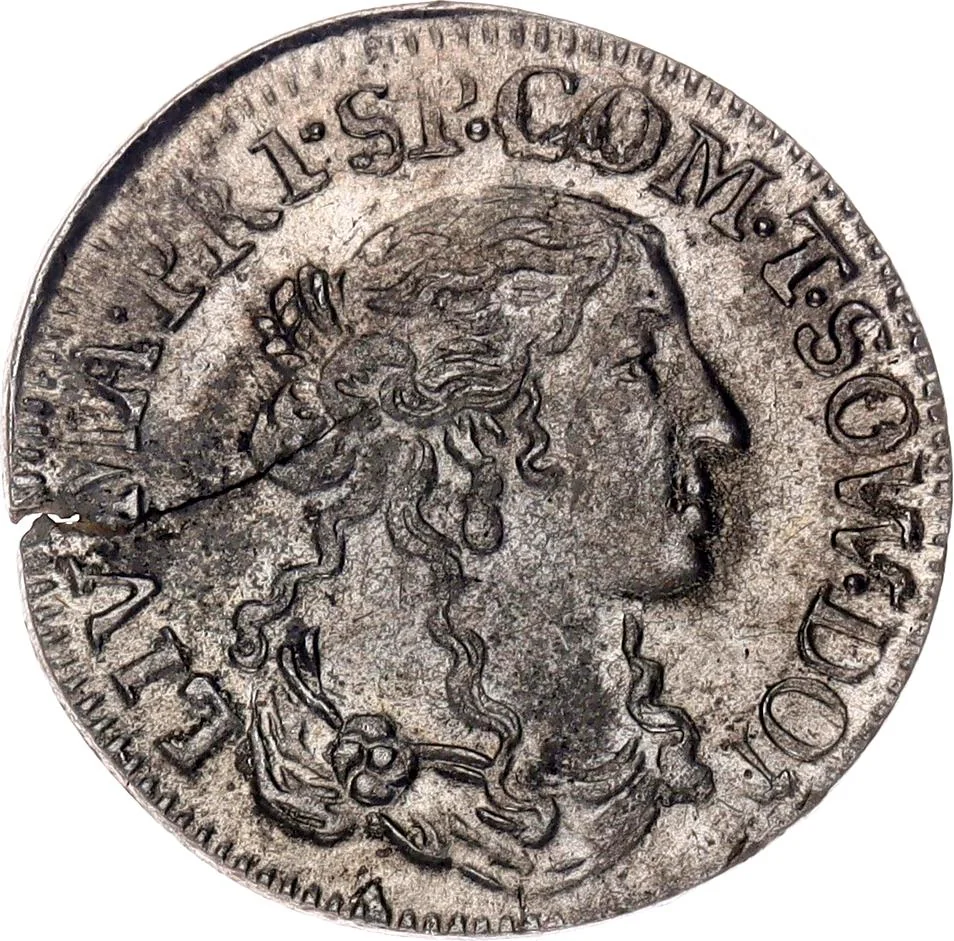
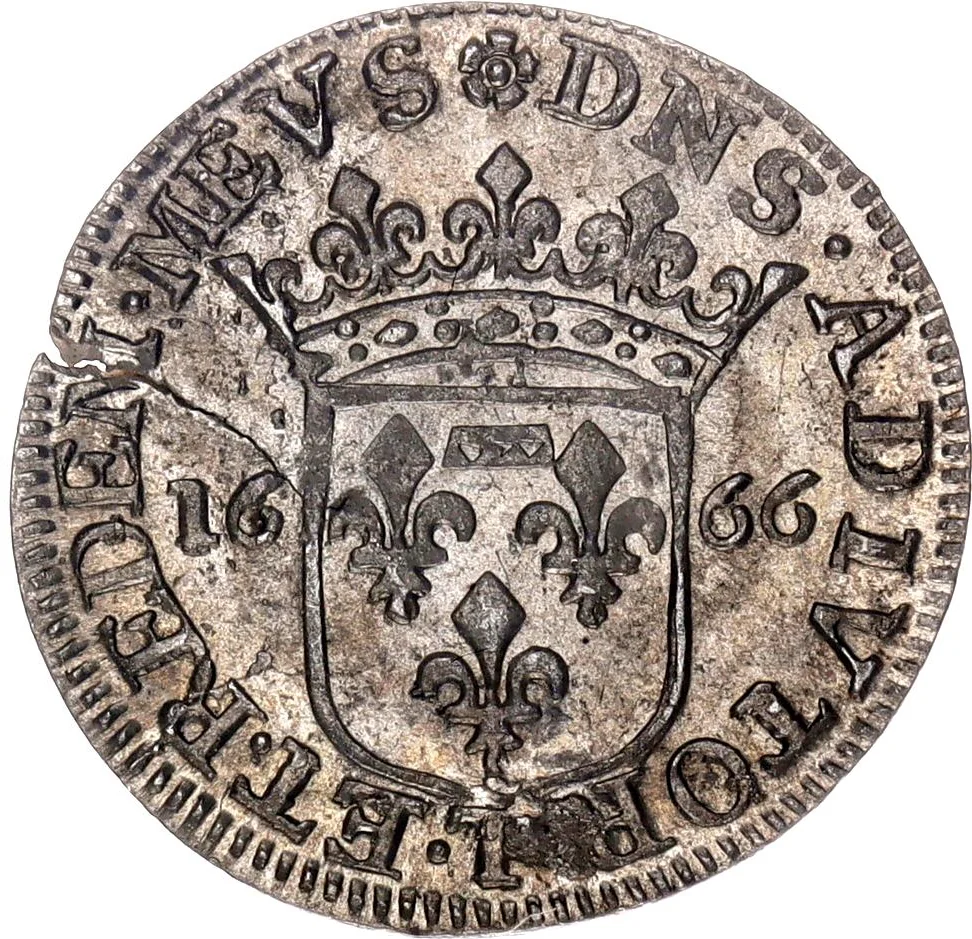
1⁄12 silver ecu – France
Add to wishlist
France
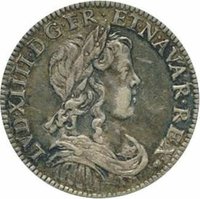
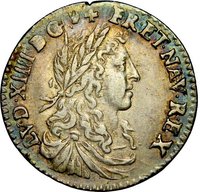
Obverse
Description:
Louis XIV in right-facing bust.
Inscription:
LVD•XIIII•D•G• FR•ET•NAV•REX
Script: Latin
Engraver: Jean Warin
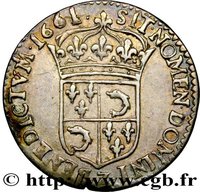
Reverse
Description:
Crowned coat of arms.
Inscription:
SIT•NOMEN•DOMINI BENEDICTVM•1661
Script: Latin
Engraver: Jean Warin
Edge
Plain
Mints
| Name | Mark |
|---|---|
| Aix-en-Provence | & |
| Monnaie de Paris | A |
| Rouen | B |
| Lyon | D |
| Tours | E |
| La Rochelle | H |
| Limoges | I |
| Bordeaux | K |
| Bayonne | L |
| Toulouse | M |
| Montpellier | N |
| Dijon | P |
| Villeneuve-lès-Avignon | R |
| Nantes | T |
| Amiens | X |
Mintings
| Year | Mint Mark | Mintage | Quality | Collection |
|---|---|---|---|---|
| 1658 | A | 13,958 | ||
| 1659 | & | — | ||
| 1659 | A | 4,360,147 | ||
| 1659 | B | 92,441 | ||
| 1659 | I | — | ||
| 1659 | N | 208,153 | ||
| 1659 | T | — | ||
| 1659 | X | 51,998 | ||
| 1660 | E | — | ||
| 1660 | & | 103,996 | ||
| 1660 | A | 8,175,276 | ||
| 1660 | B | 1,178,626 | ||
| 1660 | D | 8,090,538 | ||
| 1660 | I | 48,146 | ||
| 1660 | K | — | ||
| 1660 | L | — | ||
| 1660 | N | 127,107 | ||
| 1660 | R | 17,333 | ||
| 1660 | T | 3,852 | ||
| 1660 | X | 30,814 | ||
| 1661 | I | 123,255 | ||
| 1661 | L | 26,962 | ||
| 1661 | M | — | ||
| 1661 | N | 102,070 | ||
| 1661 | R | 410,208 | ||
| 1661 | T | 1,610,019 | ||
| 1661 | A | 1,610,019 | ||
| 1661 | B | 21,184 | ||
| 1661 | C | — | ||
| 1661 | D | 3,148,782 | ||
| 1661 | H | — | ||
| 1661 | & | 200,000 | ||
| 1662 | & | 460,280 | ||
| 1662 | A | 8,652,890 | ||
| 1662 | T | 5,868,095 | ||
| 1662 | B | 375,543 | ||
| 1662 | D | 8,444,996 | ||
| 1662 | H | — | ||
| 1662 | I | 23,036 | ||
| 1662 | K | — | ||
| 1662 | L | 15,407 | ||
| 1662 | M | 317,767 | ||
| 1662 | N | 92,445 | ||
| 1662 | R | 281,175 | ||
| 1663 | & | 893,559 | ||
| 1663 | A | 1,825,715 | ||
| 1663 | D | 11,860,381 | ||
| 1663 | I | — | ||
| 1663 | L | 55,850 | ||
| 1664 | & | 893,599 | ||
| 1664 | A | 2,072,225 | ||
| 1664 | B | 92,441 | ||
| 1664 | D | 5,230,636 | ||
| 1664 | L | 34,665 | ||
| 1665 | A | 42,369 | ||
| 1665 | D | 313,916 | ||
| 1665 | L | 3,852 | ||
| 1665 | & | 44,295 | ||
| 1666 | & | 18,696 | ||
| 1666 | D | 1,406 | ||
| 1666 | L | — | ||
| 1666 | M | 9,146 | ||
| 1667 | & | 7,557 | ||
| 1667 | A | 14,946 | ||
| 1668 | & | 2,376 | ||
| 1668 | D | 2,410 | ||
| 1668 | L | — | ||
| 1669 | & | 9,720 | ||
| 1669 | A | — | ||
| 1669 | D | 3,888 | ||
| 1670 | & | 8,330 | ||
| 1670 | D | 3,828 | ||
| 1671 | & | 23,834 | ||
| 1671 | D | 2,739 | ||
| 1671 | M | 644 | ||
| 1672 | & | 6,072 | ||
| 1672 | L | 2,132 | ||
| 1673 | D | 11,555 |
Historical background
In 1658, France was in the final years of the personal reign of Cardinal Mazarin, who governed on behalf of the young King Louis XIV. The nation's currency system was in a state of profound disorder, a direct legacy of the costly foreign wars, notably the Thirty Years' War, and domestic upheavals of the Fronde. To finance these immense expenditures, the monarchy had repeatedly resorted to debasement—reducing the precious metal content in coins while maintaining their face value. This practice, alongside the issuance of unstable credit instruments, led to severe inflation, a loss of public confidence in the currency, and a chaotic circulation of both domestic and foreign coins of varying intrinsic worth.
The monetary landscape was characterized by extreme complexity. In practice, a multitude of coins—French louis d'or, écus, and liards, alongside Spanish pistoles, Dutch florins, and various German and Italian coins—circulated simultaneously. Their exchange rates fluctuated wildly based on their actual metal weight and the edicts of the crown, which attempted to fix values by royal decree. This created a lucrative but destabilizing market for money-changers and speculators, while hampering domestic trade and tax collection, as the state struggled to ascertain the real value of the revenues it received.
This unstable situation set the stage for the sweeping reforms that would follow under Louis XIV and his finance minister, Jean-Baptiste Colbert, after Mazarin's death in 1661. Recognizing that sound currency was essential for economic recovery and royal authority, Colbert would embark on a major recoinage in 1667, standardizing the gold louis and silver écu, strictly controlling minting, and cracking down on speculators. Thus, the monetary chaos of 1658 represents the troubled prelude to the era of mercantilist consolidation and absolute control that defined the Sun King's reign.
The monetary landscape was characterized by extreme complexity. In practice, a multitude of coins—French louis d'or, écus, and liards, alongside Spanish pistoles, Dutch florins, and various German and Italian coins—circulated simultaneously. Their exchange rates fluctuated wildly based on their actual metal weight and the edicts of the crown, which attempted to fix values by royal decree. This created a lucrative but destabilizing market for money-changers and speculators, while hampering domestic trade and tax collection, as the state struggled to ascertain the real value of the revenues it received.
This unstable situation set the stage for the sweeping reforms that would follow under Louis XIV and his finance minister, Jean-Baptiste Colbert, after Mazarin's death in 1661. Recognizing that sound currency was essential for economic recovery and royal authority, Colbert would embark on a major recoinage in 1667, standardizing the gold louis and silver écu, strictly controlling minting, and cracking down on speculators. Thus, the monetary chaos of 1658 represents the troubled prelude to the era of mercantilist consolidation and absolute control that defined the Sun King's reign.
🌟 Limited