

⅙ Ecu – Monaco
Monaco

Material
Diameter: 26 mm
Weight: 3.81 g
Silver weight: 3.81 g
Shape: Irregular round
Composition: Silver
Magnetic: No
Technique: Hammered
References
KM: #Click to copy to clipboard30
Numista: #357584
Value
Bullion value: $11.04
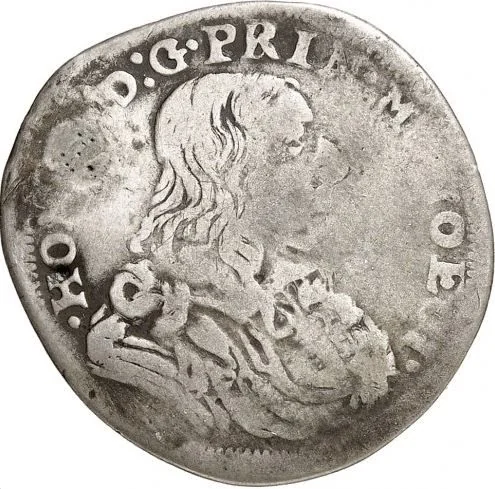
Obverse
Description:
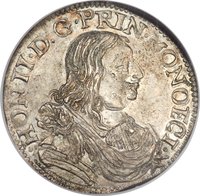
Bust of Honoré II, right-facing.
Inscription:
HON. II. D: G . PRIN . MONOECI
Script: Latin
Engraver: Georges Pallas
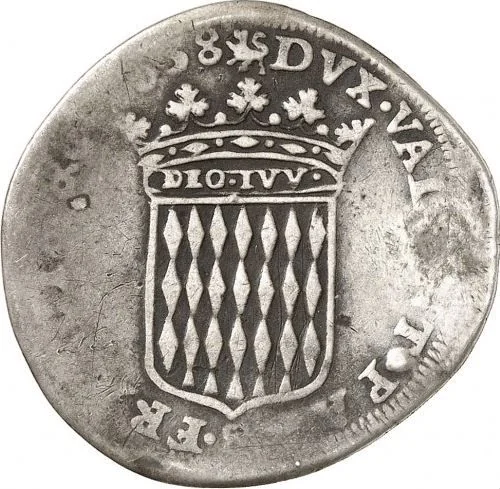
Reverse
Description:
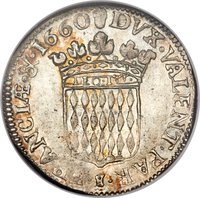
Crowned arms with seven diamonds.
Inscription:
.DEO. IVV.
DVX. VALENT. PAR. FRANCIAE. & c. 1658
DVX. VALENT. PAR. FRANCIAE. & c. 1658
Script: Latin
Engraver: Georges Pallas
Edge
Plain
Mints
| Name | Mark |
|---|---|
| Monaco | — |
Mintings
| Year | Mint Mark | Mintage | Quality | Collection |
|---|---|---|---|---|
| 1658 | — | — | ||
| 1659 | — | — |
Historical background
In 1658, Monaco's currency situation was a direct reflection of its precarious political and economic position. The principality, ruled by the Grimaldi family, was a small protectorate under the Spanish Crown, a relationship formalized by the Treaty of Péronne in 1641. Consequently, the primary circulating currency was the Spanish silver real and its larger denomination, the piece of eight (real de a ocho), which served as a key international trade coin. These coins entered Monaco through trade and Spanish stipends, anchoring its economy to the vast, but increasingly strained, Spanish Habsburg monetary system.
However, this reliance on Spanish coinage was problematic. Spain was embroiled in financial crisis and currency debasement, leading to fluctuating values and unreliable silver content in its coins. Furthermore, Monaco's location on the bustling trade routes of the French Riviera meant that a multitude of other currencies also circulated, including French livres, Italian lire, and gold écus. This created a complex and often chaotic monetary environment where exchange rates were in constant flux, complicating daily commerce for Monegasque merchants and citizens alike.
Despite these challenges, Prince Honoré II, who had spearheaded the shift from Genoese to Spanish protection, maintained limited minting rights. There is evidence of low-denomination copper monégasque coins being struck sporadically for local use, often bearing the prince's crest. These tokens facilitated small, everyday transactions but were insufficient for larger trade. Ultimately, Monaco in 1658 lacked a strong, sovereign currency, existing instead within a turbulent monetary zone dependent on the fortunes and failures of its powerful Spanish patron and the heterogeneous coinage of Mediterranean commerce.
However, this reliance on Spanish coinage was problematic. Spain was embroiled in financial crisis and currency debasement, leading to fluctuating values and unreliable silver content in its coins. Furthermore, Monaco's location on the bustling trade routes of the French Riviera meant that a multitude of other currencies also circulated, including French livres, Italian lire, and gold écus. This created a complex and often chaotic monetary environment where exchange rates were in constant flux, complicating daily commerce for Monegasque merchants and citizens alike.
Despite these challenges, Prince Honoré II, who had spearheaded the shift from Genoese to Spanish protection, maintained limited minting rights. There is evidence of low-denomination copper monégasque coins being struck sporadically for local use, often bearing the prince's crest. These tokens facilitated small, everyday transactions but were insufficient for larger trade. Ultimately, Monaco in 1658 lacked a strong, sovereign currency, existing instead within a turbulent monetary zone dependent on the fortunes and failures of its powerful Spanish patron and the heterogeneous coinage of Mediterranean commerce.

✨ Legendary