

1 ducat – Denmark
Add to wishlist
Denmark
Context
Material
References
KM: #
Numista: #112830
Value
Bullion value: $514.93
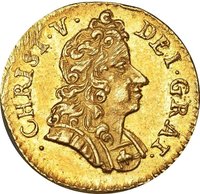
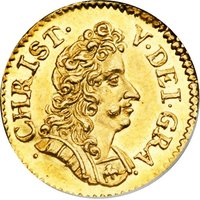
Obverse
Description:
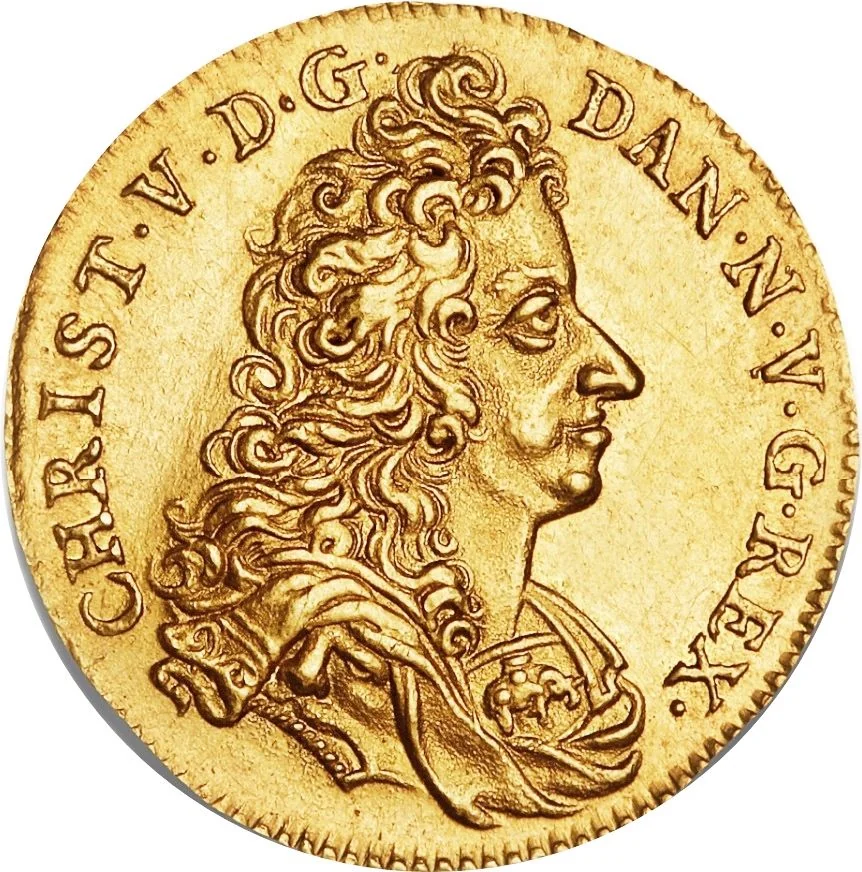
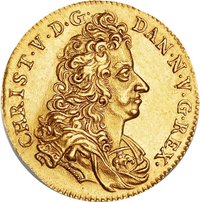
King Christian V facing right, wearing the Order of the Elephant.
Inscription:
CHRIST · V · D · G · | DAN · N · V · G · REX ·
Script: Latin
Engraver: Anton Meybusch
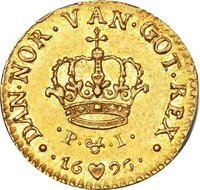
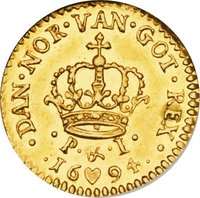
Reverse
Description:
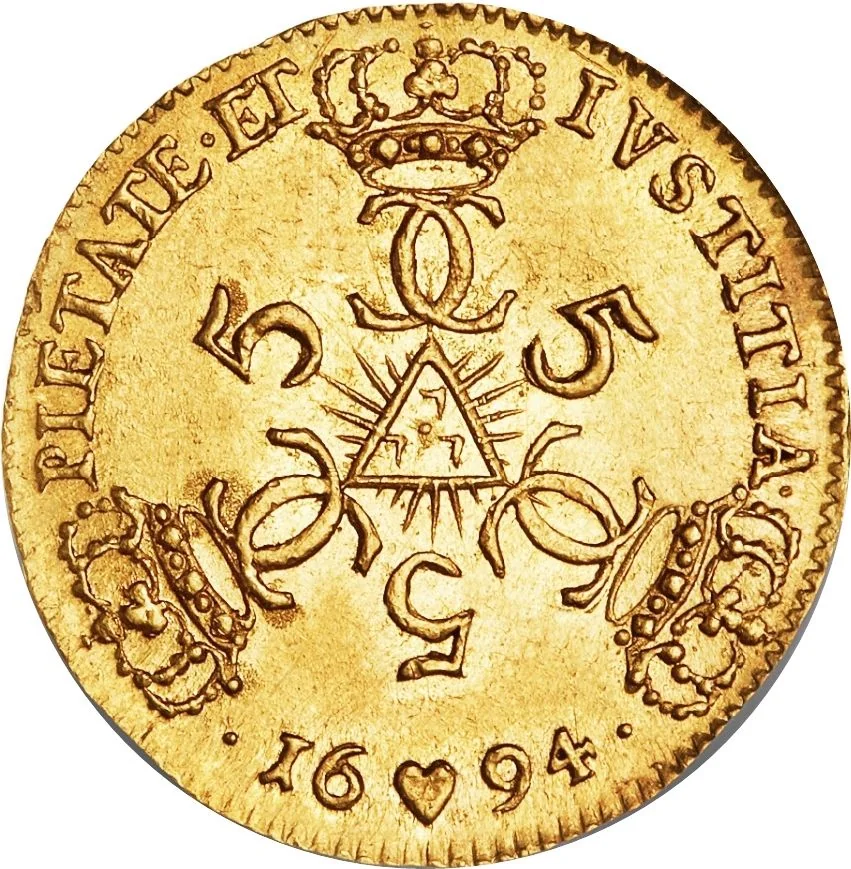
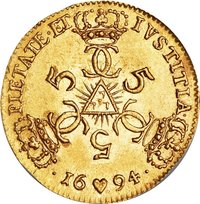
A radiating triangle with a central dot contains three Hebrew "S" letters. Above each vertex, a crowned mirrored "C" alternates with a "5" to form the King's monogram. The date, split by a heart, is below; the motto, divided by crowns, flanks the sides.
Inscription:
PIETATE · ET | IVSTITIA ·
· 16 ♥ 94 ·
· 16 ♥ 94 ·
Script: Latin
Edge
Mints
| Name | Mark |
|---|---|
| Copenhagen | ♥ |
Mintings
| Year | Mint Mark | Mintage | Quality | Collection |
|---|---|---|---|---|
| 1694 | ♥ | — |
Historical background
In 1694, Denmark found itself in a severe monetary crisis, a direct consequence of decades of deliberate currency debasement. Successive kings, particularly Christian IV and Frederik III, had financed costly wars and state projects by reducing the silver content of the coinage, flooding the economy with inferior coins. This practice, while providing short-term revenue, led to rampant inflation, a collapse in public trust, and the flight of high-quality foreign currency from the kingdom. By the 1690s, the Danish monetary system was chaotic, with a wide discrepancy between the official value of coins and their actual metal worth, crippling both domestic trade and international commerce.
The situation reached a critical point under King Christian V, whose government recognized that radical reform was essential to restore economic stability and state credit. In response, the crown issued a major monetary ordinance in 1694, spearheaded by the influential minister Count Christian Gyldenløve. The cornerstone of this reform was the introduction of a new, stable silver standard based on the rigsdaler specie. The ordinance meticulously defined new coins by their precise weight and fineness of silver, aiming to permanently end the cycle of debasement and re-establish a currency that would be trusted at home and abroad.
The 1694 reform was a pivotal moment in Danish economic history, marking a deliberate transition from a fragile, manipulated currency to one grounded in intrinsic value and state credibility. While the initial transition was challenging and required the painful withdrawal and recoinage of the old, debased money, it laid the essential foundation for long-term financial stability. This move was part of a broader European trend towards standardized monetary systems and helped integrate Denmark more securely into the networks of North European trade and finance in the decades that followed.
The situation reached a critical point under King Christian V, whose government recognized that radical reform was essential to restore economic stability and state credit. In response, the crown issued a major monetary ordinance in 1694, spearheaded by the influential minister Count Christian Gyldenløve. The cornerstone of this reform was the introduction of a new, stable silver standard based on the rigsdaler specie. The ordinance meticulously defined new coins by their precise weight and fineness of silver, aiming to permanently end the cycle of debasement and re-establish a currency that would be trusted at home and abroad.
The 1694 reform was a pivotal moment in Danish economic history, marking a deliberate transition from a fragile, manipulated currency to one grounded in intrinsic value and state credibility. While the initial transition was challenging and required the painful withdrawal and recoinage of the old, debased money, it laid the essential foundation for long-term financial stability. This move was part of a broader European trend towards standardized monetary systems and helped integrate Denmark more securely into the networks of North European trade and finance in the decades that followed.
Series: 1694 Denmark circulation coins
✨ Legendary