

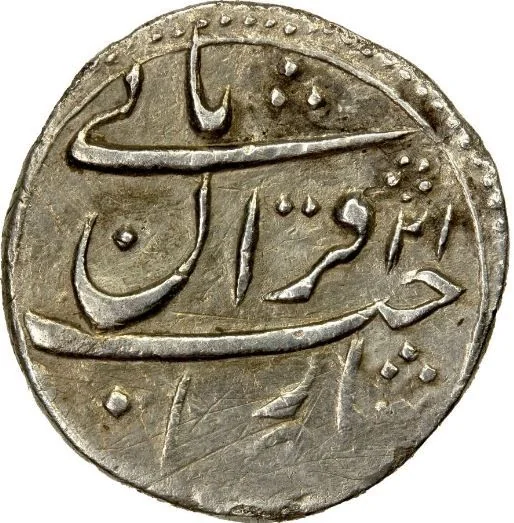
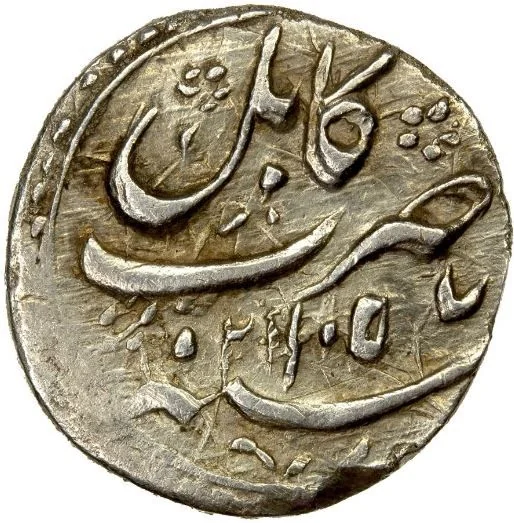
¼ Rupee – Mughal Empire
India
Context
Year: 1647
Islamic (Hijri) Year: 1057
Country: India 
Issuer: Mughal Empire
Ruler: Shah Jahan
Currency:
(1540—1842)
Demonetized: Yes
Material
References
KM: #Click to copy to clipboard246.3
Numista: #354157
Value
Bullion value: $7.91
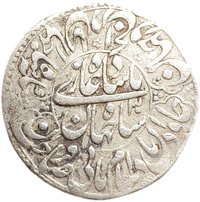
Obverse
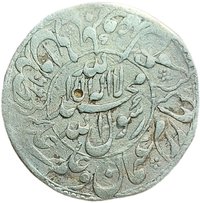
Reverse
Edge
Mints
| Name | Mark |
|---|---|
| Kabul | — |
Mintings
| Year | Mint Mark | Mintage | Quality | Collection |
|---|---|---|---|---|
| 1647 | — | — |
Historical background
By 1647, the Mughal Empire under Shah Jahan was at its zenith, both territorially and economically, supported by a sophisticated and standardized monetary system. The foundation was the silver rupee, a high-purity coin that served as the primary unit of account and medium for revenue collection, trade, and large-scale transactions. It was complemented by a gold mohur, used for hoarding, gifts, and high-value trade, and a range of copper dam coins, which facilitated everyday bazaar transactions for the common people. This trimetallic system, with officially fixed exchange rates (though market rates fluctuated), provided remarkable monetary stability across the empire's vast territories, from Kabul to Bengal.
The system's integrity was maintained through a centralized network of imperial mints (sikkas). Coins were struck in major provincial capitals like Delhi, Agra, Lahore, and Surat, each bearing standardized inscriptions that included the ruler's name, the mint name, and the regnal year, ensuring uniformity and trust. The prolific silver coinage was heavily dependent on a continuous influx of bullion, primarily from the New World, which entered the Indian economy through vibrant maritime trade with European companies on the Gujarat and Coromandel coasts. This silver stream was crucial, as indigenous silver mines were minimal.
However, this apparent stability in 1647 contained the seeds of future strain. Shah Jahan's immense architectural projects, most notably the ongoing construction of the Taj Mahal and a new capital in Delhi (Shahjahanabad), alongside massive military campaigns in Central Asia (like the Balkh and Badakhshan expeditions), placed enormous fiscal pressure on the treasury. While not yet critical, this high expenditure, funded by land revenue collected in silver rupees, began to test the system's resilience. The empire's monetary health remained precariously linked to the uninterrupted flow of American and Japanese silver, a vulnerability that would become acute under his successors.
The system's integrity was maintained through a centralized network of imperial mints (sikkas). Coins were struck in major provincial capitals like Delhi, Agra, Lahore, and Surat, each bearing standardized inscriptions that included the ruler's name, the mint name, and the regnal year, ensuring uniformity and trust. The prolific silver coinage was heavily dependent on a continuous influx of bullion, primarily from the New World, which entered the Indian economy through vibrant maritime trade with European companies on the Gujarat and Coromandel coasts. This silver stream was crucial, as indigenous silver mines were minimal.
However, this apparent stability in 1647 contained the seeds of future strain. Shah Jahan's immense architectural projects, most notably the ongoing construction of the Taj Mahal and a new capital in Delhi (Shahjahanabad), alongside massive military campaigns in Central Asia (like the Balkh and Badakhshan expeditions), placed enormous fiscal pressure on the treasury. While not yet critical, this high expenditure, funded by land revenue collected in silver rupees, began to test the system's resilience. The empire's monetary health remained precariously linked to the uninterrupted flow of American and Japanese silver, a vulnerability that would become acute under his successors.
✨ Legendary