

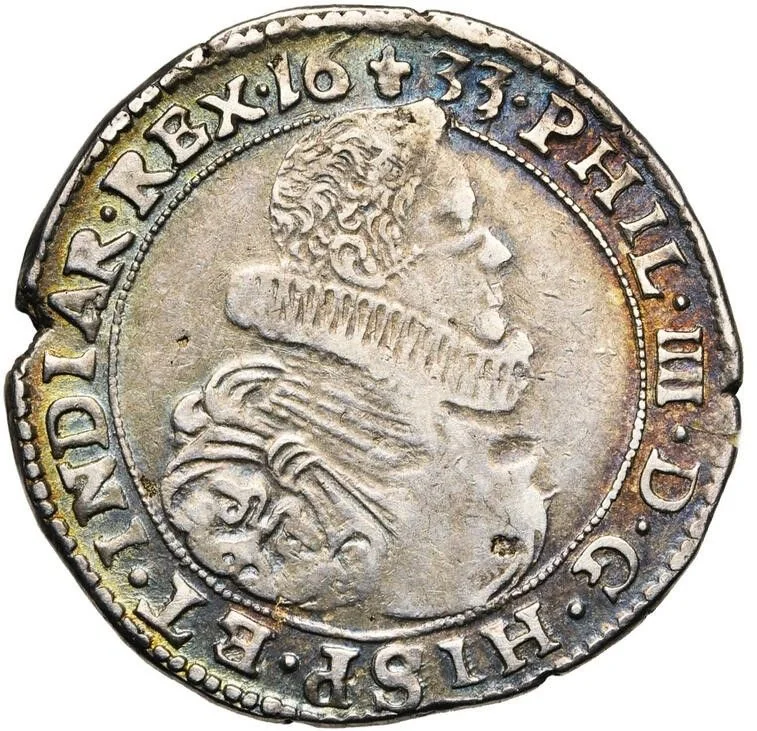
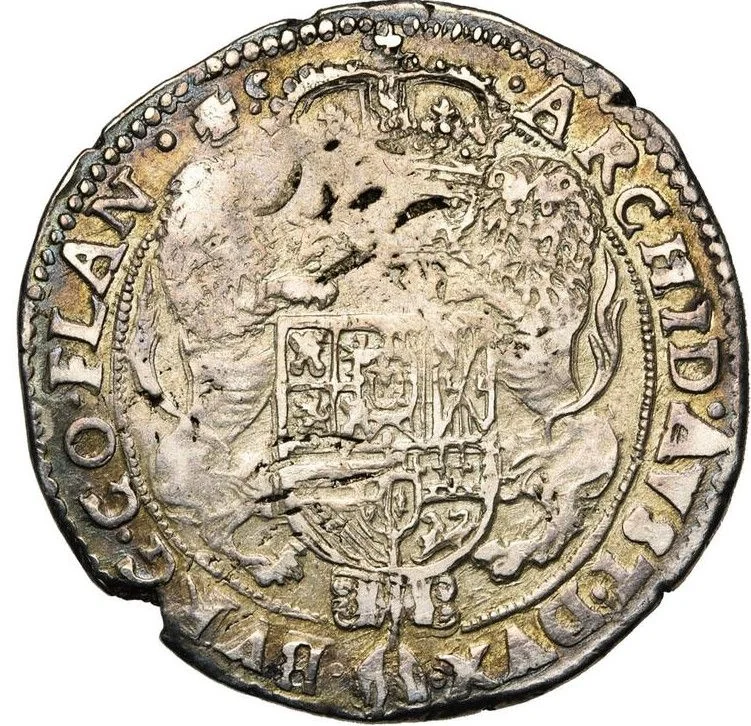
½ Ducaton – Spanish Netherlands
Netherlands
Context
Years: 1632–1637
Country: Netherlands 
Issuer: Spanish Netherlands
Ruler: Philip IV
Currency:
(1506—1713)
Demonetized: Yes
Material
Weight: 16.2 g
Silver weight: 15.29 g
Shape: Irregular round
Composition: 94.4% Silver
Magnetic: No
Technique: Hammered
References
KM: #Click to copy to clipboard45
Numista: #347362
Value
Bullion value: $44.09
Obverse
Description:
Philip bust right in ruffled collar. Date above, divided by mintmark.
Inscription:
· PHIL · IIII · D · G · HISP · ET · INDIAR · REX · 16 ⚜ 33
Script: Latin
Reverse
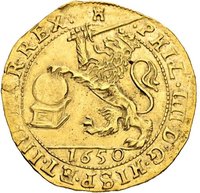
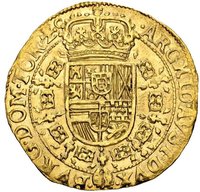
Description:
Crowned shield flanked by lions, with the Golden Fleece pendant.
Inscription:
· ARCHID · AVST · DVX· ·BVRG · ET · CO · FL · Zc
Script: Latin
Edge
Categories
| Symbols> Coat of Arms |
Mints
| Name | Mark |
|---|---|
| Bruges | ⚜ |
Mintings
| Year | Mint Mark | Mintage | Quality | Collection |
|---|---|---|---|---|
| 1632 | — | — | ||
| 1633 | — | — | ||
| 1636 | — | — | ||
| 1637 | — | — |
Historical background
In 1632, the Spanish Netherlands found itself in the midst of a severe and complex monetary crisis, a direct consequence of the ongoing Eighty Years' War (1568-1648) against the Dutch Republic and its entanglement in the broader Thirty Years' War. The region, a vital but beleaguered part of the Habsburg Empire, was financially exhausted by the colossal costs of maintaining its large, professional Army of Flanders. The Spanish crown, repeatedly declaring bankruptcy and struggling with shipments of American silver, was often unable to send sufficient socorros (subsidies), forcing local authorities to resort to debasement and credit.
The currency situation was characterized by a chaotic proliferation of heavily debased coinage. To meet military payrolls and obligations, the government frequently issued low-quality moneda de vellón (billon coins of copper with a thin silver wash) at artificially high face values. This practice, alongside the circulation of clipped, worn, and counterfeit coins from various neighboring states, led to a classic manifestation of Gresham's Law: "bad money drove out good." Sound, full-weight silver coins like the patagon or ducatón were hoarded, melted down, or exported, leaving daily commerce to be conducted in untrustworthy and unstable currency.
This monetary instability had devastating economic and social effects within the cities of the Spanish Netherlands. Prices for essential goods became highly volatile and inflated, causing widespread hardship for the population. Trade and contracts were fraught with uncertainty, as the real value of a payment could differ drastically from its nominal value. While authorities, including the central Council of Finance in Brussels, issued ordinances to regulate exchange rates and withdraw the most debased coins, these measures were largely reactive and ineffective, unable to address the fundamental problem of wartime fiscal desperation until a more lasting political and military resolution could be found.
The currency situation was characterized by a chaotic proliferation of heavily debased coinage. To meet military payrolls and obligations, the government frequently issued low-quality moneda de vellón (billon coins of copper with a thin silver wash) at artificially high face values. This practice, alongside the circulation of clipped, worn, and counterfeit coins from various neighboring states, led to a classic manifestation of Gresham's Law: "bad money drove out good." Sound, full-weight silver coins like the patagon or ducatón were hoarded, melted down, or exported, leaving daily commerce to be conducted in untrustworthy and unstable currency.
This monetary instability had devastating economic and social effects within the cities of the Spanish Netherlands. Prices for essential goods became highly volatile and inflated, causing widespread hardship for the population. Trade and contracts were fraught with uncertainty, as the real value of a payment could differ drastically from its nominal value. While authorities, including the central Council of Finance in Brussels, issued ordinances to regulate exchange rates and withdraw the most debased coins, these measures were largely reactive and ineffective, unable to address the fundamental problem of wartime fiscal desperation until a more lasting political and military resolution could be found.
✨ Legendary