

1 Couronne – Spanish Netherlands
Netherlands
Context
Years: 1627–1643
Country: Netherlands 
Issuer: Spanish Netherlands
Ruler: Philip IV
Currency:
(1506—1713)
Subdivision: 1 Couronne = 42 Stuivers = 84 Groot
Demonetized: Yes
Total mintage: 28,834
Material
Diameter: 28 mm
Weight: 3.41 g
Gold weight: 3.05 g
Shape: Irregular round
Composition: 89.5% Gold
Magnetic: No
Technique: Hammered
Alignment: Coin alignment
flip
References
KM: #Click to copy to clipboard40
Numista: #128882
Value
Bullion value: $509.79
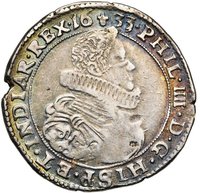
Obverse
Description:
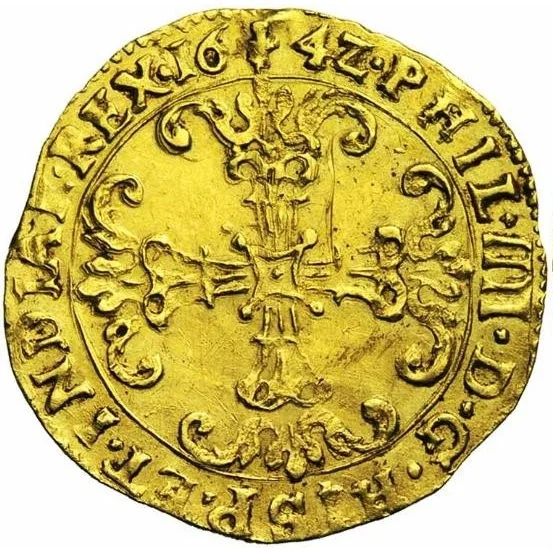
Voided floriate cross, date above mint mark (fleur-de-lis).
Inscription:
PHIL · IIII · D · G · HISP · ET · INDIAR · REX · 16 ⚜ 42
Script: Latin
Reverse
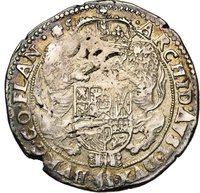
Description:
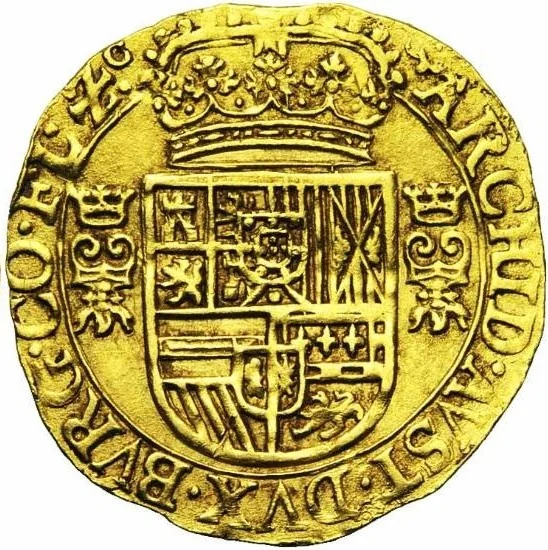
Crowned arms flanked by firesteels, with the Golden Fleece jewel.
Inscription:
ARCHID · AVST · DVX · BVRG · CO · FL · Zc
Script: Latin
Edge
Mints
| Name | Mark |
|---|---|
| Bruges | — |
Mintings
| Year | Mint Mark | Mintage | Quality | Collection |
|---|---|---|---|---|
| 1627 | — | 834 | ||
| 1628 | — | — | ||
| 1629 | — | — | ||
| 1631 | — | 13,000 | ||
| 1632 | — | — | ||
| 1640 | — | 15,000 | ||
| 1642 | — | — | ||
| 1643 | — | — |
Historical background
In 1627, the Spanish Netherlands found itself in the midst of a severe and protracted monetary crisis, a direct consequence of the ongoing Eighty Years' War. The region's economy was strained by the immense costs of maintaining the Army of Flanders, leading the Spanish Crown to repeatedly debase the coinage. By lowering the silver content in coins like the patagon and real, authorities aimed to create more money from the same amount of bullion, effectively financing the war through inflation. This practice, however, shattered public confidence in the currency and disrupted all commercial activity, as the value of money became unstable and unpredictable.
The situation was exacerbated by the circulation of a chaotic mix of coins. Alongside the debased official currency, older full-weight coins were hoarded, and a flood of inferior foreign and counterfeit coins entered the market. This led to the economic principle of "bad money driving out good" (Gresham's Law), where sound money was saved or melted down, leaving only the poorest coins in daily use. Merchants and cities began to set their own exchange rates for different coin types, creating a bewildering patchwork of valuations that further hampered trade and sowed confusion and distrust in the marketplace.
Attempts to resolve the crisis proved difficult. The central authorities in Brussels issued ordinances to fix official values, but these were often ignored by local provinces and cities acting in their own interest. A significant monetary ordinance was indeed promulgated in 1627, aiming to standardize and stabilize the coinage by setting official values and prohibiting certain debased pieces. However, its effectiveness was limited without a fundamental restoration of fiscal discipline and a reduction in wartime expenditures. Thus, the currency situation remained a critical weakness, reflecting the broader political and military struggles of the Spanish Habsburgs in the Low Countries.
The situation was exacerbated by the circulation of a chaotic mix of coins. Alongside the debased official currency, older full-weight coins were hoarded, and a flood of inferior foreign and counterfeit coins entered the market. This led to the economic principle of "bad money driving out good" (Gresham's Law), where sound money was saved or melted down, leaving only the poorest coins in daily use. Merchants and cities began to set their own exchange rates for different coin types, creating a bewildering patchwork of valuations that further hampered trade and sowed confusion and distrust in the marketplace.
Attempts to resolve the crisis proved difficult. The central authorities in Brussels issued ordinances to fix official values, but these were often ignored by local provinces and cities acting in their own interest. A significant monetary ordinance was indeed promulgated in 1627, aiming to standardize and stabilize the coinage by setting official values and prohibiting certain debased pieces. However, its effectiveness was limited without a fundamental restoration of fiscal discipline and a reduction in wartime expenditures. Thus, the currency situation remained a critical weakness, reflecting the broader political and military struggles of the Spanish Habsburgs in the Low Countries.
✨ Legendary