Logo Title
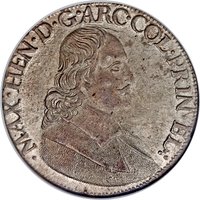
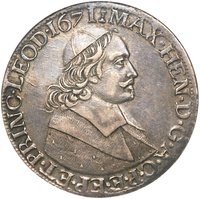
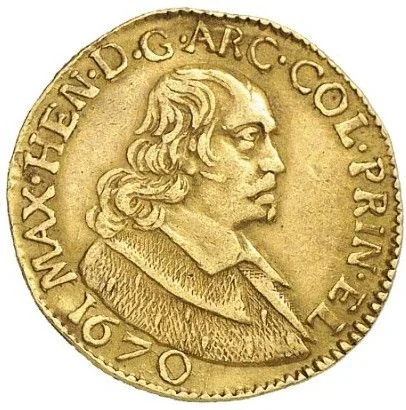
obverse
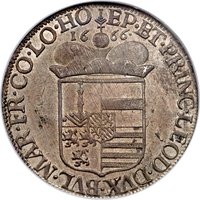
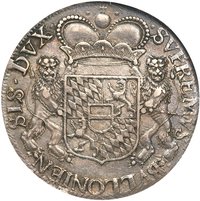
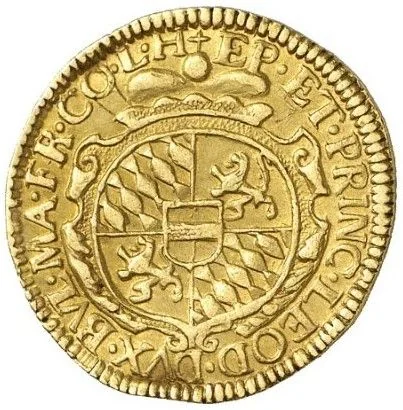
reverse
Fritz Rudolf Künker GmbH & Co. KG, Osnabrück and Lübke & Wiedemann KG, Leonberg

1 Ducat – Prince-bishopric of Liege

Belgium
Context
Years: 1662–1674
Country: Belgium Country flag
Currency:
(1650—1795)
Demonetized: Yes
Material
Weight: 3.5 g
Gold weight: 3.45 g
Shape: Round
Composition: 98.6% Gold
Magnetic: No
References
KM: #Click to copy to clipboard81
Numista: #339848
Value
Bullion value: $572.04

Obverse

Description:
Maximilian Henry in electoral robes, bust right, date below.
Inscription:
MAX • HEN • D • G • ARC • COL • PRIN • EL

1670
Script: Latin

Reverse

Description:
Bavaria-Palatinate-Bouillon arms in cartouche.
Inscription:
EP • ET • PRINC • LEOD • DVX • BVL • MA • FR • CO • L • H
Script: Latin

Edge

Mints

NameMark
Liège

Mintings

YearMint MarkMintageQualityCollection
1662
1663
1664
1666
1667
1668
1669
1670
1671
1672
1674

Historical background

In 1662, the Prince-Bishopric of Liège was navigating a complex and deteriorating monetary environment, characteristic of the wider "crisis of small change" affecting Europe. The bishopric, a sovereign ecclesiastical state within the Holy Roman Empire, had its own mint and issued a variety of coins, including the patard and the liard. However, its economy was deeply intertwined with its powerful neighbors, particularly the Spanish Netherlands and the Dutch Republic, whose heavier, high-quality silver coins circulated widely and were often hoarded or exported, leaving Liège with a scarcity of sound money.

This situation led to a proliferation of debased and lightweight coins, both domestic and foreign, which flooded the market. The intrinsic value of the metal in these coins fell below their face value, leading to Gresham's Law in practice: "bad money drives out good." People hoarded the full-weight coins of Liège and its neighbors, while conducting daily transactions with increasingly inferior copper and billon (low-grade silver) pieces. This eroded public trust, caused price inflation for basic goods, and created significant hardship for the common people and for trade.

The political response was fragmented and often ineffective. While the Prince-Bishop, Maximilian Henry of Bavaria, and the mint masters had the authority to issue ordinances and attempt monetary reforms, the powerful guilds and trades of Liège's vibrant cities, along with foreign economic pressures, limited central control. Efforts to recall old coinage and issue new, standardized pieces in 1662 were typical attempts to restore confidence, but they were temporary fixes. The underlying structural issues—competition between currencies, sovereign debt, and the profit from seigniorage (the mint's profit from coin production)—meant that monetary instability remained a persistent feature of Liège's economy throughout the period.
Legendary