

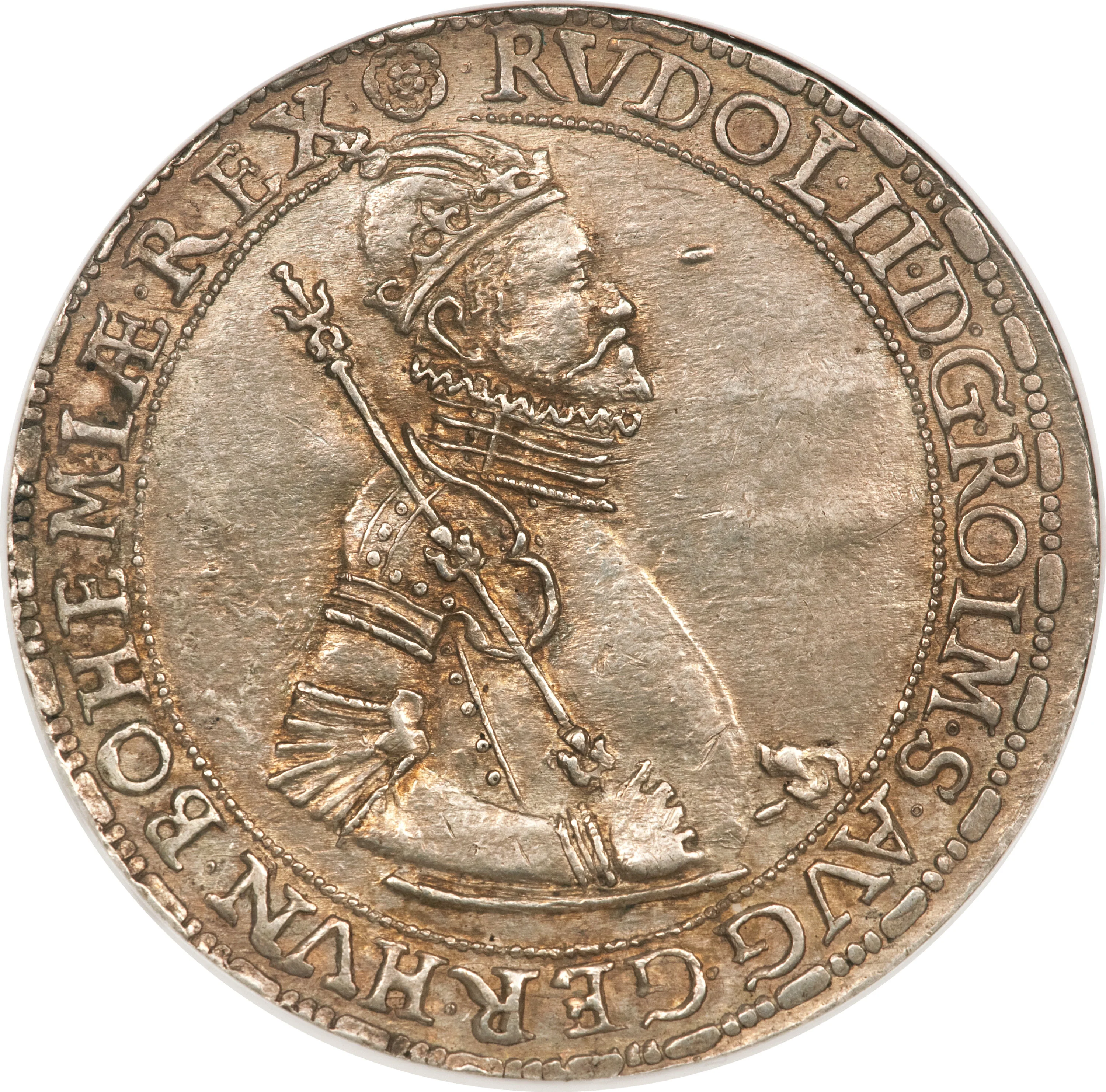
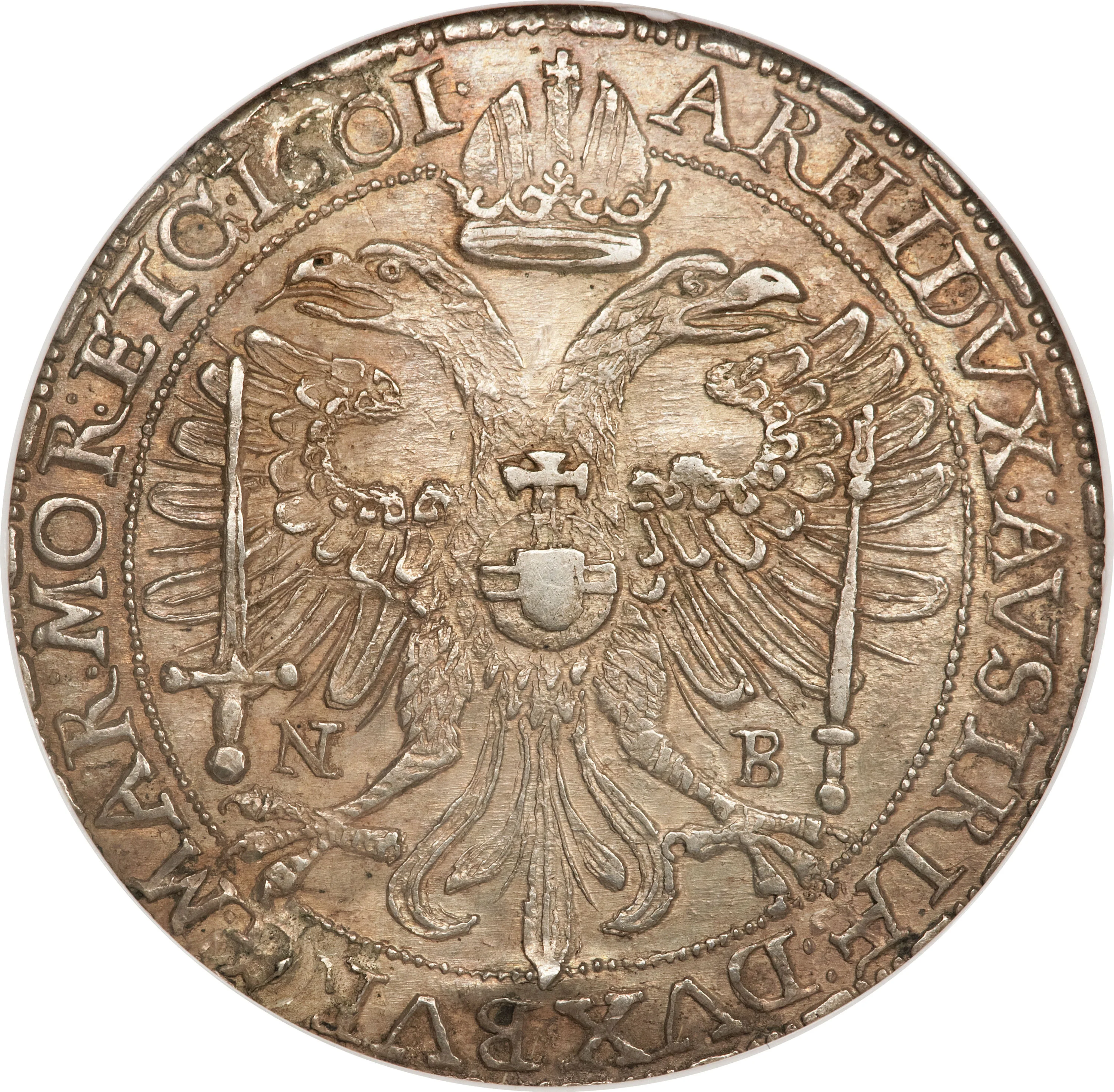

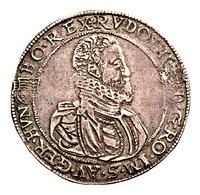
Obverse
Description:
Crowned armored bust facing right, holding scepter and sword. Pearl circle under legend.
Inscription:
RVDOL · II · D · G · RO · IM · S · AVG · GER · HVN · BOHEMIÆ · REX ·
Script: Latin
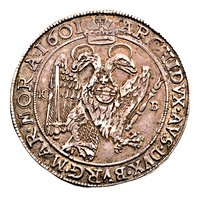
Reverse
Description:
A crowned double-headed eagle, holding sceptre and sword with an imperial orb on its breast, divides the letters N B.
Inscription:
ARCHIDVX · AVSTRIÆ · DVX · BVRG · MAR · MOR · ETC · 1602 ·
Script: Latin
Edge
Plain
Mints
| Name | Mark |
|---|---|
| Baia Mare | NB |
Mintings
| Year | Mint Mark | Mintage | Quality | Collection |
|---|---|---|---|---|
| 1601 | N | — | ||
| 1602 | N | — | ||
| 1603 | N | — | ||
| 1604 | N | — |
Historical background
In 1601, Hungary’s currency situation was chaotic and deeply unstable, a direct consequence of the ongoing Long Turkish War (1593-1606) and the division of the kingdom. The realm was split into three parts: the Ottoman-occupied centre, the Habsburg-controlled Royal Hungary in the north and west, and the semi-independent Principality of Transylvania in the east. This political fragmentation led to a parallel fragmentation of monetary systems. The Habsburg authorities in Vienna, financing a massive and costly war effort, heavily debased the silver denars (also called kreuzers) minted for use in Royal Hungary. By 1601, these coins contained minimal silver, causing rampant inflation and a loss of public trust, as their nominal value far exceeded their intrinsic metal worth.
Alongside these official but debased coins, a multitude of other currencies circulated, creating a complex and dysfunctional monetary environment. High-quality foreign coins, particularly the Thaler (German silver coin), were widely used for large transactions and hoarded as a stable store of value, driving the good money out of circulation—a classic example of Gresham’s Law. Meanwhile, in Ottoman-occupied territories, Turkish akçe and para coins circulated, and in Transylvania, local princes minted their own coinage. This resulted in a bewildering system where exchange rates fluctuated wildly, and merchants and peasants alike faced severe uncertainty and exploitation.
The economic consequences for the Hungarian population were severe. The hyper-inflation of the debased denar devastated wages and fixed incomes, leading to widespread social hardship and famine in some areas. The constant need for war funds also led to heavy taxation, often demanded in higher-quality silver coin, further squeezing the populace. Thus, in 1601, Hungary’s currency was not merely an economic issue but a source of profound social distress, reflecting the broader devastation of a country serving as a perpetual battlefield and fiscal resource for the distant Habsburg court.
Alongside these official but debased coins, a multitude of other currencies circulated, creating a complex and dysfunctional monetary environment. High-quality foreign coins, particularly the Thaler (German silver coin), were widely used for large transactions and hoarded as a stable store of value, driving the good money out of circulation—a classic example of Gresham’s Law. Meanwhile, in Ottoman-occupied territories, Turkish akçe and para coins circulated, and in Transylvania, local princes minted their own coinage. This resulted in a bewildering system where exchange rates fluctuated wildly, and merchants and peasants alike faced severe uncertainty and exploitation.
The economic consequences for the Hungarian population were severe. The hyper-inflation of the debased denar devastated wages and fixed incomes, leading to widespread social hardship and famine in some areas. The constant need for war funds also led to heavy taxation, often demanded in higher-quality silver coin, further squeezing the populace. Thus, in 1601, Hungary’s currency was not merely an economic issue but a source of profound social distress, reflecting the broader devastation of a country serving as a perpetual battlefield and fiscal resource for the distant Habsburg court.
Series: 1601 Hungary circulation coins

✨ Legendary