

1 Thaler – Hungary
Hungary

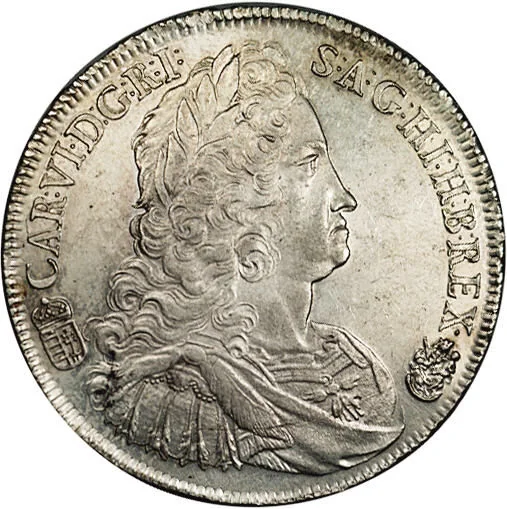
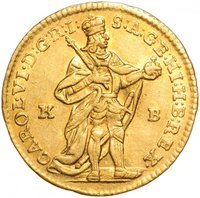
Obverse
Description:
Laureate bust in curled wig and ornate dress, breaking top and bottom inscriptions. No inner circle. Inscription begins with a crowned Hungarian shield and ends with a Madonna and child stamp.
Inscription:
CAR : VI · D : G : R : I : S : A : G : HI : H : B : REX ·
Script: Latin
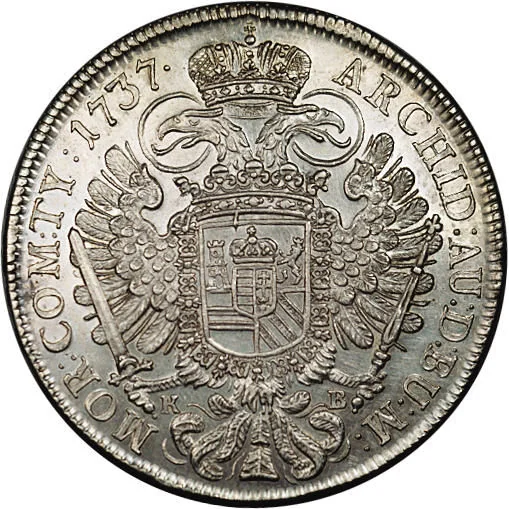
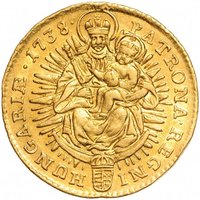
Reverse
Description:
Imperial eagle with divided K B mintmark on tail. Straight-topped U-shaped cartouche on chest with crowned fourfold arms. Central crowned Hungarian shield. No inner circle, date ends inscription.
Inscription:
ARCHID : AU : D : BU : M : MOR : COM : TY : 1737 ·
K B
K B
Script: Latin
Edge
Inscripted
Legend:
CONSTANTEM CONTINET ORBEM
Mints
| Name | Mark |
|---|---|
| Kremnica | KB |
Mintings
Historical background
In 1730, the currency situation in the Kingdom of Hungary, then part of the Habsburg Monarchy, was characterized by significant instability and complexity stemming from the aftermath of the Rákóczi War of Independence (1703-1711). The war had severely disrupted the economy, and the subsequent peace saw the Habsburgs consolidating control, including over monetary policy. The primary circulating coins were silver, notably the forint (florin) and tallér (thaler), but their value and purity were inconsistent. A major problem was the widespread circulation of debased coins, including lower-quality domestic issues and a flood of foreign specie, particularly from German states, which eroded trust in the currency and complicated trade.
The monetary system was officially bimetallic (gold and silver), but in practice, it was fragmented. The Habsburg government in Vienna aimed to standardize coinage across its realms, leading to the introduction of the Conventionsthaler standard in the 1750s, but in 1730 this process was still incomplete. Locally, transactions were often conducted in a confusing array of older Hungarian coins, new Viennese issues, and foreign currency. Furthermore, the accounting unit, the Hungarian forint, was used for large sums and contracts but existed primarily as a unit of account rather than a physical coin, creating a disconnect between daily transactions and official records.
This instability had tangible economic consequences. The unreliable currency hindered commerce, encouraged hoarding of high-quality coins (Gresham's Law), and created uncertainty for both peasants paying feudal dues and landlords receiving them. The situation placed a burden on the Hungarian estates, who frequently petitioned the crown for sound money. Thus, the currency landscape of 1730 was one of transition and disorder, reflecting Hungary's integration into the Habsburg fiscal system while still grappling with the legacies of war and a traditionally decentralized economy.
The monetary system was officially bimetallic (gold and silver), but in practice, it was fragmented. The Habsburg government in Vienna aimed to standardize coinage across its realms, leading to the introduction of the Conventionsthaler standard in the 1750s, but in 1730 this process was still incomplete. Locally, transactions were often conducted in a confusing array of older Hungarian coins, new Viennese issues, and foreign currency. Furthermore, the accounting unit, the Hungarian forint, was used for large sums and contracts but existed primarily as a unit of account rather than a physical coin, creating a disconnect between daily transactions and official records.
This instability had tangible economic consequences. The unreliable currency hindered commerce, encouraged hoarding of high-quality coins (Gresham's Law), and created uncertainty for both peasants paying feudal dues and landlords receiving them. The situation placed a burden on the Hungarian estates, who frequently petitioned the crown for sound money. Thus, the currency landscape of 1730 was one of transition and disorder, reflecting Hungary's integration into the Habsburg fiscal system while still grappling with the legacies of war and a traditionally decentralized economy.
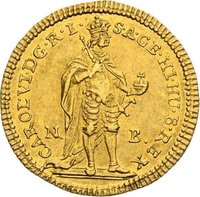
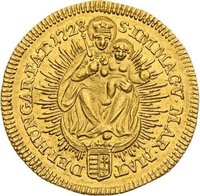
💎 Extremely Rare