

1 Ducat – Hungary
Hungary

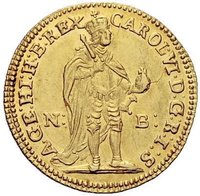
Obverse
Description:
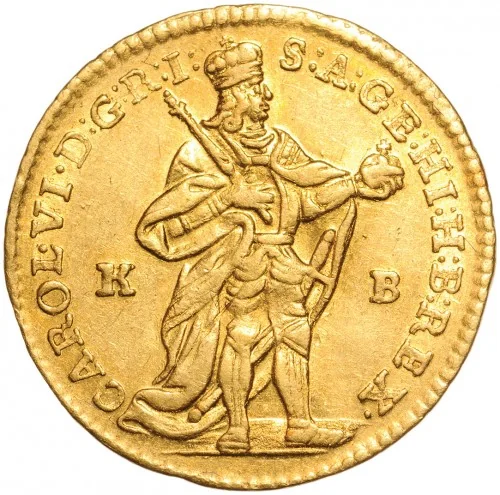
Crowned monarch facing right, holding scepter and orb, divides K B mintmark. Effigy interrupts inscription. No inner circle. CAROLVS begins at left foot.
Inscription:
CAROL : VI : D : G R : I : S : A : G : HI : H : B : REX
K B
K B
Script: Latin
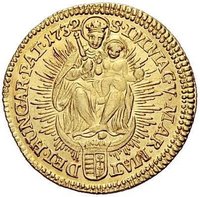
Reverse
Description:
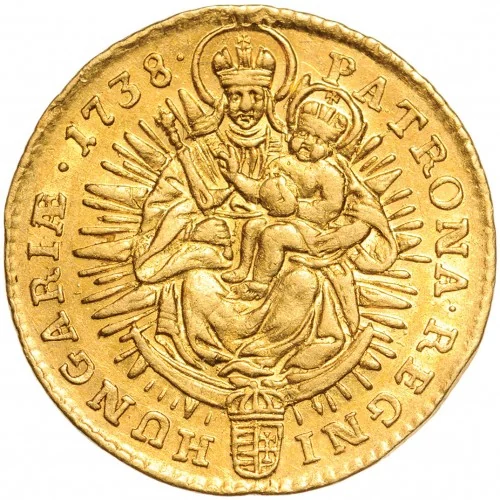
Crowned Madonna with scepter and child on a crescent moon, above a double-crowned Hungarian shield.
Inscription:
PATRONA · REGNI · HVNGARIÆ · 1735
Script: Latin
Edge
Plain
Mints
| Name | Mark |
|---|---|
| Kremnica | KB |
Mintings
| Year | Mint Mark | Mintage | Quality | Collection |
|---|---|---|---|---|
| 1731 | K | — | ||
| 1732 | K | — | ||
| 1733 | K | — | ||
| 1734 | K | — | ||
| 1735 | K | — | ||
| 1736 | K | — | ||
| 1737 | K | — | ||
| 1738 | K | — | ||
| 1739 | K | — | ||
| 1740 | K | — |
Historical background
In 1731, the currency situation in the Kingdom of Hungary, then part of the Habsburg Monarchy, was characterized by significant instability and complexity. The primary unit was the silver forint (guilder), but the monetary system was a tangled mix of domestic and foreign coins circulating simultaneously. Alongside the official coinage, older Hungarian issues, Austrian thalers, Dutch ducats, and Turkish gold coins were all in use, leading to constant difficulties in exchange and valuation. This chaos was exacerbated by a chronic shortage of small-denomination coins for everyday trade, which hampered commerce and fueled public frustration.
The root of the problem lay in Vienna's fiscal policies, which prioritized the broader needs of the Habsburg empire, often at Hungary's expense. The state treasury, frequently depleted by wars (notably the recent War of Spanish Succession and ongoing conflicts with the Ottoman Empire), engaged in debasement—reducing the precious metal content in coins to mint more money from existing silver stocks. This practice, particularly affecting the lower-denomination poltura and krajcár, led to inflation and a loss of public trust. People hoarded older, purer coins, further removing sound money from circulation in a classic example of Gresham's Law ("bad money drives out good").
Consequently, economic activity in 1731 was stifled by this unreliable monetary environment. Trade and taxation became fraught with uncertainty, and the disparity between the official mint price of silver and its market value encouraged widespread smuggling of bullion. While calls for monetary reform were growing, a comprehensive solution would not emerge until later under Maria Theresa, with the standardized Conventionsthaler system of the 1750s. Thus, in 1731, Hungary remained trapped in a period of monetary transition and disorder, reflecting its subordinate position within the Habsburg financial framework.
The root of the problem lay in Vienna's fiscal policies, which prioritized the broader needs of the Habsburg empire, often at Hungary's expense. The state treasury, frequently depleted by wars (notably the recent War of Spanish Succession and ongoing conflicts with the Ottoman Empire), engaged in debasement—reducing the precious metal content in coins to mint more money from existing silver stocks. This practice, particularly affecting the lower-denomination poltura and krajcár, led to inflation and a loss of public trust. People hoarded older, purer coins, further removing sound money from circulation in a classic example of Gresham's Law ("bad money drives out good").
Consequently, economic activity in 1731 was stifled by this unreliable monetary environment. Trade and taxation became fraught with uncertainty, and the disparity between the official mint price of silver and its market value encouraged widespread smuggling of bullion. While calls for monetary reform were growing, a comprehensive solution would not emerge until later under Maria Theresa, with the standardized Conventionsthaler system of the 1750s. Thus, in 1731, Hungary remained trapped in a period of monetary transition and disorder, reflecting its subordinate position within the Habsburg financial framework.
💎 Extremely Rare