

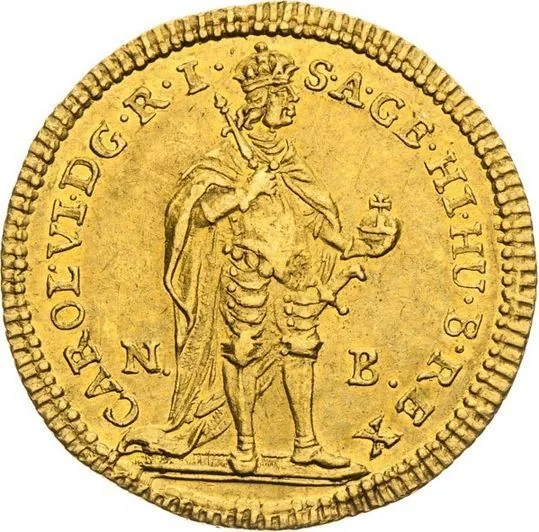

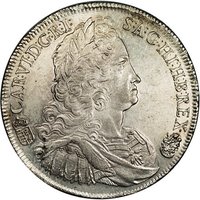
Obverse
Description:
Crowned monarch facing right, holding scepter and orb, divides mintmark "N B". Effigy interrupts inscription, which begins at the right foot. No inner pearl circle.
Inscription:
CAROL : VI : D : G : R : I S : A : GE : HI : H : B : REX
N B
N B
Script: Latin
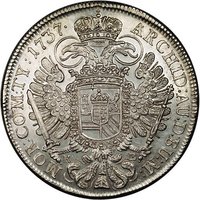
Reverse
Description:
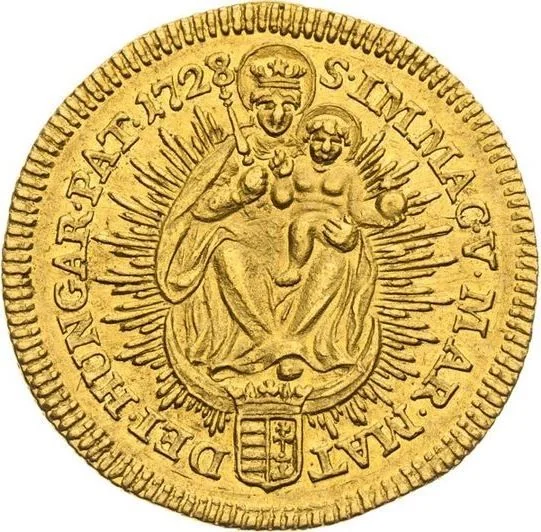
Radiant crowned Madonna, holding a scepter and seated on a crescent moon with the Child on her left arm. A double-crowned Hungarian shield is below, with the date in the inscription.
Inscription:
S · IMMAC · VIR · MARIA · MAT · DEI · PAT · HVNG · 17 21 ·
Script: Latin
Edge
Plain
Mints
| Name | Mark |
|---|---|
| Baia Mare | NB |
Mintings
Historical background
In 1727, the currency situation in the Kingdom of Hungary, then part of the Habsburg Monarchy, was defined by a state of profound monetary disorder and debasement. Following the costly wars of the previous decades, particularly against the Ottoman Empire and the Rákóczi War of Independence, the Habsburg state treasury was depleted. To finance these conflicts, the authorities had heavily debased the small-denomination denarius coins (kreuzers) circulating in Hungary, drastically reducing their silver content. This led to a classic "bad money drives out good" scenario, where older, full-value coins were hoarded or melted down, leaving the economy flooded with unreliable and depreciating currency, causing price instability and public mistrust.
Recognizing the crisis, the Vienna Court Chamber initiated a comprehensive monetary reform, which was formally decreed for Hungary in 1727. The cornerstone of this reform was the introduction of a new, high-quality silver coin, the conventionsthaler, based on the 1690 Leipzig monetary convention standard. This established a stable, large-denomination currency tied to a fixed silver content, intended for international trade and large transactions. Crucially for daily commerce, the reform also systematically reorganized the subsidiary coinage, issuing new copper and silver fractional coins to restore confidence in the smaller units of account.
The 1727 reform was a significant, top-down effort to integrate Hungary more firmly into the Habsburg monetary system and stabilize its economy. While successful in establishing a new, credible standard and curbing the worst of the debasement, the long-standing structural issues of wartime finance and the dualist nature of Habsburg-Hungarian administration meant challenges persisted. The reform laid a foundation for stability, but the currency system remained susceptible to future pressures from Vienna's central fiscal needs.
Recognizing the crisis, the Vienna Court Chamber initiated a comprehensive monetary reform, which was formally decreed for Hungary in 1727. The cornerstone of this reform was the introduction of a new, high-quality silver coin, the conventionsthaler, based on the 1690 Leipzig monetary convention standard. This established a stable, large-denomination currency tied to a fixed silver content, intended for international trade and large transactions. Crucially for daily commerce, the reform also systematically reorganized the subsidiary coinage, issuing new copper and silver fractional coins to restore confidence in the smaller units of account.
The 1727 reform was a significant, top-down effort to integrate Hungary more firmly into the Habsburg monetary system and stabilize its economy. While successful in establishing a new, credible standard and curbing the worst of the debasement, the long-standing structural issues of wartime finance and the dualist nature of Habsburg-Hungarian administration meant challenges persisted. The reform laid a foundation for stability, but the currency system remained susceptible to future pressures from Vienna's central fiscal needs.
✨ Legendary