Logo Title
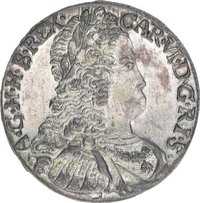
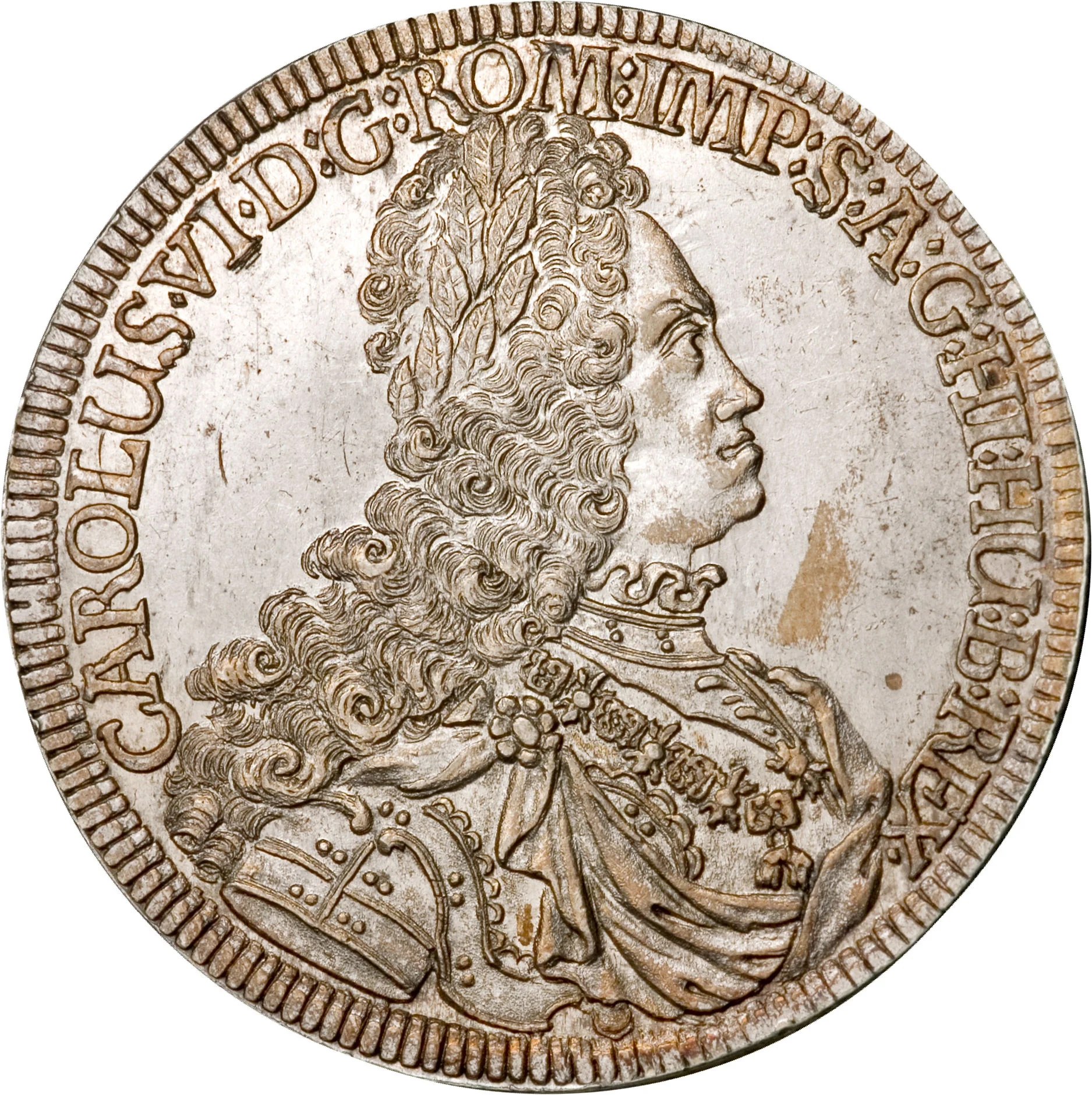
obverse
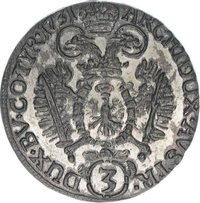
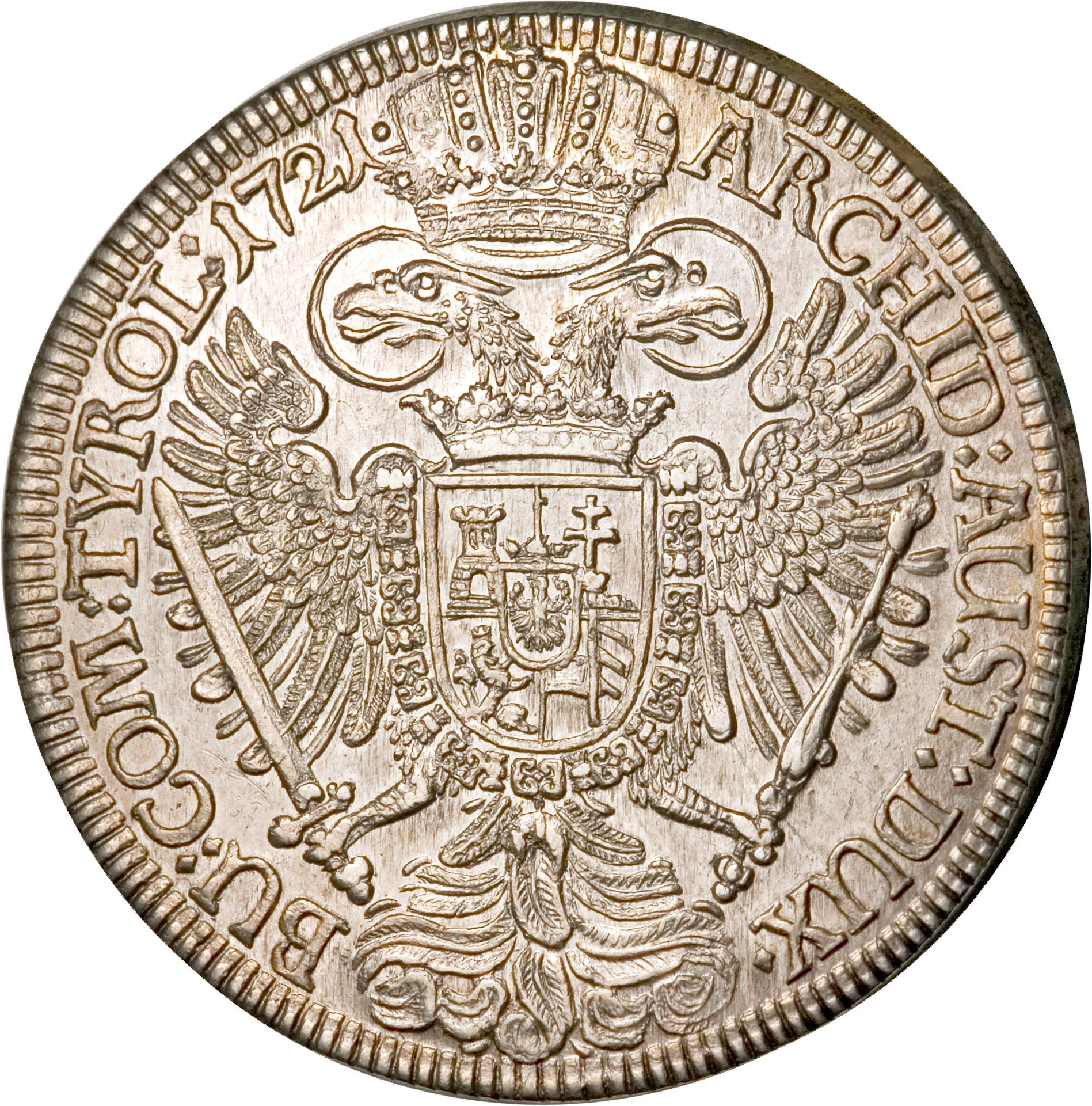
reverse
Heritage Auctions
Austria
Context
Years: 1719–1734
Country: Austria Country flag
Currency:
Demonetized: Yes
Total mintage: 1,175,000
Material
Diameter: 43 mm
Weight: 28.63 g
Silver weight: 25.05 g
Shape: Round
Composition: 87.5% Silver
Magnetic: No
Alignment: Medal alignment
Obverse
OBVERSE ↑
flip
Reverse
REVERSE ↑
References
KM: #Click to copy to clipboard1594
Numista: #33485
Value
Bullion value: $70.29

Obverse

Description:
Laureate bust facing right, extending to rim. Continuous legend above, no inner circle.
Inscription:
CAROLUS VI D G ROM IMP S A G HI HU B REX
Script: Latin

Reverse

Description:
Imperial double-headed eagle with central composite arms, small Tyrol shield, divided legend below, no inner circle.
Inscription:
ARCHID AUST DUX BU COM TYROL 1721
Script: Latin

Edge

Plain

Mints

NameMark
Hall

Mintings

YearMint MarkMintageQualityCollection
1719118,000
1720132,000
1721411,000
1724145,000
1725216,000
1734153,000

Historical background

In 1719, the County of Tyrol was navigating a complex and challenging monetary landscape, deeply influenced by its position within the Habsburg Empire. The region's economy was still recovering from the financial strains of the War of the Spanish Succession (1701-1714), which had depleted treasuries and led to widespread debasement of coinage across the German states. Like much of the Holy Roman Empire, Tyrol suffered from a proliferation of various circulating coins, including local Tyrolean issues, Reichsthalers from the Empire, and coins from neighboring Italian and German states, all with fluctuating values and metal content. This created chronic confusion in trade and facilitated widespread fraud.

The Habsburg state attempted to impose order through imperial ordinances. A pivotal moment came with the issuance of the Reichsmünzfuß (Imperial Minting Standard) of 1738, but even in 1719, authorities were striving to stabilize the currency. The core issue was the discrepancy between the official Kurantgeld (specie or "current money") tied to silver content and the depreciated Landesmünze ("local money") used for everyday transactions. Furthermore, the government's own practice of reducing the silver content in coins to generate seigniorage revenue for state coffers undermined public trust and exacerbated inflationary pressures.

For the Tyrolean populace, this situation meant economic uncertainty. Peasants, merchants, and artisans faced difficulties in pricing goods, repaying debts, and saving, as the real value of money could shift unpredictably. The instability particularly harmed those on fixed incomes and complicated the county's important transit trade through the Alpine passes. Thus, in 1719, Tyrol's currency system was a patchwork of official mandates and market realities, caught between imperial reform efforts and the persistent fiscal demands of the Vienna court, awaiting a more definitive and stable monetary resolution.
💎 Extremely Rare