

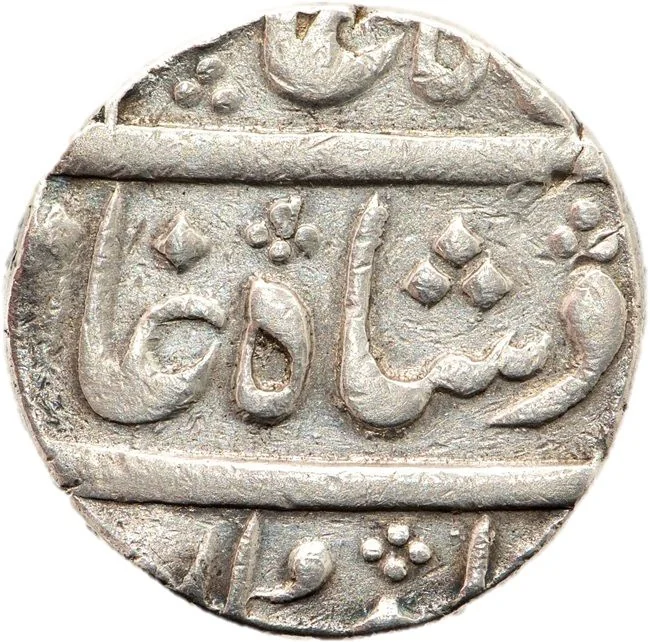
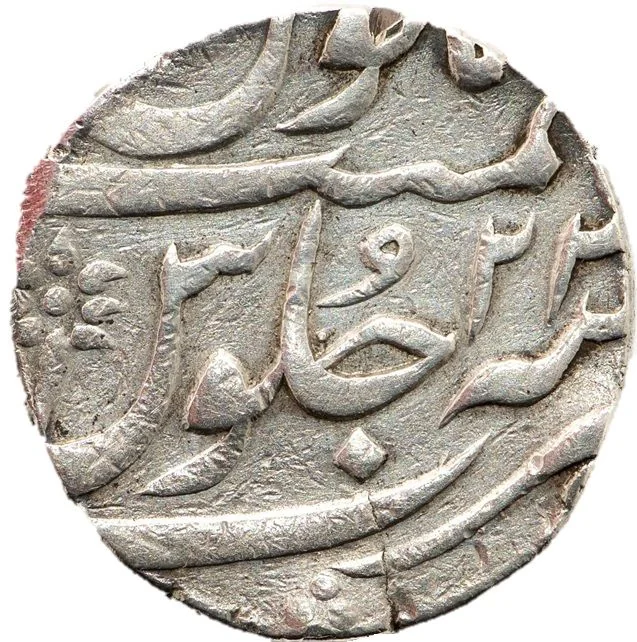
1 rupee – Mughal Empire
Add to wishlist
India
Context
Years: 1775–1797
Country: India
Issuer: Mughal Empire
Ruler: Shah Alam II
Currency:
(1540—1842)
Demonetized: Yes
Material
Diameter: 21 mm
Weight: 11.6 g
Silver Weight:: 11.60 g
Shape: Irregular round
Composition: Silver
Magnetic: No
References
KM: #
Numista: #334312
Value
Bullion value: $29.64
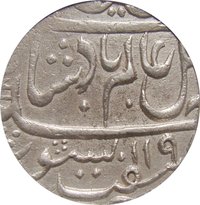
Obverse
Description:
Privy Mark#1: Surat Mint
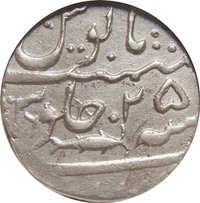
Reverse
Edge
Mintings
| Year | Mint Mark | Mintage | Quality | Collection |
|---|---|---|---|---|
| — | — | — | ||
| 1775 | — | — | ||
| 1797 | — | — |
Historical background
By 1775, the Mughal Empire's currency system, once a benchmark of stability and uniformity across South Asia, was in a state of severe fragmentation and decline. The imperial silver rupee, bearing the name of the powerless Emperor Shah Alam II, remained the nominal standard, but its authority had crumbled alongside Mughal political power. The empire's revenue base had catastrophically shrunk following the defeats at Buxar (1764) and the subsequent Treaty of Allahabad (1765), which granted the East India Company the diwani (revenue rights) of Bengal, Bihar, and Orissa. This stripped the imperial treasury of its richest provinces, drastically reducing the central mint's output and control.
The vacuum was filled by a multitude of competing issuers, leading to a complex and chaotic monetary landscape. Provincial governors, emerging regional powers like the Marathas and Awadh, and even some larger zamindars (landholders) struck their own coins, often debasing the silver content. Most significantly, the East India Company had begun minting its own rupees in Calcutta, Madras, and Bombay, effectively creating a parallel currency system that was better managed and gradually gaining trust. This resulted in a bewildering variety of rupees in circulation—Bengal sicca rupees, Bombay surat rupees, and Maratha Annas among them—each with differing weights and purity, complicating all inter-regional trade.
Consequently, the year 1775 represents a pivotal moment of transition. The Mughal currency system was no longer an empire-wide instrument of economic integration but a decaying relic. Trust had shifted from the imperial seal to the financial strength of the issuer, whether a regional state or the Company. This monetary fragmentation mirrored the political reality: the Mughal Empire was a hollow shell, with real economic power and the future of Indian currency lying in the hands of the rising British East India Company and other regional successors.
The vacuum was filled by a multitude of competing issuers, leading to a complex and chaotic monetary landscape. Provincial governors, emerging regional powers like the Marathas and Awadh, and even some larger zamindars (landholders) struck their own coins, often debasing the silver content. Most significantly, the East India Company had begun minting its own rupees in Calcutta, Madras, and Bombay, effectively creating a parallel currency system that was better managed and gradually gaining trust. This resulted in a bewildering variety of rupees in circulation—Bengal sicca rupees, Bombay surat rupees, and Maratha Annas among them—each with differing weights and purity, complicating all inter-regional trade.
Consequently, the year 1775 represents a pivotal moment of transition. The Mughal currency system was no longer an empire-wide instrument of economic integration but a decaying relic. Trust had shifted from the imperial seal to the financial strength of the issuer, whether a regional state or the Company. This monetary fragmentation mirrored the political reality: the Mughal Empire was a hollow shell, with real economic power and the future of Indian currency lying in the hands of the rising British East India Company and other regional successors.
✨ Legendary