

1 rupee – Mughal Empire
Add to wishlist
India
Context
Years: 1770–1771
Country: India
Issuer: Mughal Empire
Ruler: Shah Alam II
Currency:
(1540—1842)
Demonetized: Yes
Material
References
KM: #
Numista: #86064
Value
Bullion value: $27.86
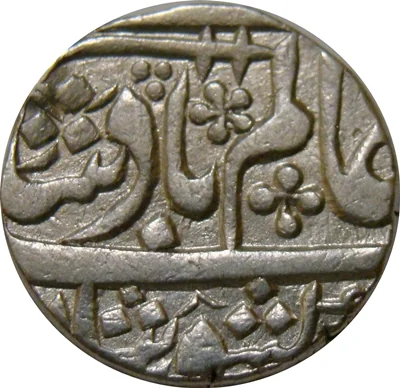
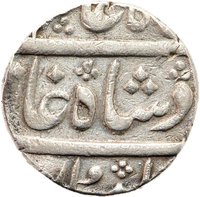
Obverse
Description:
Issuer: Mirza Najaf Khan.
Inscription, sword, floral bead, cross.
Inscription, sword, floral bead, cross.
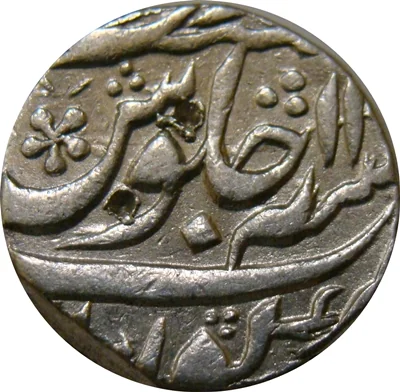
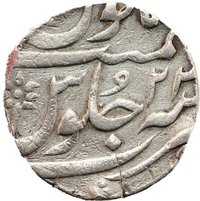
Reverse
Description:
Inscription, mint mark upper right.
Edge
Mintings
| Year | Mint Mark | Mintage | Quality | Collection |
|---|---|---|---|---|
| — | — | — | ||
| 1770 | — | — | ||
| 1771 | — | — |
Historical background
By 1770, the Mughal Empire's currency system, once a benchmark of stability and uniformity, was in a state of severe fragmentation and decline. The central authority of the Emperor had eroded dramatically following the invasions of Nadir Shah (1739) and Ahmad Shah Durrani (multiple raids from 1748), which drained the imperial treasury of vast quantities of gold and silver. With effective power now in the hands of regional successor states like Bengal, Awadh, and the Maratha Confederacy, the unified monetary system collapsed. These states, along as European East India Companies, began issuing their own coins, leading to a proliferation of currencies of varying weight, purity, and acceptability across the subcontinent.
The core problem was a critical shortage of precious metals, particularly silver, which had traditionally anchored the rupee. The empire's negative balance of trade and the looting of treasuries meant there was insufficient bullion to mint high-quality coins at the old standards. This led to widespread debasement; both regional mints and the fading imperial mint in Delhi produced rupees with reduced silver content. Consequently, older Mughal coins from the reigns of Aurangzeb or earlier, known as "sicca" rupees, circulated at a premium over newer, debased "current" rupees, creating a complex and chaotic exchange environment that hampered trade and revenue collection.
This monetary instability directly reflected and accelerated the empire's political disintegration. The British East India Company, having gained the diwani (revenue rights) of Bengal in 1765, began to assert its own monetary authority, eventually standardizing the Bengal rupee. By 1770, the Mughal currency system was no longer an empire-wide instrument of economic integration but a patchwork of competing issues. The famine that devastated Bengal in 1769-1770 further strained the system, as agrarian collapse reduced revenue and increased pressure on mints, marking the final phase of Mughal monetary sovereignty before the Company's systems would dominate.
The core problem was a critical shortage of precious metals, particularly silver, which had traditionally anchored the rupee. The empire's negative balance of trade and the looting of treasuries meant there was insufficient bullion to mint high-quality coins at the old standards. This led to widespread debasement; both regional mints and the fading imperial mint in Delhi produced rupees with reduced silver content. Consequently, older Mughal coins from the reigns of Aurangzeb or earlier, known as "sicca" rupees, circulated at a premium over newer, debased "current" rupees, creating a complex and chaotic exchange environment that hampered trade and revenue collection.
This monetary instability directly reflected and accelerated the empire's political disintegration. The British East India Company, having gained the diwani (revenue rights) of Bengal in 1765, began to assert its own monetary authority, eventually standardizing the Bengal rupee. By 1770, the Mughal currency system was no longer an empire-wide instrument of economic integration but a patchwork of competing issues. The famine that devastated Bengal in 1769-1770 further strained the system, as agrarian collapse reduced revenue and increased pressure on mints, marking the final phase of Mughal monetary sovereignty before the Company's systems would dominate.
💎 Extremely Rare