

1 rupee – Mughal Empire
Add to wishlist
India
Context
Years: 1784–1786
Country: India
Issuer: Mughal Empire
Ruler: Shah Alam II
Currency:
(1540—1842)
Demonetized: Yes
Material
References
KM: #
Numista: #146834
Value
Bullion value: $27.39
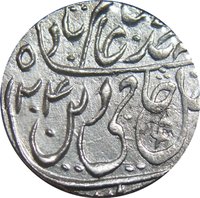
Obverse
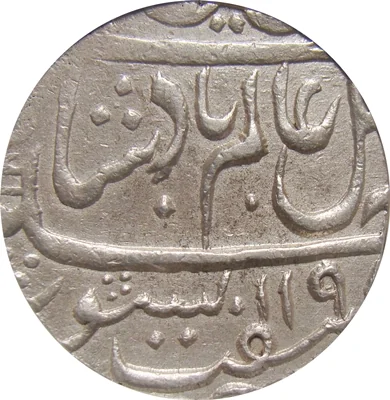
Description:
Inscribed, dated AH.
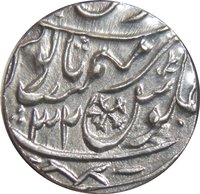
Reverse
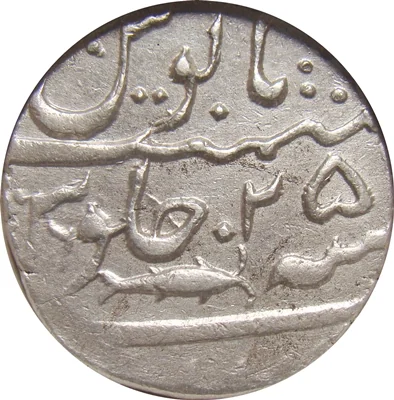
Description:
Regnal year, mint name, and fish mark below. Arabic numeral 6 to left of Julus.
Edge
Mintings
| Year | Mint Mark | Mintage | Quality | Collection |
|---|---|---|---|---|
| 1784 | — | — | ||
| 1785 | — | — | ||
| 1786 | — | — |
Historical background
By 1784, the Mughal Empire's currency system, once a pillar of its administrative and economic strength, was in a state of severe fragmentation and decline. The central minting authority in Delhi, which had historically produced the renowned and trusted silver rupee and gold mohur, had lost much of its power and geographic reach. Emperor Shah Alam II, restored to the throne in 1772 under the protection of the Marathas, held little practical sovereignty. The imperial treasury was depleted, and the production of uniform, high-quality coinage from the capital had become inconsistent, undermining the currency's credibility as a universal standard.
Effective monetary control had devolved to rising regional powers and the European East India Companies. In the east, the British East India Company, after securing the Diwani (revenue rights) of Bengal in 1765, was increasingly minting its own coins in Calcutta and Benares, effectively setting the monetary standard for its expanding territories. Similarly, the Maratha Confederacy, the Sikh Misls in the Punjab, and various Nawabs like those of Awadh and Hyderabad issued their own rupees, often of varying weight and purity. This created a complex and inefficient monetary landscape where trade required constant exchange and assay, and the value of a "rupee" depended entirely on whose portrait and mint mark it bore.
Consequently, the year 1784 represents a point of transition where the Mughal monetary system was becoming a historical relic. While coins bearing Shah Alam II's name were still struck—sometimes under duress by regional rulers to lend a veneer of legitimacy—they circulated alongside and often in competition with a plethora of other issues. The British victory in the Second Anglo-Mysore War and the signing of the Treaty of Mangalore that same year further consolidated the Company's political and economic influence, setting the stage for the eventual displacement of indigenous coinages by a unified, British-controlled currency system in the nineteenth century.
Effective monetary control had devolved to rising regional powers and the European East India Companies. In the east, the British East India Company, after securing the Diwani (revenue rights) of Bengal in 1765, was increasingly minting its own coins in Calcutta and Benares, effectively setting the monetary standard for its expanding territories. Similarly, the Maratha Confederacy, the Sikh Misls in the Punjab, and various Nawabs like those of Awadh and Hyderabad issued their own rupees, often of varying weight and purity. This created a complex and inefficient monetary landscape where trade required constant exchange and assay, and the value of a "rupee" depended entirely on whose portrait and mint mark it bore.
Consequently, the year 1784 represents a point of transition where the Mughal monetary system was becoming a historical relic. While coins bearing Shah Alam II's name were still struck—sometimes under duress by regional rulers to lend a veneer of legitimacy—they circulated alongside and often in competition with a plethora of other issues. The British victory in the Second Anglo-Mysore War and the signing of the Treaty of Mangalore that same year further consolidated the Company's political and economic influence, setting the stage for the eventual displacement of indigenous coinages by a unified, British-controlled currency system in the nineteenth century.
✨ Legendary