

1 Farthing – Ireland
Ireland
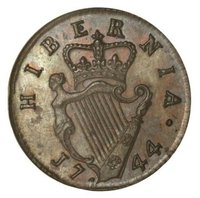
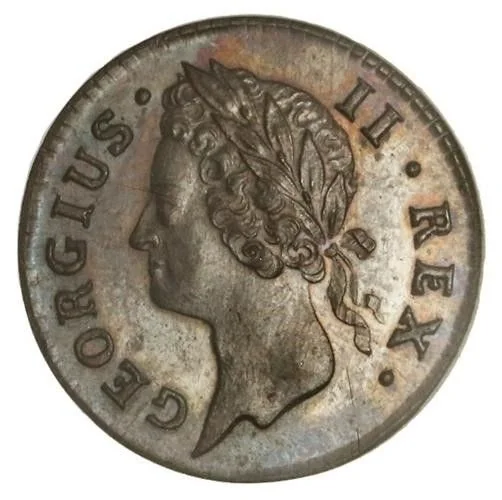
Obverse
Description:
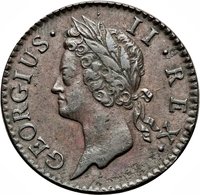
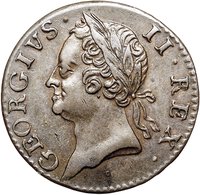
Young laureate bust left, legend divided.
Inscription:
GEORGIUS . II . R E X .
Script: Latin
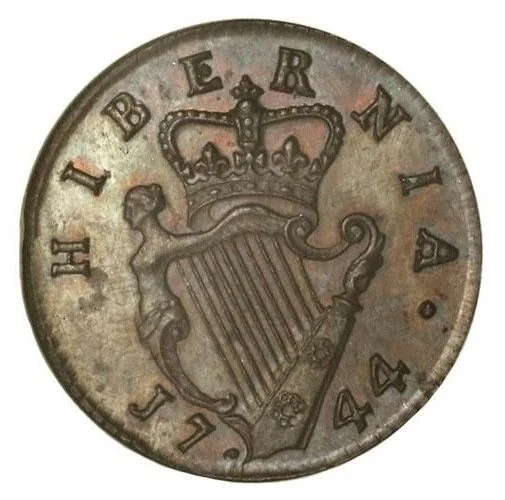
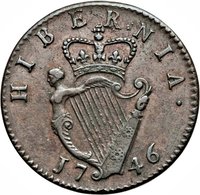
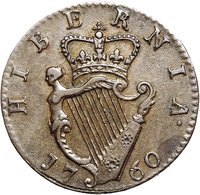
Reverse
Edge
Mints
| Name | Mark |
|---|---|
| Royal Mint (Tower of London) | — |
Mintings
| Year | Mint Mark | Mintage | Quality | Collection |
|---|---|---|---|---|
| 1744 | — | — |
Historical background
In 1744, Ireland operated under a complex and restrictive monetary system, largely dictated by its political and economic subordination to Britain. The official currency was the Irish pound, which was not a separate physical coinage but a unit of account that traded at a persistent discount against the British pound sterling—typically around 13%. This meant that accounts and large transactions were kept in Irish pounds, but the physical coins in circulation were a chaotic mixture of foreign currencies, predominantly British, Portuguese, and Spanish coins, valued by their weight in silver or gold.
This scarcity of official coinage created significant problems for daily trade and the wider economy. The shortage of small change was particularly acute, hindering local commerce. To fill this void, a proliferation of private tokens, issued by merchants, city corporations, and even landlords, circulated unofficially. These tokens, often made of copper, promised redemption in official currency at the issuer's premises and became a necessary, though unreliable, lubricant for the local economy. Their value was only as good as the reputation of the issuer.
The underlying cause of this monetary confusion was a series of British legislative restrictions designed to prevent Ireland from competing economically with England. Laws inhibited the development of an Irish mint and controlled the flow of specie. Consequently, Ireland suffered from a chronic trade imbalance with Britain, which drained gold and silver coin out of the country. The situation in 1744 was therefore one of monetary dependency and insufficiency, stifling economic growth and leaving the Irish economy vulnerable and inefficient, a point of growing frustration for Irish merchants and reformers.
This scarcity of official coinage created significant problems for daily trade and the wider economy. The shortage of small change was particularly acute, hindering local commerce. To fill this void, a proliferation of private tokens, issued by merchants, city corporations, and even landlords, circulated unofficially. These tokens, often made of copper, promised redemption in official currency at the issuer's premises and became a necessary, though unreliable, lubricant for the local economy. Their value was only as good as the reputation of the issuer.
The underlying cause of this monetary confusion was a series of British legislative restrictions designed to prevent Ireland from competing economically with England. Laws inhibited the development of an Irish mint and controlled the flow of specie. Consequently, Ireland suffered from a chronic trade imbalance with Britain, which drained gold and silver coin out of the country. The situation in 1744 was therefore one of monetary dependency and insufficiency, stifling economic growth and leaving the Irish economy vulnerable and inefficient, a point of growing frustration for Irish merchants and reformers.
💎 Extremely Rare