

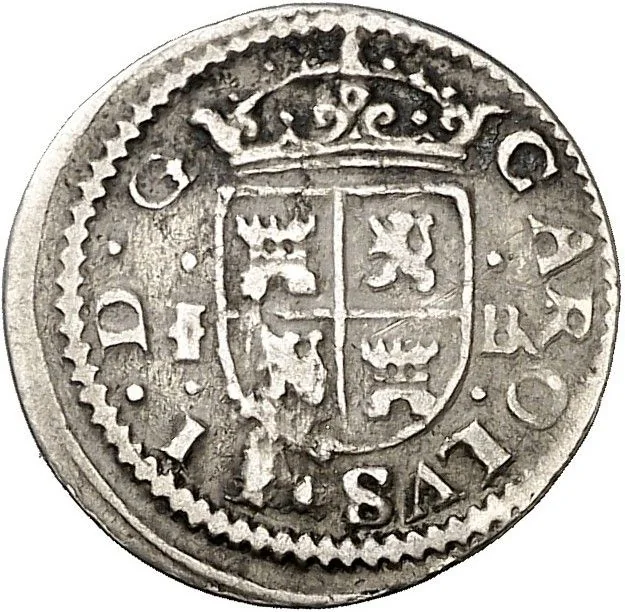
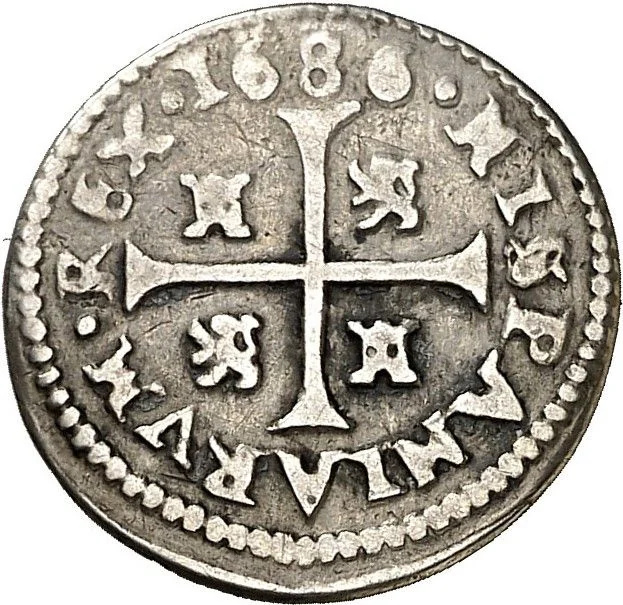
½ real – Spain
Add to wishlist
Spain
Context
Material
Diameter: 16 mm
Weight: 1.7 g
Silver Weight:: 1.58 g
Thickness: 0.8 mm
Shape: Round
Composition: 93.1% Silver
Magnetic: No
Technique: Roller milled
References
KM: #
Numista: #111642
Value
Bullion value: $3.84
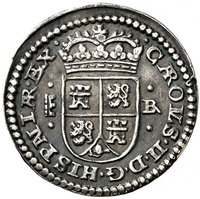
Obverse
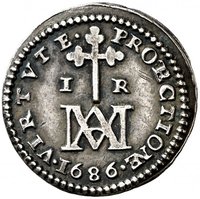
Reverse
Description:
Cross with castles in the quarters and lions in the angles.
Inscription:
HISPANIARVM · REX · 1686 ·
Script: Latin
Edge
Categories
| Animal> Feline |
| Building> Castle or fortification |
| Symbols> Coat of Arms |
| Symbol> Cross |
Mints
| Name | Mark |
|---|---|
| Royal Mint of Segovia | — |
Mintings
| Year | Mint Mark | Mintage | Quality | Collection |
|---|---|---|---|---|
| 1685 | BR | — | ||
| 1686 | BR | — |
Historical background
In 1685, Spain's currency situation was a complex and deteriorating system, reflecting the broader economic decline of the Habsburg monarchy. The primary unit was the silver real, with the famous piece of eight (8 reales) serving as a key international trade coin. However, decades of fiscal crisis, driven by costly wars, a stagnant domestic economy, and the declining influx of silver from the Americas, had led to severe monetary manipulation. The Crown repeatedly resorted to debasement, reducing the silver content in coins to create short-term revenue, which eroded public trust and sparked rampant inflation.
This period was marked by the circulation of a chaotic mix of coins. Alongside freshly minted, lower-quality coins, older, higher-grade "good money" from the 16th and early 17th centuries remained in use but was often hoarded or exported, following Gresham's Law that "bad money drives out good." Furthermore, a plethora of vellón coinage—copper or heavily copper-alloyed money—flooded the economy. The government had issued massive quantities of this nearly intrinsically worthless vellón to finance its deficits, leading to wild fluctuations in its exchange rate against silver and causing severe hardship for common people who used it for daily transactions.
The monetary chaos of 1685 was symptomatic of a state in financial distress. Attempts at reform, like the failed stabilization of the vellón in the 1680s, were ineffective without addressing the Crown's chronic insolvency. The situation stifled commerce, discouraged investment, and placed a heavy burden on the populace. This unstable foundation would persist until the broader reforms initiated after the War of Spanish Succession and the arrival of the Bourbon dynasty in the early 18th century.
This period was marked by the circulation of a chaotic mix of coins. Alongside freshly minted, lower-quality coins, older, higher-grade "good money" from the 16th and early 17th centuries remained in use but was often hoarded or exported, following Gresham's Law that "bad money drives out good." Furthermore, a plethora of vellón coinage—copper or heavily copper-alloyed money—flooded the economy. The government had issued massive quantities of this nearly intrinsically worthless vellón to finance its deficits, leading to wild fluctuations in its exchange rate against silver and causing severe hardship for common people who used it for daily transactions.
The monetary chaos of 1685 was symptomatic of a state in financial distress. Attempts at reform, like the failed stabilization of the vellón in the 1680s, were ineffective without addressing the Crown's chronic insolvency. The situation stifled commerce, discouraged investment, and placed a heavy burden on the populace. This unstable foundation would persist until the broader reforms initiated after the War of Spanish Succession and the arrival of the Bourbon dynasty in the early 18th century.
✨ Legendary