

1 Real – Spain
Spain
Context
Material
Diameter: 21 mm
Weight: 2.7 g
Silver weight: 2.51 g
Thickness: 0.8 mm
Shape: Round
Composition: 93.1% Silver
Magnetic: No
Technique: Roller milled
References
KM: #Click to copy to clipboard204
Numista: #111666
Value
Bullion value: $7.05
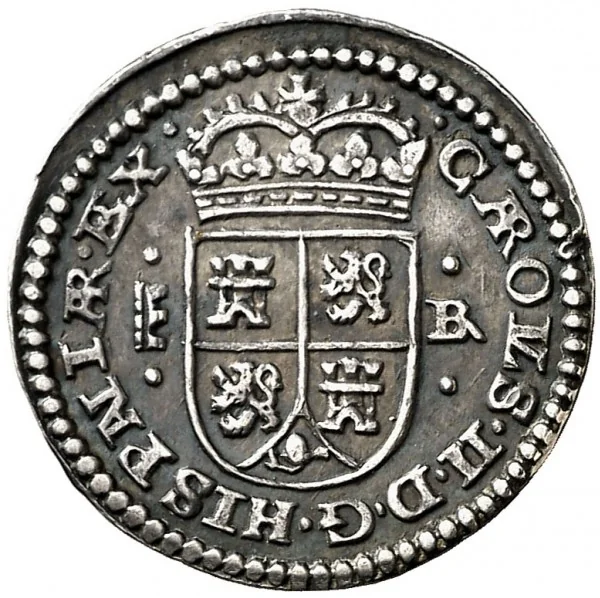
Obverse
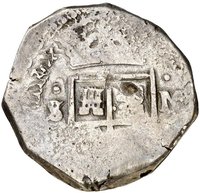
Description:
Royal arms of Spain.
Inscription:
CAROLVS · II · D · G · HISPANIAR · REX
BR
BR
Script: Latin
Reverse
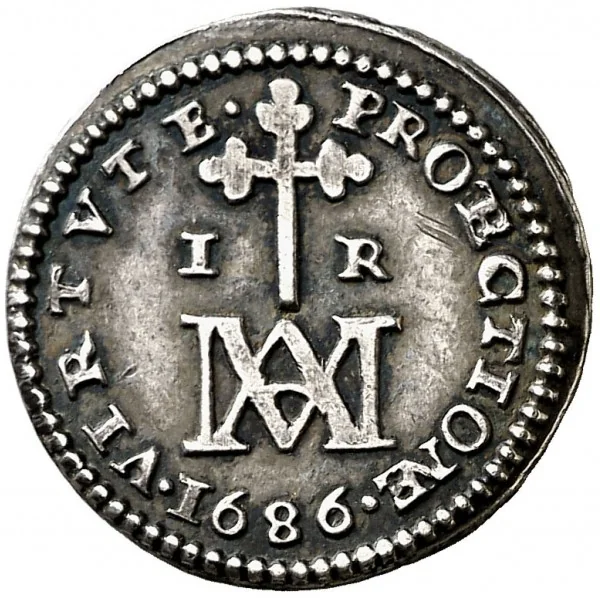
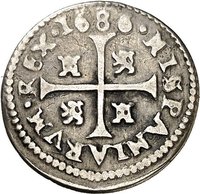
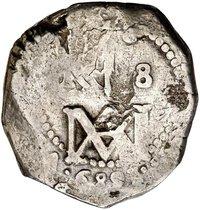
Description:
MA monogram with trilobed cross above.
Inscription:
VIRTVTE · PROTECTIONE
· 1686 ·
I R
MA
· 1686 ·
I R
MA
Script: Latin
Edge
Mints
| Name | Mark |
|---|---|
| Royal Mint of Segovia | — |
Mintings
| Year | Mint Mark | Mintage | Quality | Collection |
|---|---|---|---|---|
| 1686 | BR | — | ||
| 1687 | BR | — |
Historical background
In 1686, Spain’s currency system was in a state of profound crisis, a direct legacy of the "Price Revolution" and the Crown’s chronic fiscal mismanagement. Decades of debasement—reducing the silver content in coins like the real and the maravedí—had been used to finance the endless wars of the Habsburg monarchy. This practice, combined with a massive influx of cheaper American silver, had triggered severe inflation and a loss of confidence in the coinage. The result was a chaotic monetary landscape where the intrinsic metal value of older, purer coins often exceeded their face value, leading to hoarding and the circulation of heavily clipped and counterfeit coins.
The situation was further complicated by the existence of multiple regional mints and a complex system of accounting money (moneda de cuenta), such as the maravedí, which was used for bookkeeping but had no physical counterpart. The primary silver coin, the real de a ocho or "piece of eight," remained an internationally recognized trade coin, but its domestic stability was undermined. In response, the government of King Charles II attempted a major reform in 1686, decreeing a recoinage and the issuance of new, purer silver reales. The aim was to restore public trust and stabilize prices by tying the currency firmly to its precious metal content.
However, the 1686 reform was only a partial and temporary success. The Crown lacked the fiscal discipline to sustain it, and the fundamental problem of insufficient revenue to cover state debts remained. While the new coins were an improvement, the underlying economic weakness of Spain—with its declining domestic production, stagnant population, and heavy tax burden—prevented a lasting recovery. The monetary instability would persist into the next century, a symptomatic reflection of the broader decline of the Spanish Habsburg empire in its final decades.
The situation was further complicated by the existence of multiple regional mints and a complex system of accounting money (moneda de cuenta), such as the maravedí, which was used for bookkeeping but had no physical counterpart. The primary silver coin, the real de a ocho or "piece of eight," remained an internationally recognized trade coin, but its domestic stability was undermined. In response, the government of King Charles II attempted a major reform in 1686, decreeing a recoinage and the issuance of new, purer silver reales. The aim was to restore public trust and stabilize prices by tying the currency firmly to its precious metal content.
However, the 1686 reform was only a partial and temporary success. The Crown lacked the fiscal discipline to sustain it, and the fundamental problem of insufficient revenue to cover state debts remained. While the new coins were an improvement, the underlying economic weakness of Spain—with its declining domestic production, stagnant population, and heavy tax burden—prevented a lasting recovery. The monetary instability would persist into the next century, a symptomatic reflection of the broader decline of the Spanish Habsburg empire in its final decades.
✨ Legendary